The Reaction
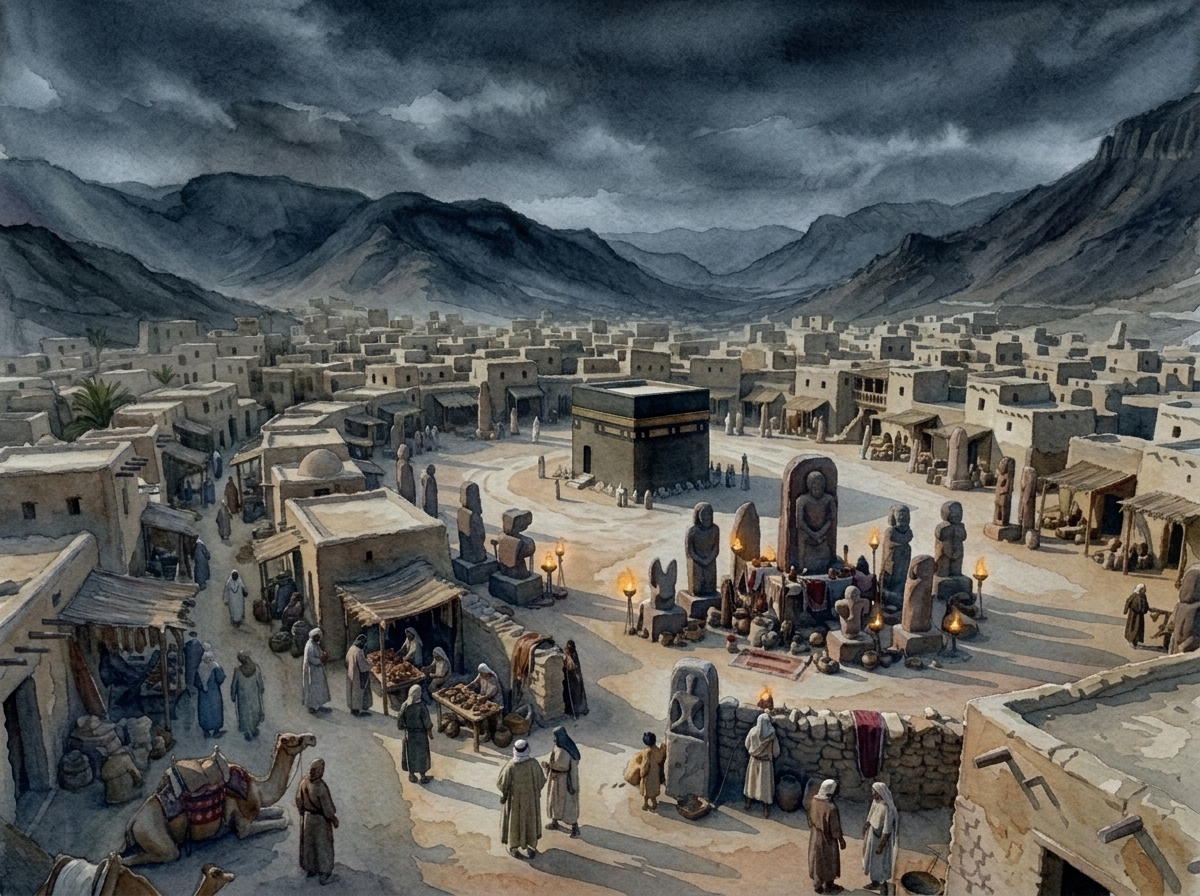
what was the response of the people of Quraish to the Da’wah of Rasūlullāh ﷺ? They responded in various different ways, and some of them were at different times, and some of them might have been at different stages, but these are the different responses that the people of Quraish showed towards the Message of Muhammad ﷺ, and there is a list of them; we will start talking about them now in detail but first I will go through the list:
1 Mockery
2 Insulting and harming the Messenger 3 Accusations or character assassination 4 Deforming or defaming the Message 5 Bargaining and negotiating with Rasūlullāh ﷺ 6 Allurements and temptations 7 Setting challenges 8 Putting Muhammad ﷺ under pressure 9 Jealousy and hatred
10 Persecution
11 Assassination attempts.
Mockery
So Inshā'Allāh, we will start with the number one; mockery. Allāh ﷻ says: And when they see you, O Muhammad, they take you not except in ridicule, saying, "Is this the one whom Allāh has sent as a Messenger?"54 They were saying that did Allāh not find anyone else to send? There was no one better to send except you? So they would make fun of Rasūlullāh ﷺ, they would mock him. Now, even though Rasūlullāh ﷺ belonged to the noblest family and he had the most outstanding character in Quraish, but because he was not the wealthiest, because he was not the most powerful, they made fun of him.
People are attracted to the ones who have wealth and the ones who have power, and there is precedence in this when the Banī Isrā'īl – and the story is mentioned in Sūrah Al-Baqarah – went to their Prophet and they said, ‘We want you to appoint a king over us so that we could fight in Jihād.’ The Nabï appointed Tālūt to be a King and their leader. They refused, even though they were the ones who asked the Nabï to appoint for them, and when the Nabï appointed, they rejected, and refused to accept the leadership of Tālūt. Why? They said two things; that he does not have a lot of money; he is not wealthy, and there are people more prominent among us to be kings. “How can he have kingship over us while we are more worthy of kingship than him and he has not been given any measure of wealth?”
And when Rasūlullāh ﷺ went to At-Tā'if – and we will talk about his story in At-Tā'if – one of the men of At-Tā'if told Muhammad ﷺ, “Did Allāh not find anyone better than you to send as a Prophet?” So they would mock Muhammad ﷺ and they would make fun of him.
Insulting and Harming the Messenger
Abū Jahl Threatens to Trample over the Neck of Rasūlullāh ﷺ and
Rub his Face in Dirt
The second response that the people of Quraish showed was insulting and harming Muhammad ﷺ. In Sahīh Muslim, Abū Hurairah narrates the story; Abū Jahl came to some of the leaders of Quraish who were sitting next to Al-Ka’bah and he told them, “Are you allowing Muhammad to rub his face in the dirt?” That was his evil way of saying Sujūd. “Are you allowing Muhammad to rub his face in the dirt? If I see him do that, I will trample over his neck and I will rub his face in the dirt.” Well, Rasūlullāh ﷺ did come and he started to pray, and Rasūlullāh ﷺ would pray publicly in front of anyone, so Rasūlullāh ﷺ was praying right there in front of Al-Ka’bah and Abū Jahl and his friends saw this, so Abū Jahl stood up to go and fulfil his threat. So he walked up to Muhammad ﷺ and Muhammad ﷺ was in Sujūd, and suddenly, they saw Abū Jahl falling back and he was waving with his hands like someone who was trying to repulse a danger that was about to befall him. So Abū Jahl came back and they asked him, “What had happened to you, what was wrong?” He said, “What do you mean what happened? Did you not see what happened?” They said, “No, we did not, there was nothing. All what we saw was you falling on your back and waving your hands.” Abū Jahl said, “There was a trench in front of me and there was fire and wings and terror.” Rasūlullāh ﷺ said, “Those were the angels. If he would have come any closer to me, they would have torn him into pieces.” So he saw that but everybody else did not, all what they saw was Abū Jahl retreating, and Rasūlullāh ﷺ said that those were the angels and they would have torn him if he came any closer. ‘Uqbah Bin Abī Mu‘ayt Tries to Choke Rasūlullāh ﷺ One day, ‘Uqbah Bin Abī Mu‘ayt came to Rasūlullāh ﷺ next to Al-Ka’bah – and you would notice that most of these events occurred next to Al-Ka’bah because that is where Rasūlullāh ﷺ would pray publicly, and they would always try and stop him from doing that – so ‘Uqbah Bin Abī Mu‘ayt walked up to Muhammad ﷺ and he grabbed his clothes and he started wrapping them around the neck of Rasūlullāh ﷺ trying to choke him, until Abū Bakr stepped in and pushed ‘Uqbah Bin Abī Mu‘ayt away and he said, “Do you want to kill a man just because he says, ‘My Lord is Allāh?’ – A'Turīdūna An Taqtulūna Rajulan Ayyaqūla Rabbī Allāh?” The reason why you want to kill him is because he is saying my Lord is Allāh, and he pushed ‘Uqbah Bin Abī Mu‘ayt away. Now, for some people, they do not mind being hurt or cursed or humiliated, some people naturally have thick-skin, they are not sensitive at all, but the Ambiyā' of Allāh, may the peace and blessings of Allāh be upon them all, were very sensitive and they had a lot of dignity, so such things hurt them and harmed them a lot. And the Ambiyā' of Allāh all had very respectable personalities, so when such things happened, these were very, very insulting events to them. And this was hurting Rasūlullāh ﷺ a lot, but he would continue with his Da’wah and go on and he would follow what Allāh ﷻ told him to do: Wa A’rid ‘Anil Jāhilīn – And turn away from the ignorant.Just ignore the ignorant, ignore them. Rasūlullāh ﷺ would not respond to them, would not fight with them, he would go on with his work.
‘Uqbah Bin Abī Mu‘ayt Dumps Contents of Camel's Abdomen on Rasūlullāh ﷺ while he is in Sujūd Another incident that was narrated by Al-Bukhārī; Rasūlullāh ﷺ again was praying next to Al-Ka’bah, and Abū Jahl came to the leaders of Quraish who would always meet and sit next to Al-Ka’bah, and he told them, “So and so has slaughtered a camel; who will go and pick up the contents of the abdomen of the camel and dump it on Rasūlullāh ﷺ in Salāh?” So the most evil among them, ‘Uqbah Bin Abī Mu‘ayt, he picked up the challenge and he went and grabbed all of the insides of the abdomen, the intestines and the stomach, and he carried it, and he waited until Rasūlullāh ﷺ was in the position of Sujūd, and he dumped it over him. Rasūlullāh ﷺ continued with his Sujūd as if nothing happened, and then his daughter Fātimah saw what happened to her father.
And by the way, it is very hurting to children to see their parents being humiliated, and psychiatrists in Falastīn say that this is affecting the psychology of the children in Falastīn when they see their fathers and their mothers being abused and kicked and hit by Israeli soldiers. So you have an entire generation of children who are growing up seeing their parents going through all of this abuse. And this psychiatrist was saying that it leaves some very dangerous marks and scars on their personalities, especially for children; it is very detrimental for them to see their parents go through humiliation.
So Fātimah saw this happening to her father and her father continued in Sujūd, so she ran up to him and she started picking all of that dirt from the shoulders of her father. When Rasūlullāh ﷺ finished his Salāh, he made a Du‘ā', and he made this Du‘ā' publicly in front of the people of Quraish, he said, “O Allāh! Punish Abū Jahl, and ‘Utbah Bin Rabī‘ah, and Shaybah Bin Rabī‘ah, Al-Walīd Bin ‘Utbah, Ummayyah Bin Khalaf, and ‘Uqbah Bin Abī Mu‘ayt.” He made Du‘ā' against seven, but I counted six. ‘Abdullāh Ibn Mas‘ūd, the narrator of the Hadīth, said, “I forgot who was the seventh.” So Rasūlullāhmade Du‘ā' against them, and this was a very rare thing, that Rasūlullāh ﷺ would make Du‘ā' against some people, but it got so bad and Rasūlullāh ﷺ was so hurt that he made Du‘ā' against them, and he made Du‘ā' in front of Al-Ka’bah. ‘Abdullāh Ibn Mas‘ūd said, “I have seen with my own eyes all of these men killed in the Battle of Badr.” All of them. That was the fulfilment of the Du‘ā' of Rasūlullāh ﷺ;they all died on Kufr.
Now, I just gave a few examples, but there are many other examples that one could go through that illuminate this point further.
Character Assassination of Muhammad
They Would Slander Rasūlullāh ﷺ with the Worst Names
Number Three: Accusing the Prophet, or what we could refer to as character assassination. They would try to attack the character of the Messenger to destroy the Message. So they would accuse Rasūlullāhof
being a magician. And they say, "O you upon whom the Message has been sent down, indeed you are mad." Wa Qālal Kāfirūna Hādhā Sāhirun Kadhdhāb – And the Disbelievers say, "This is a magician and a liar." And they said he is a soothsayer – Kāhin. They used whatever slandering terms they could use, they would just throw them at Rasūlullāh ﷺ in order to assassinate the character of Rasūlullāh ﷺ, and the purpose of that was to destroy the Message itself, because Allāh says: We know that you, O Muhammad, are saddened by what they say. And indeed, they do not call you untruthful, but it is the verses of Allāh that the wrongdoers reject.
They do not disbelieve you, but they are rejecting the signs of Allāh. Allāh is saying that they do not really have a problem with you, they do not disbelieve you; deep in their hearts they know that you are the Truthful and the Honest, but it is because they want to reject the Message that they are attacking you. So all of these attacks that you are receiving is not because of your character, it is because of the Religion. And this would take us back to the words of Waraqah Bin Naufal; in the early days he told Muhammad ﷺ,” You will be driven out of your land.” Rasūlullāh ﷺ said, “Me?!
They would drive me out of my land?!” Rasūlullāhknew that he was so admired and loved by the people of Makkah, he could not imagine how one day they would drive him out of his land, but then Waraqah Bin Naufal said, “Anyone who would present to his people with a message similar to yours would be fought.” He will have enemies. So it is not you, it is the Message. So now they were accusing Muhammadin order to block the Message.
Rasūlullāh ﷺ Would Give Da’wah to the Masses in Marketplaces Rasūlullāh ﷺ would go into the marketplace, and the marketplaces in Makkah served not only as a place for doing business, but it was also a place where they would have events such as competitions in poetry, and they would have competitions in speeches; they would hold those
competitions in those marketplaces, so the marketplace was not strictly for business, but it was also the cultural centre; that is where the speakers would come, sort of like Hyde Park; speakers from all over the world would go and just congregate there! Although there was a difference; in Hyde Park you do not necessarily get the best, but in Sūq ‘Ukāz you would get the best. The best speakers of Arabia would go to Sūq ‘Ukāz and they would present their works; their poetry and their speeches, and the best of these poems would be hung on the wall of Al-Ka’bah, they were called Al-Mu‘allaqāt – The hanged poems. Rasūlullāhwould enter these marketplaces and speak to the masses. In this Hadīth narrated by Al-Imām Ahmad, Rabī‘ah Bin ‘Abbād says, “I saw the Messenger of Allāh in the market of Dhul-Majāz and he was saying, ‘O you people, say there is no God but Allāh and you will prosper.’” That was his message to the people; Say Lā Ilāha Illallāh; Tuflihū – Say there is no God but Allāh and you would be successful. And he would repeat that message again and again and walk and meet different people.
Abū Lahab Tells People Rasūlullāh ﷺ is a Liar and Eliminates his
Hardwork
Now, Rabī‘ah said, “There was a man following him, and whoever Rasūlullāh ﷺ would speak to, this man would go and speak to them and say, ‘Do not believe him, he is a liar.’” So Rasūlullāh ﷺ would go and speak to a group of people and tell them, ‘Say Lā Ilāha Illallāh; you would succeed,’ and when Rasūlullāh ﷺ would leave, Abū Lahab would come in and tell the same people, ‘Do not believe him, he is a liar.’ Now, Rabī‘ah Bin ‘Abbād60 said, “I asked who that man was, they said this is his uncle Abū Lahab.” Rabī‘ah Bin ‘Abbād was not from Makkah, he said “I asked who that man was, they said this is his uncle.” Imagine how difficult this was; Abū Lahab was unwinding whatever was being winded by Rasūlullāh ﷺ. Whatever Rasūlullāh ﷺ would do, Abū Lahab would go behind him and destroy it.
We gain encouragement by seeing the fruits of our efforts, we have to be rewarded one way or another, otherwise we would not have motivation to go on. In our work, unless there is some kind of reward, it would be impossible for us to work. And we are rewarded in different forms; one of them is financial – you are being paid for what you do, another form of reward is recognition, third form of reward is support that you would get from workers or your leaders. But it would be impossible to go on if everything is against you at your work, and what keeps you going is seeing the fruits of your effort. Imagine that we arrange this course and it does not work out, and then we try to arrange it again a month later and it does not work out, no one shows up, we try it again third time, no one shows up, do you think we will have the spirit to continue doing this again and again? It becomes very difficult.
Rasūlullāh ﷺ and many of the Ambiyā' would continue doing the same thing again and again and nothing would happen. And Nūh for example, he is giving his people Da’wah day and night, publicly and privately, with no response, no response whatsoever, he is seeing no fruits of his effort at all; that is very difficult, especially when we are talking about 950 years. Rasūlullāhin Makkah is going and speaking to these people who do not know him, he is speaking to foreigners in this fair of Dhul-Majāz and ‘Ukāz, and as soon as he speaks to the people, someone comes and distorts his reputation by saying he is a liar. Nevertheless, Rasūlullāh ﷺ had the encouragement to continue and speak to the people and go on and on neglecting what his uncle was doing to him. Especially in the society of Arabia where there is seniority, what can Rasūlullāh ﷺ do to stop his uncle? So he would just leave him alone and continue with his Da’wah. And in another narration it says that Abū Lahab would go and tell the people, “O people, let not this man entice you away from your religion, the religion of your forefathers.” And this was narrated by Al-Bayhaqī.
Al-Walīd Bin Mughīrah Holds Meeting to Have a Unified Opinion against Rasūlullāh ﷺ Another example narrated by Al-Bayhaqī and Al-Hākim; right before the season of Hajj, Al-Walīd Bin Mughīrah who was the elder of Quraish at the
time, he addressed a meeting with the leaders of the community and he told them, “The season of Hajj is approaching; Pilgrimage, and the delegations of the Arabs are going to start pouring in, let us unify our opinion regarding this associate of yours and let us not contradict each other.” What Al-Walīd Bin Mughīrah is referring to here is that the season of Pilgrimage is coming and the Arabs are going to start coming to Makkah, and Muhammad will be visiting them and speaking to them, we do not want to contradict each other in our opinion regarding him, so we do not want some people saying that he is a liar, some people saying that he is a magician, some people saying that he is a soothsayer, we have to have a unified opinion in order to go to the people and warn them from this man.
So the people said, “You tell us what you think, we will abide by it.” AlWalīd Bin Mughīrah said, “I want to hear from you.” They said, “We will claim that he is a soothsayer.” He responded, “No, he is no soothsayer. I have seen soothsayers and he does not engage in the rhymed mumbling doggerel they use.” He was saying that people are not going to believe you if you say that he is a soothsayer. They said, “Well, let us say that he is crazy; possessed by spirits.” He said, “He is not crazy. We have seen and known those who are crazy and he has none of their choking erratic movement and mumbling.” He does not show the signs of people who are insane or possessed by Jinn. They said, “Well, let us claim that he is a poet.” He said, “No, he is no poet. We know poetry in all its metrical forms and what he speaks is not poetry.” Al-Walīd Ibn Mughīrah in another narration says, “I am the most expert among you in poetry, I know all of its forms, and Qur'ān is not poetry.” They said, “Let us claim that he is a sorcerer.” He said, “No, he is no sorcerer. We have seen sorcerers and their magic and he does not do any of their tying and untying.” So basically they mentioned all what they had and Al-Walīd Ibn Mughīrah was saying that this will not make sense. Eventually they asked, “Well, what are we going to say?!” So he thought about it for a while and then he came back and said, “Well, let us just say that he is a sorcerer.”
61 Sheikh says 'obsessed' but I think he meant 'possessed', therefore I have changed it to possessed, and I have done this throughout the book.
Before that he said, “By God, there is splendour in what he speaks. In essence, he is like a palm tree whose branches give much fruit. All you have been saying will not be believed. The closest thing is for you to say that this man is a sorcerer who comes between a man and his religion, a man and his father, a man and his wife, a man and his brother, and a man and his tribe.” That is the closest that we can come to agree on that he is a sorcerer. That is when Allāh ﷻ revealed the Āyāt: Indeed, he thought and deliberated. So may he be destroyed for how he deliberated. Then may he be destroyed for how he deliberated. Then he considered again; Then he frowned and scowled; Then he turned back and was arrogant. And said, "This is not but magic imitated from others. This is not but the word of a human being."
Deforming the Message
Number Four: Deforming the Message. An-Nadr Bin Hārith went to Persia specifically to learn stories; he went all the way to Persia to learn stories. He came back, and whenever he would see Rasūlullāh ﷺ sitting with a group of people, he would call the people and call others and say, “Come to me, I have better stories to tell. My stories are better.” And he was saying it is all about stories; what Muhammad ﷺ is speaking about, the past, all of this, these are just fables, tales, and I have something better to offer. Allāh says: And they say, "Legends of the former peoples which he has written down, and they are dictated to him morning and afternoon. So they were saying that this is just storytelling, tales, that are fabricated, untrue; who knows what happened to Mūsā? Who knows what happened to ‘Īsā? Who knows what happened to the other Ambiyā'? He is just telling you stories. There is no basis of what he is narrating to you.
Bargaining and Negotiations
Number Five: Bargaining and Negotiations. The people of Quraish came to Muhammad ﷺ and said, “Let us make a deal, we will agree to worship
Allāh for one day, and you worship our gods for another day.” Rasūlullāh ﷺ told them, “I would never agree to such a thing.” They came back to him some time later and they said, “We have a better offer to make, we will worship Allāh for a week and you worship our gods for one day.” He said, “No.” They came back again, “We have a better offer to make, we will worship Allāh for a month, and you just give us one day.” Rasūlullāh ﷺ said, “No”. Allāh ﷻ revealed the Āyah: Waddū Law Tud'hinu FaYud'hinūn – They wish that you would soften in your position, so they would soften toward you.64 They would wish that you would compromise so that they can compromise with you. Their religion is man-made; they can compromise in it, they can change it, it is okay for them to worship Allāh for a day and their gods for another day, it is fine, it is a man-made religion, there is no control on it, but Rasūlullāh ﷺ is receiving Wahī from Allāh, he cannot change it, so he cannot compromise on the Message, the Message does not change. Even if you worship Allāh for a year, I am not going to give you one day, I am not going to give you a day from my whole life. “O Disbelievers, I do not worship what you worship. Nor are you worshippers of what I worship.”65 “For you is your religion, and for me is my religion.”66 And they tried all different ways of bargaining; it would never work with Muhammad ﷺ. Now, they would become upset because this is something they could afford to do, and they were wondering how come Rasūlullāh ﷺ cannot do it? Why do we have to always keep on compromising and bargaining and he is not reciprocating? And obviously that aggravated them further, but Muhammad ﷺ was telling them that I am just a conveyor of a Message, it is not from myself, it is from Allāh.
Allurements and Temptations and Setting Challenges
Leaders of Quraish Try to Allure and Tempt Rasūlullāh ﷺ
Number Six: Allurements and Temptations, and Number Seven: Setting
Challenges. This following narration points out to both number six and
seven, it is a narration by Ibn Is'hāq. Ibn ‘Abbās said, “The leaders from Quraish met next to Al Ka’bah and they said, ‘Let us send for Muhammad and speak with him.’” They were saying that we want to exhaust all different ways and we do not want to give him any excuse, so let us try everything with him. So they sent someone to call Muhammad ﷺ. Ibn ‘Abbās says that Muhammad ﷺ came rushing, he was eager to come and meet with the leaders because he thought that there might be a change of heart; maybe now they want to respond, maybe they are willing to soften their stance, so he came to them in a hurry. When he arrived there, they told Muhammad, may the peace and blessings of Allāh be upon him, “O Muhammad, we sent for you to reconcile with you.” So it started with this very nice statement, so Rasūlullāh ﷺ was getting an impression that finally they are softening. They said, “O Muhammad, we sent for you to reconcile with you. By God, we know of no Arab man who has ever brought his people as much trouble as you have. You have reviled the forebearers, criticised the religion, ridiculed the values, cursed the gods, and divided our community. Every unpleasant thing possible you have done to make a rift between you and us.” In another narration they said, “We have never seen a person who has brought so much evil on his people like you have.” And now they were starting to throw out the temptations to Muhammad ﷺ, they said, “O Muhammad, if you are presenting us with this Message because you are in need of money, we will collect for you money until we make you the wealthiest among us. O Muhammad, if you are coming up with this religion because you are seeking power, we will appoint you as a king over us. O Muhammad, if you are presenting us with this religion because you are desiring women, we will choose for you the best 10 women in Quraish and marry them all to you. O Muhammad, if you are presenting us with this Message because you are possessed with demons, we will spend whatever is needed to cure you, even if we have to exhaust all of our wealth in the process. Tell us what you want.” Rasūlullāh ﷺ responded and said, “What you have said does not apply to me. I have not brought you my Message seeking your money, nor honour among you, nor sovereignty over you. God has sent me to you as a Messenger, He has revealed a document to
me and has ordered me to bring you good news and warn you. I have brought you a Message from my Lord and have given you counsel. If you accept what I have brought to you, then that is for your good on Earth and in the Hereafter, if you reject it, I will await God’s decision until He decides between myself and you.” These are the approximate words of Muhammad ﷺ.
Kuffār of Quraish Set up Challenges for Rasūlullāh ﷺ They said, “Alright, if you are turning down all of our offers, then you know how narrow our land is.” You know, for those of you who have seen Makkah, Makkah is very narrow valleys surrounded by mountains; mountains all over. And it is a very rough environment; the weather of it and all of these mountains. And it is very narrow. So they said, “O Muhammad, you know how narrow our land is and how poor we are and how difficult our life is, so how about you go to your Lord who has sent you and you tell Him to move these mountains away, just level them, and give us more space and land. And then why do you not ask Him to make some rivers flow in Makkah like the rivers of Syria and ‘Irāq, we want to have rivers like other people have. And then we want you also to go to your Lord and to tell Him to bring back to life some of our forefathers, and we want you to bring back to life Qusaÿ Bin Kilāb because he was a truth-telling Sheikh, and we want to ask him if what you are saying is true or not. And then Muhammad, if you do that and our forefathers agree to what you say, then we will follow you.” Muhammad ﷺ responded and said, “This is not why I have been sent. I have only brought to you from God what He has sent me with, I have informed you of what I was sent to convey to you. If you accept it then that is your good fortune on Earth and in the Hereafter, if you reject it, I must wait patiently for God’s decree and for Him to judge between us.” They continued and they said, “Well, how about if you then ask your Lord to send down an angel who will witness to your truth. And also, we want you to ask Him to give us some castles, gardens, treasures of gold and silver. And then how about you do this; why do you not tell Him to fulfil your needs, because we see that you are seeking a livelihood just like we are, you are doing
business. Now, if you are so close to your God, why do you not tell Him to give you some wealth so that we will know how prestigious you are in His Eyes? That is if you are claiming to be a Messenger.” They were saying how come you are like every one of us, you are going and working?! Tell your Lord if He loves you to give you some wealth. Again, Rasūlullāh ﷺ said, “I am not going to do so, I am not one to ask such things of his Lord. That is not why I have been sent to you. God has sent me to announce and warn. If you accept my Message then that is your good fortune here on Earth and in the Afterlife, if you reject it, then I must be patient and leave the matter up to God until He decides between myself and you.” They said, “Well then fine, ask your Lord to bring down the punishment that you have been promising us. Come on, let Him bring the sky upon our heads right now, show us if you can.” Rasūlullāh ﷺ said, “That is up to God, if He wishes He will do that to you.” They commented and said, “O Muhammad, does your Lord not know these questions that we are asking you? How come He is not helping you in giving you an answer? We know who is teaching you all of this, you are being taught this Qur'ān of yours by a man in Yamāmah called Ar-Rahmān, and we are never going to believe in that man called Ar-Rahmān.” All of it just fabricating lies one over another. This man in Yamāmah called Ar-Rahmān; something they made up and fabricated.
Nothing Will Work with Some People
One of them said, “We worship the angels who are God’s daughters.” Another said, “We will not believe you till you bring us God and the angels before us.”67 It was all mockery and insults, and then they left. One of them came back to Rasūlullāh ﷺ, so one might think that this man ‘Abdullāh Ibn Umayyah felt sorry for what happened, and maybe he wanted to come and apologise, or maybe he wanted to come and become Muslim, especially because he was a cousin of Rasūlullāh ﷺ;his mother was Rasūlullāh ﷺ’s aunt. Well, ‘Abdullāh Ibn Umayyah came to Rasūlullāh ﷺ and said, “O Muhammad, your people have offered you the best offers and you turned them down. And then they asked you to perform miracles for them and you Changed 'beforehand' to 'before us' as I believe this is what the Sheikh meant.
refused. They asked you to bring down punishment on them and you did not. Now I tell you what, I am not going to believe in you until you bring a ladder that goes all the way up to the heaven, and then you climb it while I am watching you, and you go up to Allāh and you ask Him to write down for you a letter stating that you are His Prophet and have Him sign it, and then we want that document to come down accompanied by four angels to be witnesses that you are a Messenger from God. And then you know what? Even if you do that, I think I am not going to believe in you.” Dead end; nothing is going to work with these people. Wa Iyyaraw Kulla Āyatil Lā Yu'minū Bihā – And if they should see every sign, they will not believe in it.68 This was the environment Rasūlullāh ﷺ was working in, dealing with these types of people. It is a dead end, you cannot go any further; whatever you are going to do, I am telling you beforehand, I am not going to believe. Even if Allāh sends down a message from Himself personally, with four angels to witness it, it is not going to be enough.
Rasūlullāh ﷺ went back home, he was regretful at the failure to achieve what he had expected from his people, because he went with all of this good expectation that now my people have changed; that was the impression he got when they invited him, and then suddenly he was turned down in this ruthless fashion.
Putting Muhammad Under Pressure
Number Eight: They would try to put Muhammadunder pressure. They were persistent, they would never give up, they would keep on trying every method, including using his close uncle Abū Tālib to pressure him. In this narration that we have over here, ‘Aqīl, the son of Abū Tālib, he narrates and says that the people of Quraish came to Abū Tālib and they told him, “This nephew of yours is disrupting and disturbing us in our meetings and in our mosque,” so they considered the Da’wah of Rasūlullāhto be disruption, “so tell him to stay away from us.” Abū Tālib told ‘Aqīl, “Go and call Muhammad for me.” So ‘Aqīl said, “I found him in Kanas.” Kanas means a
very small room or a tent, and it was noon time, very hot in Makkah. So Rasūlullāh ﷺ came to meet his uncle Abū Tālib. His uncle told him, “Your people are complaining and saying that you are disrupting them and you are disturbing them in their meetings, so why do you not stop?” And Abū Tālib was not speaking to Muhammad ﷺ in a tone of an order; ‘Do this!’ But he was telling him as an advice; ‘It is better.’ He was saying, ‘So that you would not harm or have your people upset, how about if you stop disturbing them or disrupting their meetings?’ He was saying this in a very kind way.
Rasūlullāh ﷺ looked at the sky and he pointed towards the sun and told Abū Tālib, “O my uncle, do you see the sun?” He said, “Yes”. Rasūlullāh ﷺ said, “I am no more capable of stopping that than you are of getting me a flame from it.” In other words, it is impossible for me to stop this just like it is impossible for you to get a flame from the sun. This is part of me, Da’wah is my life, spreading Islām is my mission, I cannot give it up, it is impossible. And you must have heard of the narration where Rasūlullāh ﷺ says, “If they put the sun in my right hand and the moon in my left hand, I would not give up this matter until Allāh ﷻ judges or I lose my life.” This narration is weaker, but we find the same meaning in the strong narration, that no matter what, I will continue with this mission. His uncle told him, “O my nephew, you are telling the truth, I believe you, go ahead and continue.” So Abū Tālib was telling Muhammad ﷺ I believe you that you cannot give this up; go ahead and I will support you, do what Allāh has told you to do. We see from this that the people of Quraish were using every method to try to sway Muhammad, and they would never give up. Even when the Messenger of Allāh ﷻ told the Sahābah to go to Habashah – Abyssinia, so that they could flee from the persecution, still Quraish were not satisfied with that and they sent a delegation to Abyssinia to ask An-Najāshī to turn the Muslims over. Why? Were the Muslims in Abyssinia any threat to Quraish politically? No. Were they a threat economically? No. So what is the reason Quraish are so persistent in following the Muslims even though the Muslims left them alone? So the issue here is that even if Rasūlullāh ﷺ would have stopped, they would not have left Rasūlullāh ﷺ alone.
The people of Quraish wanted to stop this Message by all means possible. And if you would leave them alone, they will not leave you alone.
Jealousy and Hatred
Number Nine: Jealousy and Hatred. Al-Walīd Bin Mughīrah, one of the elders of Quraish, said, “If Allāh wanted to choose a Prophet, how come he did not choose me? I am more wealthy and wise and older than Muhammad “!And there was a similar claim made by a man in At-Tā'if. Now, the two prominent towns of Hijāz were Makkah and At-Tā'if, so Allāh revealed the Āyah: And they said, "Why was this Qur'an not sent down upon a great man from one of the two cities?" One of the two cities here is referring to Makkah and At-Tā'if.
Al-Mughīrah Bin Shu’bah, who was from At-Tā'if, was visiting Makkah, and according to this Hadīth narrated by Al-Bayhaqī, Al-Mughīrah Bin Shu’bah said, “My first contact with Rasūlullāh ﷺ happened one day when I was walking with Abū Jahl in the streets of Makkah and we ran into Muhammad. So he walked up to us and he spoke to Abū Jahl and said, ‘Why do you not follow me, believe in Allāh, believe in Islam?’” He was giving Abū Jahl Da’wah. “Abū Jahl responded by saying, ‘O Muhammad, when are you going to stop cursing our gods? If you want us to testify that you have fulfilled your mission, we will testify for you, and if I knew you were telling the truth, I would have already followed you.’ Muhammad left.” Rasūlullāh ﷺ was telling them again and again that my role is to convey a Message, it is not my role to convert you, that is up to Allāh, all what I want to do is to fulfil my mission. So Abū Jahl was saying that if you want us to witness for you in front of Allāh then we will do so, we will tell Allāh that you have done your job, but just leave us alone, because if I knew that you were telling the truth then I would have already followed you. So Muhammadleft.
Al-Mughīrah said, “Abū Jahl looked at me and said, ‘I know that he is telling the truth, but there is something holding me back. The descendants of
Qusaÿ said we want to have Hijābah,” – remember, these are the honours of Quraish, the power and the authority of Quraish, we talked about it when we talked about Qusaÿ Bin Kilāb, if you remember. Al-Hijābah is the guardianship of Al-Ka’bah, An-Nadwah means the assembly of Quraish, Siqāyah and Rifādah is providing the Pilgrims with food and water, Al-Liwā' is the banner of war. – So Abū Jahl said, “I know that this man is telling the truth, but there is something holding me back. The descendants of Qusaÿ said we want the authority of An-Nadwah; we gave it to them, we want the authority of Hijābah; we gave it to them, we want the authority of Al-Liwā'; we gave it to them, we want the authority of Rifādah and Siqāyah; we gave it to them, and now when we started picking up and competing with them and we were running neck to neck, they come up and say that we have a Prophet among us; how can we compete with that? By God we are never going to accept this.’”
Abū Jahl is saying that this is a matter of competition, a power struggle between us and the family of Rasūlullāh ﷺ. They have been given all of the authorities of Makkah, and now we want to catch up with them, compete with them. We can compete with them in providing for the Pilgrims and things like that, but we cannot compete in Prophethood. None of us can compete with the Qur'ān that has been given to Muhammad ﷺ, so we are never going to admit that that is the truth, because if we do, that means they would have won against us. So it is a matter of power and authority. So you can see the element of jealousy and hatred and not willing to give up power. And that is why you would find again and again in Qur'ān that usually the ones who are the most outspoken and violent in their rejection of the Message of the Prophets are the ones in authority, the people in power. Why? Because they feel that this is a Message that will change the status quo and will strip us from our abilities to take advantage of others and to enslave others, this is a religion that will free people from worshipping people into worshipping Allāh. And these are referred to in Qur'ān as AlMala'. Whenever you would have Al-Mala' in Qur'ān, it is referring to the leadership. Wa Qālal-Mala'u Min Qawmih. And this comes up with
Fir‘aun, it comes up with the People of ‘Ād, Sālih; you would find that it is Al-Mala'.
Persecution
Rasūlullāh ﷺ was Never Persecuted but his Companions were Number Ten: Persecution. Now, even though Rasūlullāh ﷺ was insulted and harmed and false accusations were directed towards him, he was not persecuted, and that is part of the protection of Allāh towards Muhammad ﷺ. Allāh ﷻ has protected Muhammad ﷺ in the early years through his uncle Abū Tālib, and later on they would try to assassinate him and Allāh would protect him even though his uncle Abū Tālib had passed away. So Rasūlullāhwas not really persecuted, but it was his followers who were persecuted, and this was the opinion of Ibn Is'hāq, he says, “Allāh has protected Muhammadbecause of His love of His Messenger, and Allāh has protected him through his uncle Abū Tālib.” These are the words of Ibn Is'hāq. But the persecution of the followers of Rasūlullāh ﷺ used to hurt the Messenger of Allāh a lot, because he cared about them so much, and pretty much all of them went through one form of persecution or another. In one statement of Ibn Is'hāq, he says, “They would wrap them up in shields of iron and leave them in the sun to burn.” So they would clothe them in shields of iron; steel, and they would leave them in the hot sun of Makkah. Now, the strongest among the Sahābah in his response in fighting the persecution was Bilāl Bin Rabāh. The more they would persecute him, the stronger he would become. He was asked, “How come when you were punished and tortured you would say, ‘Ahadun Ahad – Allāh is One, Allāh is One,’ how come you choose that slogan?” Bilāl said, “Because I found out that when I would say Ahadun Ahad, it would make them the angriest; this statement would anger them the most, and that is why I would say Ahadun Ahad.” So Bilāl was not looking for a way to reduce the punishment, he did not care. And the statement of Ibn Is'hāq is, “Bā‘ah Nafsahū Lillāh – he sold himself to Allāh ﷻ, “he gave up his life to Allāh. He would say Ahadun Ahad and Umayyah Bin Khalaf would become angry and would add to the punishment and Bilāl would only say it louder, he would not give up.
The Sahābah Went through Different Forms of Torture
Now, they went through different forms of torture, and the torture was not only limited to the slaves and servants, but even some of the nobility were tortured. ‘Uthmān Ibn ‘Affān, belonging to one of the noblest families of Quraish, Banū Umayyah, he was wrapped in a carpet and then they would jump over him and crush him inside that carpet. And you are familiar with some of the stories of persecution that happened to the slaves, like what happened to Sumaiyyah and her husband and her son; Yāsir and Sumaiyyah were both killed under the severe tormenting of Abū Jahl. In one narration it states that Abū Jahl struck Sumaiyyah with a spear in her private parts until he killed her. And all of this was becoming too much on their son Sayyidinā ‘Ammār; it was a combination of psychological pain and physical pain. Physical pain because of the torment he was going through, plus psychological pain because of seeing his mother and father go through this severe punishment and sad ending. ‘Ammār Ibn Yāsir buckled under this pressure and he spoke some words against Muhammad ﷺ. Now, when he woke up from the pain, he went to Rasūlullāh ﷺ sad and sorry for what had happened and he narrated the incident to Muhammad ﷺ.
Allāh ﷻ revealed an Āyah dealing with that particular situation saying that one is excused to speak some words with the tongue under this torture if the heart is confident on Faith. If the heart is firm on Īmān and has Yaqīn, it is okay for a person to speak such words because: Lā Yukallifullāhu Nafsan Illā Wus‘ahā – Allāh does not charge a soul except with that within its capacity.70 Allāh ﷻ does not overburden a person; this is unbearable pain that ‘Ammār Ibn Yāsir was going through.
So this persecution continued with almost all of the Sahābah with a few exceptions; the ones who had some strong backing of their families, and had some sympathy from some of their Non-Believing relatives. Now, the severest in his punishment and the one who would actually mobilise the people of Quraish was Abū Jahl, he was their leader in evil. Ibn Is'hāq states:
“That sinner Abū Jahl was the one who incited the men of Quraish against them. When he heard of a man of status and influence who had accepted Islām, he would upbraid and insult him, saying, ‘You have abandoned the religion of your father, a man better than you. We will depreciate your values, deride your opinions, and destroy your reputation.’ If the Muslim were a merchant, he would say, ‘We will by God boycott doing business with you, and we will ruin you.’ If the Muslim was defenceless, Abū Jahl would beat him up and incite others against him. May Allāh damn and punish him.”
So Abū Jahl was the spearhead of the effort of Quraish against the Muslims in Makkah.
‘Umar Ibn Al-Khattāb had a slave-girl who he would torture, and sometimes he would stop. And to show you his personality! ‘Umar Ibn Al-Khattāb, when he would stop, he would tell her, “Do not think I am giving you a break because I am having sympathy on you, the only reason why I stopped is because I am tired, otherwise I would continue.” But Allāh ﷻ, Yahdī May-Yashā' – Allāh ﷻ guides whomever He wills.
Assassination Attempts
Number Eleven: When Quraish’s attempts of character assassinations failed, they attempted to assassinate the character itself. They tried to destroy the Message by distorting the image of the Messenger. When that did not work, they tried to eliminate the Messenger. And these attempts occurred after Abū Tālib passed away. They knew that they had no way of assassinating Muhammad ﷺ during the life of Abū Tālib, but when he passed away, they attempted to assassinate him. Allāh ﷻ says: And remember, O Muhammad, when those who disbelieved plotted against you to restrain you or kill you or evict you from Makkah. But they plan, and Allāh plans. And Allāh is the best of planners.71 So the attempts were made, but Allāh ﷻ would protect him, and we will talk about one of these attempts when we talk about Hijrah.
So these were the various methods that the people of Quraish used at one time or another during the era of Makkah.
Response of Rasūlullāh ﷺ
Rasūlullāh ﷺ’s Response when Khabbāb Ibn Al-Aratt Asks him to Make Du‘ā' What was the response of Rasūlullāh ﷺ?How would he respond to all of this? In Al-Bukhārī, Khabbāb Ibn Al-Aratt, who was one of the Sahābah who went through a lot, he went to Rasūlullāh ﷺ while the Messenger of Allāh was leaning his back towards Al-Ka’bah, and he walked up to Muhammadand said, “Yā Rasūlullāh ﷺ, Alā Tad‘u Lanā, Alā Tastansirū Lanā? – O Messenger of Allāh, why do you not make Du‘ā' for us?” That was all what he said, but the message implies that we are going through a lot; why do you not ask Allāh to ease the pain that we were going through? And Khabbāb Ibn Al-Aratt was going through a lot himself. One day, later on, when ‘Umar Ibn Al-Khattāb was the Khalīfah, ‘Umar was asking all of the people around to talk about their experiences in Makkah, what did you go through? So when the turn came on Khabbāb Ibn Al-Aratt, he did not speak, all what he did was lift his shirt and expose his back, that was it. ‘Umar Ibn Al-Khattāb said, “I have never seen something like this, what happened to you?” Khabbāb Ibn Al-Aratt had deep black holes in his back. He said, “When I was in Makkah, the people of Quraish would bring some small rocks and burn them on fire until they turned red, and then they would lay them on the hot sand in the desert of Makkah and they would throw me on top of it. So these rocks would burn through my flesh, and I would hear the burning of my flesh, and I would smell my fat.” It was like grease was burning. He said, “I would smell the smoke coming off from my back.” So Khabbāb Ibn Al-Aratt had something to complain about, this was severe pain that he was going through, and all what he asked for is, “Yā Rasūlullāh ﷺ, Alā Tastansirū Lanā? – O Rasūlullāh ﷺ, why do you not ask Allāh to give us victory?” What was the response of Rasūlullāh ﷺ?Rasūlullāh ﷺ sat straight and his face turned red – and that would happen to Rasūlullāh ﷺ when he would become angry – and then he said, “A Believer among those
who were before you used to be combed with iron combs that would separate their flesh and nerves from their bones, but they would never desert their religion. And they would bring one of them and place a saw on top of their heads, and they would be cut into two halves, yet they would never give up their religion. In the name of Allāh, Allāh will give His religion victory until a traveller will go from Sana‘ā' all the way to Hadramaut fearing no one but Allāh.”
Lessons from Hadīth of Khabbāb Ibn Al-Aratt
What can we learn from this Hadīth?
Be Patient
Number One: Rasūlullāh ﷺ is asking us to be patient. Be patient, even if you are going through a lot, be patient, never give up. Despite all what Khabbāb Ibn Al-Aratt was going through, still Rasūlullāh ﷺ was telling him to be patient.
Victory Comes through Stages
The second lesson: Allāh ﷻ has some laws, just like there are laws of nature, there are laws of history, there are laws of sociology, there are laws of psychology, and there are laws in the establishment of Religion. And you will have to go through the stages, and Allāh ﷻ will not give you an exception; you will have to go through what the nations before you went through. This is what they went through; the same will happen with you. And Rasūlullāh ﷺ wanted his Ummah to be the best of nations; if the people before were patient, I want my Ummah to be more patient, if the people before were strong, I want my people to be stronger, and that is why Rasūlullāh ﷺ was angry. He wants the best in his Ummah, he wants his Ummah to show the best example, he wants to be proud of us on the Day of Judgement.
Therefore dear brothers and sisters, we have to live up to what Rasūlullāh ﷺ
expects from us. He wants to meet us on the Day of Judgment and see us and he wants to be proud of us, and Rasūlullāh ﷺ has stated this in a few Ahādīth, for example in one Hadīth Rasūlullāhsays, “I want you to get married and to multiply, because I want to be proud with your numbers on the Day of Judgment.” He even wants to be proud with our numbers, so he is asking us to have a lot of kids, and he is asking us to get married. And Rasūlullāh ﷺ said in another Hadīth, “I saw a huge nation in front of my eyes, so I asked the angels who were accompanying me, ‘Is this my Ummah?’ They said, ‘No, this is not your Ummah, this is the Ummah of Mūsā, these are Banī Isrā'īl.’” So Banī Isrā'īl is the second largest Ummah after the Ummah of Rasūlullāh ﷺ, they are huge in numbers. So the greatest Ummah after the Ummah of Muhammad ﷺ is the Children of Israel. Rasūlullāh ﷺ continues, “And then the angels told me, ‘Look at your right side,’ so I looked and I saw people filling the horizon. They told me, ‘Look at your left side,’ and I looked and I saw a people filling the horizon. The angels told me, ‘This is your Ummah. In addition to them, Allāh will give you 70,000 who will enter Paradise without going through reckoning.’” Rasūlullāh ﷺ said in another narration of the Hadīth, “I was very impressed by their looks. I was so impressed by their looks, I was proud.” And the commentators of the Hadīth said that Rasūlullāh ﷺ was impressed because he saw on them the signs of Sujūd and Wudū', and that made light shine out of their faces. So Rasūlullāhloves this, he loves to see his Ummah in the best shape and form. So he was telling Khabbāb Ibn Al-Aratt, ‘You have to be patient. This is what happened to the people before. You have to go through that and you have to show a better example.’ Sana‘ā' and Hadramaut Third lesson to be learnt: Rasūlullāh ﷺ said, “Allāh will complete His Religion until a traveller will leave from Sana‘ā' all the way to Hadramaut, fearing no one but Allāh.” How come Rasūlullāh ﷺ chose Sana‘ā' and Hadramaut? Rasūlullāh ﷺ was in Makkah, why did he not use Makkah as a reference point? And since they were insecure, how come he did not speak about their insecurity, how come Rasūlullāh ﷺ is bringing an example from Yemen? Both Sana‘ā' and Hadramaut are in Yemen. Now, since this
relates to someone going through insecurity in Makkah, how come Rasūlullāh ﷺ did not say Makkah and Madīnah? Makkah and Hajar?
Makkah and Syria? Or how come he did not choose two reference points in another country? How come Sana‘ā' and Hadramaut? There is something interesting in the choice of Rasūlullāh ﷺ of these particular two areas in Yemen. Yemen used to be, and still is, a very tribal society. And in the time of Rasūlullāh ﷺ, all of that area was covered by armed tribes who had constant wars between themselves, and they were in rivalry, and it was insecure. When Islām entered into Yemen during the time of Rasūlullāh ﷺ, Islām made the whole area peaceful. Subhān'Allāh, now when people are getting away from Islām and we are missing the Islāmic rule, that same area between Sana‘ā' and Hadramaut today is one of the most insecure areas in Yemen, and if someone wants to travel through a particular route that will go through the tribal areas between Sana‘ā' and Hadramaut, forget about travelling if you are not armed. So Subhān'Allāh, it is very interesting that Rasūlullāh ﷺ chose this area which is now one of the more insecure areas in the world as a reference, to say that you cannot have peace without Islām. And this leads to the fifth lesson: There is No Comprehensive Peace unless Islām Reigns There is no comprehensive peace unless Islām reigns. Under Islām, people will have true peace, and that is the meaning of the word Islām; peace.
Rasūlullāh ﷺ’s Response to ‘Utbah Bin Rabī‘ah Another example that could reveal to us how Rasūlullāh ﷺ used to deal with these situations of the people of Quraish is when the people of Quraish met together and said, “Let us find somebody who is the most expert in poetry and magic to go and meet Muhammad and tell us how to deal with him.” So they decided they are going to send ‘Utbah Bin Rabī‘ah, who was supposedly an expert in these areas. ‘Utbah Bin Rabī‘ah went to Muhammad ﷺ and said, “Tell me O Muhammad, who is better,
you or ‘Abdul Muttalib?” These questions are a set up. In the society of Arabia, they had so much respect and glorification for their ancestry, and the family of Rasūlullāh ﷺ was a lineage of nobility, so these people were held in very high esteem, not only among the family of Rasūlullāh ﷺ but among everyone in Makkah. Qusaÿ Bin Kilāb, Hāshim, ‘Abdul Muttalib; these were people who were glorified. And forget about speaking against any one of them, you just cannot do that, it was not allowed, unaccepted, not tolerated.
So ‘Utbah, who was not a descendant of Banū Hāshim, is asking Muhammad ﷺ,” What do you say about your father ‘Abdullāh, tell us, what is your opinion about him? What do you say about your grandfather ‘Abdul Muttalib?” These were set-up questions. He asked him about ‘Abdullāh, and Rasūlullāh ﷺ remained silent, he did not answer. He asked him about ‘Abdul Muttalib, Rasūlullāh ﷺ did not respond. So ‘Utbah said, “If you claim those men to be better than you, the fact is they worshipped the gods you have criticised. If you claim to be better than them, then speak, so we can hear what you say. By God, we have never seen any fool more harmful to his people than you. You have caused division and dissension among us, criticised our religion, and so disgraced us in the eyes of the Arabs that the rumour is current among them that there is a magician or a sorcerer amidst Quraish.” Now, ‘Utbah is blaming Muhammad ﷺ for this rumour that there is a sorcerer in Quraish. Who founded this rumour to start with? Who was the one who went around telling the people that there is a sorcerer among us? Is it not the leaders of Quraish and among them ‘Utbah? And now he is blaming Muhammad ﷺ for it because it affected them and it was an embarrassment for them. They are the ones who told the Arabs that he is a sorcerer and now it is an embarrassment for them; everyone among the other tribes are speaking about this sorcerer among Quraish.
And then he said, “By God fellow, it seems all we have to await is the cry of a pregnant woman for us all to be at one another with swords till we wipe ourselves out.” What he meant by this, that we are waiting for the cry of a pregnant woman, is that in a very short time we might be fighting each other
in Quraish because of what you have brought, you have caused disunity among us, we are about to jump at each other's throats. And then he offered him similar offers; what do you want, status or wealth? Whatever you want we will give it to you, just tell us so that we could bring an end to this. Rasūlullāh ﷺ allowed ‘Utbah to go on with this nonsense without interrupting him, Rasūlullāh ﷺ was a very good listener. Even though all of this was stuff that did not make any sense, Rasūlullāh ﷺ was calmly listening. And when ‘Utbah finished, Rasūlullāhasked him, “O ‘Utbah, are you done?” Very kindly; “Are you done?” He said, “Yes.” Rasūlullāh ﷺ did not respond to what he was saying with his own words, but he started reciting Āyāt from Sūrah Fussilat: In the name of God, the Entirely Merciful, the Especially Merciful. Hā Meem. This is a Revelation from the Entirely Merciful, the Especially Merciful. A Book whose verses have been detailed, an Arabic Qur'ān for a people who know.
And he went on, going on and on, it was about a page; quite a few Āyāt. And he kept on reciting until he reached to a verse that states: But if they turn away, then say, "I have warned you of a thunderbolt like the thunderbolt that struck In one narration it says that when Rasūlullāh ﷺ mentioned this Āyah, ‘Utbah placed his hand over the mouth of Rasūlullāh ﷺ and urged him to stop, because this Āyah is threatening them with punishment, and ‘Utbah knew deep in his heart that Muhammad ﷺ is truthful, he never said anything that did not come to happen, and if he is threatening us with punishment then it might come to happen, so I need to stop him, and he said, “I ask you in the name of the relationship between us to stop.” In this other narration it states that ‘Utbah went back to the people and they asked him what happened, he said, “He recited to me Qur'ān and I did not understand anything he was saying except that he threatened us with a punishment like the punishment of ‘Ād and Thamūd.” They told him, “Woe
to you! He is speaking to you in Arabic and you do not understand him?!” He said, “In the name of Allāh, I did not understand what he was talking about.” Well, the same Āyāt say that some people have a seal over their hearts; they will not understand it. The lesson to learn from this is that Rasūlullāh ﷺ dealt with different situations in different ways, and many times he would use Qur'ān to respond to what they were saying. So let us use Qur'ān, let us use the concepts of Qur'ān in our Da’wah. What is better to use than the Words of Allāh?
Dimād Al-Azdī
I will talk about the story of Dimād. Dimād Al-Azdī was a man from Azjanuwa from Southern Arabia. He came into Makkah and he heard some of the people in Makkah saying that there is a man among us who is possessed with Jinn – they were referring to Muhammad ﷺ. Dimād AlAzdī used to be a man who would heal people who were possessed by demons, so with the right intentions, Dimād Al-Azdī went to Rasūlullāh ﷺ to offer his help. He did not mean anything bad, he had never met Rasūlullāh ﷺ, he did not know him, but since he was an expert healer, he went to Rasūlullāhand said, “I heard that you are possessed by Jinns and I am offering my service. If you want I can help you.” Which is quite an insulting statement, but Rasūlullāh ﷺ was a very compassionate man and he understood that this man must have heard some wrong information, so Rasūlullāhstarted by mentioning the words of Khutbatul Hājah: Innal Hamda Lillāh. Nahmaduhū Wa Nasta‘īnuhū Wa Nastaghfiruhū Wa Nastahdī. Wa Na‘ūdhu Billāhi Min Shurūri Anfusinā Wa Min Sayyi'āti A’mālinā. May-Yahdihillāhu Fa-Lā Mudillalah, Wa May-Yudlil Fa-Lā Hādiya Lah. Wa Ash'hadu Allā Ilāha Illallāhu Wahdahū Lā Sharīka Lāh.
These are the words Rasūlullāh ﷺ would usually start with in order to open his speech, as an opening of his speech. So Rasūlullāhjust started with these words, let me translate them: Verily all praise is for Allāh, we praise Him and seek His help and His forgiveness. We seek refuge with Allāh from the evil of our own
souls and from our bad deeds. Whomsoever Allāh guides will never be led astray, and whomsoever Allāh leaves astray, no one can guide. I bear witness that there is no god but Allāh, alone and without any partner.
These words in Arabic obviously have a rhyme to them and are quite eloquent; you lose that in translation. But anyway, Dimād interrupted Rasūlullāh ﷺ, he stopped him and he said, “O Muhammad, can you please repeat those words again?” Rasūlullāh ﷺ repeated them again. Dimād said, “I have never heard something like this. These words are so wonderful, they are going to reach the depths of the ocean.” Meaning these words are going to have influence. Rasūlullāhsaid, “Then pledge allegiance to me – Umdud Yadaka ‘Ubāya‘ak.” Become a Muslim. He immediately extended his hand and said, “Ash'hadu Allā Ilāha Illallāh, Wa Ash'hadu Anna Muhammad Ar-Rasūlullāh ﷺ.” Rasūlullāh ﷺ said, “How about you also pledge for your people, your tribe?” He said, “And I will pledge for my people.” Subhān'Allāh, here you have a man, coming with one objective; meeting Rasūlullāh ﷺ for a few minutes, and then leaving as a Muslim. He came to heal Rasūlullāh ﷺ, Rasūlullāh ﷺ healed him. He went and left after this short meeting as a Muslim; that was the personality that Rasūlullāh ﷺ had. He had such a presence, such an influence on people that within a short meeting it completely changes their lives. This was a lifechanging event for Dimād, becoming a Muslim, it occurred within one meeting. And this is a leadership quality that Allāh ﷻ has given Muhammad ﷺ, he had this ability to influence others. Subhān'Allāh, years later, Rasūlullāh ﷺ sent an army that passed next to the village of Dimād. The leader of the army asked them, “Did you take anything from these people?” So one soldier in the army said, “Yes, I have taken away from them a strong camel.” The leader of the army said, “Give it back because these are the people of Dimād, and Rasūlullāh ﷺ has given them protection. Give them back what belongs to them.”
‘Amr Ibn ‘Absah
Another story is of a man called ‘Amr Ibn ‘Absah. ‘Amr Ibn ‘Absah was a
man from Arabia, he was not from Makkah. ‘Amr Bin ‘Absah speaks about himself, he mentions a story, it is in Sahīh Al-Muslim. He says: “In the time of Jāhiliyyah, in the time of Ignorance, I had belief in my heart that the religion of my people is false, and I had no trust or belief in worshipping idols, I knew deep in my heart that this is wrong. And then one day I came to know that there is a man in Makkah preaching a new religion, so I immediately went on my camel to meet him. So I came in and FaTalaqqaftu – I had to sneak in and secretly meet him.” That was how difficult the conditions were in Makkah that a person from outside Makkah could not meet Muhammad ﷺ publicly, you cannot even meet him. He said, “Fa-Talaqqaftu – I had to do it secretly. And then I came to meet Rasūlullāh ﷺ, I asked him, ‘What are you?’ He said, ‘I am a Prophet.’ I asked, ‘What does that mean?’ He said, ‘I was sent by Allāh.’ ‘What did He send you with?’” And you can notice the simplicity of the Bedouin, their mind is not complicated with philosophy and arguments; very simple – What are you? I am a Prophet. What does that mean? It means that I was sent by Allāh. So ‘Amr continued, “What did He send you with?” He said, “He sent me with a Message of worshipping Him alone, associating no gods with Him, and to destroy idols.” He asked, “Can I follow you?” Rasūlullāh ﷺ said, “You cannot follow me now, do you not see my situation? But go back to your people, and when you hear that I prevail, then come and see me.” Rasūlullāh ﷺ knew that he will prevail one day, he said that when you hear that I have prevailed, come and meet me. So ‘Amr Ibn Al-‘Absah said, “I left, and I would constantly ask about news, anything that relates to Muhammad. I would always ask the travellers, ‘What is happening with Muhammad ‘?Until one day I heard that Muhammad has migrated to Madīnah and he has been victorious, so I went to meet him in Madīnah. I approached Rasūlullāh ﷺ and I asked him, ‘Do you know me?’” This meeting now is years after he met with Rasūlullāh ﷺ, and he only met with Rasūlullāh ﷺ for a very short time. So he went to Rasūlullāh ﷺ and asked, “Do you know who I am?” Rasūlullāh ﷺ said, “Yes, you are the man who came and met me in Makkah.”
And see, that is another leadership quality; you know your followers, you
remember them, you remember their names, you know about them.
Sayyidinā Sulaimān was inspecting the army, and his army was composed of humans, Jinn, birds, so it was not only restricted to one form of life; he had humans, Jinn, his air-force was birds. And he noticed the absence of one soldier, Al-Hudhud; one soldier was absent, and only Allāh knows the number of his army, but he noticed the absence, and he asked, “Where is Hudhud?” So Rasūlullāh ﷺ remembered ‘Amr Bin ‘Absah years after he met him and he said, “Yes, you are the man who came and met me in Makkah.” ‘Amr Bin ‘Absah said, “O Messenger of Allāh, teach me of that knowledge which Allāh has taught you. Tell me about Salāh.” Rasūlullāh ﷺ described how to pray. And then he said, “Teach me about Wudū',” and Rasūlullāhtaught him about Wudū'.482F x Abū Dharr Abū Dharr Leaves Ghifār because of Corruption We covered the story of the Islām of Dimād and ‘Amr Bin ‘Absah, we move on to the story of Abū Dharr. I am going to mention to you the Imām Ahmad version. Abū Dharr stated, “Me, my brother and my mother left our land of Ghifār because our people used to be disrespectful of the Ash'hur Al-Hurum.” Al-Ash'hur Al-Hurum are four months which the Arabs used to consider sacred and this would give them a break from warfare. So they would not allow killing or war during those four months, and it was a firm tradition among them that you do not break the sanctity of these four months. The people of Ghifār were different, these were professional raiders of caravans, they did not really care about Ash'hur Al-Hurum and all of this stuff, they were Bedouins who would raid caravans, steal, kill, corrupt, and they did not follow any rules or customs; these were the people of Ghifār. And they had a bad reputation in Arabia; people in Arabia knew Ghifār, these people do not abide by any rules, are violent, etc. Abū Dharr, before Islām, disagreed with this style of life, so he, his brother and mother decided to leave Ghifār, just go out. So they went and they visited an uncle of theirs, he used to be a member of a different tribe, and they stayed with him, and Abū Dharr says, “He was very generous and hospitable to us –
very kind. But his relatives were becoming very jealous; how come he is treating us so well?” So what they did was they went up to the uncle of Abū Dharr and they told him, “When you are absent, Āna Unais – Abū Dharr’s brother – goes and visits your wife and he is interested in her.” The uncle, quite naively, went to Abū Dharr and Unais and mentioned to them what he heard, he said, “People are saying that Unais is interested in my wife.” Abū Dharr was very angry and upset – this was false – he was very angry and he said, “All the good that you have done to us, you have cancelled it. All of your hospitality, your kindness, is gone after this accusation of yours.” And they immediately packed up and left. Abū Dharr said, “My uncle was quite sorry and regretful for what he had done and he wrapped up himself in a cloth and was crying. But we were so angry, we just left.” And now they settled in a place close to Makkah.
Abū Dharr Receives News of Arrival of New Prophet and Goes to
Investigate
Abū Dharr says, “My brother Unais went to do some business in Makkah and he met a man who claimed to be a Prophet.” He met Muhammad ﷺ.
So Unais came back and he said, “I found a man who is preaching a new religion, worshipping Allāh alone.” Abū Dharr said, “And at that time, I had already worshipped Allāh for three years and revoked all of the worshipping of idols; I renounced it.” Subhān'Allāh, you see these people, their Fitrah guides them and tells them that this is wrong, this is false. Abū Dharr says, “I had been praying to Allāh for three years.” So Abū Dharr was asked, “How were you praying to Allāh?” He said, “I would pray to whichever direction Allāh would point me to, and I would pray in whatever way Allāh would guide me to, and I would pray at night until I fell asleep, and only the sun would wake me up in the morning.” So he would pray; he does not know how to pray but he would pray to Allāh ﷻ, for three years. Abū Dharr asked his brother Unais, “What does he teach?” So Unais mentioned some of the teachings of Islām that he learnt from Rasūlullāh ﷺ. And then he asked, “What are the people saying about him?” Unais said, “They are claiming that he is a sorcerer, a magician, a liar,” and he went down the list.
Abū Dharr said, “Mā Ashfaita Ghalīlī – You have not satisfied my hunger, I want to go and investigate the matter myself.”
What the people say might not necessarily be right; the media of Makkah, the CNN of the day or the ABC or whatever you call it, had all of these labels that they would brand Rasūlullāh ﷺ with, but Abū Dharr did not have trust in what the people are saying, he would have to go and meet Rasūlullāh ﷺ and hear it from the Messenger himself, and that is what a Muslim is required to do; Tabayyanū. Allāh ﷻ says when you receive some information, verify it; Tabayyanū. And this is where our scholars learnt the science of Hadīth; they would verify it. It is just not enough to hear a Hadīth narrated from someone. The scholars used to say, “Hātū Rijālakum,” or “Sammū Lanā Rijālakum.” Whenever they would hear a Hadīth they would say “Mention the names of your men.” Where did you hear this from? Tell us the names, we want to know who you got this information from, we do not just follow any hearsay.
People of Quraish Beat Up Abū Dharr
Abū Dharr said, “I went into Makkah and I asked the first man I saw in front of me, ‘Can you please guide me towards Muhammad?’” He said, “That man immediately started calling the men of Quraish and they started pelting me with stones, rocks, whatever they could get their hands on, until I fell unconscious. By the time I woke up, I was like Nusub Ahmar.” Nusub Ahmar – the people of Quraish used to have these stones or idols which they would slaughter and sacrifice their animals over, so they would be soaked with blood. That is the description Abū Dharr gave of himself; like a red pole, soaked with blood from head to toe. He said, “So I went to the well of Zamzam, I drank water and I washed the blood off my body, and then I went next to Al-Ka’bah.” In the narration of Imām Ahmad it says that he stayed there for 30 days, not knowing where to meet Rasūlullāh ﷺ. And Abū Dharr said, “I did not have any food for the entire period except for drinking the water of Zamzam.” Now, I think physicians can tell us that a person can survive by drinking water for quite a while, so maybe that is not such a surprise, but the surprising thing is what comes next. Abū Dharr said,
“And I started picking up weight until I was getting folds on my stomach.” You know, for them, the Bedouins, they would have flat tummies, they were very fit, but Abū Dharr said, “I was gaining weight, and now the flesh in my stomach was folding.” You know how when you sit down and the flesh on the stomach folds?
Abū Dharr’s Intense Hatred of Idol-Worshipping Abū Dharr states that he then saw two women making Tawāf and they would touch Isāf and Nā'ilah on every turn. What is the story of Isāf and Nā'ilah? Isāf and Nā'ilah are a man and a woman who were in love and they could not get married, and they had an appointment, a date, to meet next to Al-Ka’bah, and they intended to fornicate next to the House of Allāh. Allāh turned them into stones on the spot. After the passage of some time, the Mushrikīn of Quraish started worshipping them, they started worshipping these two stones, Isāf and Nā'ilah. This shows you how when you open the floodgate for Shaitān, you cannot close it, he just throws you in dungeons of darkness, you can never get out of it, it is a spiral; if you get in, you never come out, darkness over darkness, one veil after another. The story of idolworshipping actually started as erecting statues after righteous men died. Shaitān came to the people of Nūh and told them, “After the righteous men have passed away, why do you not erect statues of these righteous men so that they would remind you about Allāh?” He came to teach them good, he said they would remind you about Allāh ﷻ, so they did that, and then after a few generations he started telling them, “Worship them.” That is how the idol-worshipping grew.
So here you have Isāf and Nā'ilah being worshipped, and these two women would make Tawāf and they would touch Isāf and Nā'ilah on every turn. Now, Abū Dharr despised idol-worshipping, so he threw out a comment, he said, “Why do you not make one of them have intercourse with the other?” Either the women did not understand what he said or they did not believe what they heard, so they continued. When Abū Dharr saw that his words did not deter them, he threw out an even cruder comment, and I am not going to mention it! Now the women were sure of what they heard, they
immediately just started running and screaming, wailing down the streets of Makkah, and who did they run into? Muhammad ﷺ and Abū Bakr.
Muhammad ﷺ and Abū Bakr are seeing these two women running in the streets screaming. They asked, “What is wrong with you?” They said, “That heretic over there!” Rasūlullāh ﷺ said, “What is the matter with him?” They said, “He spoke a word that fills the mouth – Tamla‘ul Fam.” In other words, something that is unspeakable; very bad words.
Abū Dharr Meets Rasūlullāh ﷺ and Accepts Islām and Proudly
Publicises It
Rasūlullāh ﷺ and Abū Bakr went to meet this man, Abū Dharr, and they started a conversation. Rasūlullāh ﷺ asked Abū Dharr, “Where are you from? – Min Aynar-Rajul?” He replied, “Ana Min Ghifār – I am from Ghifār.” Rasūlullāh ﷺ placed his hand on his forehead. Abū Dharr said, “Rasūlullāh ﷺ was surprised and amazed to see someone from Ghifār coming to Makkah in search of the truth.” From Ghifār?! These people who raid caravans? The ones who do not follow any rules or any customs? And he is searching for truth in Makkah and the people of Makkah, the ones who are considered to be the religious authority of Arabia, are rejecting my Message. Abū Dharr said, “I felt that he might have disliked that I mentioned that I am from Ghifār, so I extended my hand to pull his hand from his forehead.” Abū Dharr said, “Abū Bakr slammed my hand and told me, ‘Put your hand down.’” Then the conversation continued and Abū Dharr ended up embracing Islām.
Rasūlullāhtold Abū Dharr, “Uktum Īmān – Keep your Īmān secret.”
Abū Dharr went out the next day, and rather than keeping his Īmān secret, he went in front of the people of Quraish and said, “Ash'hadu Allā Ilāha Illallāh, Wa Ash'hadu Anna Muhammad Ar-Rasūlullāh ﷺ.” He did not care about the consequences. He said, “They gathered around me and they beat me up so bad, I was going to die, until Al-‘Abbās Bin ‘Abdul Muttalib came in and said, ‘Do you know where this man is from?’” Just one question. “He is from Ghifār.” Abū Dharr said, “Immediately, they just ran away.” All what you would see is them fleeing, running away from him. But he did the
same thing the next day, and he did the same thing the third day, and every day the same thing would happen; they would come and beat him up until Al-‘Abbās comes and tells this new group of people who are hitting him that the man is from Ghifār. Al-‘Abbās said, “And you know, if this man gets killed by you, that none of your trade will make it safely to Syria,” they are going to take revenge of you.
Rasūlullāh ﷺ Sends Abū Dharr to his People to Convey the Message
Rasūlullāh ﷺ then told Abū Dharr, “Go back to your people and convey the Message to them, and when you hear that I prevail, come to me.” How long did Abū Dharr stay with Rasūlullāh ﷺ?Quite a short time. How much did he learn from him? Probably not a lot; a few verses, a few Ahādīth here and there, and that was it. Abū Dharr went back to his people, Ghifār, and he started giving them Da’wah. Slowly and slowly, people were accepting Islām among the people of Ghifār. He said, “By the time Rasūlullāh ﷺ made Hijrah, almost half of my tribe were Muslim,” – from the whole tribe of Ghifār. He said, “And then we decided to go and visit Rasūlullāh ﷺ and the rest of the tribe had said, ‘When Rasūlullāh ﷺ arrives and when we go and meet him, we will become Muslim.’” So now the whole tribe is Muslim; all of them are Muslim. The other half just said we are going to wait, it is a matter of time and then we will become Muslim, and they did. One day when Rasūlullāh ﷺ was in Madīnah, they see in the horizon this dust cloud; sign of an army approaching, a large group of people. So some of the Sahābah rushed to their weapons thinking that maybe an army is approaching us, but Rasūlullāh ﷺ said, “Kun Abā Dharr – Be Abū Dharr,” and the prophecy of Rasūlullāh ﷺ was true, it was Abū Dharr and all of his tribe of Ghifār coming to pledge their allegiance to Rasūlullāh ﷺ –the entire tribe.
Now, there was rivalry between two tribes; Ghifār and Aslam. When Aslam heard that Ghifār became Muslim and they went and pledged allegiance to Rasūlullāh ﷺ, they immediately went to Rasūlullāh ﷺ and said, “We also want to become Muslim.” Two tribes! Rasūlullāh ﷺ said, “Ghifār; Ghafarullāhu Lahā, Wa Aslam; Salamahullāh – Ghifār; may Allāh forgive
them, and Aslam; may Allāh give them peace.” All of it started by the work of one man. And how much did this man know? Was he a scholar at the time? No, he just knew a few Āyāt, it was later on that Abū Dharr came to learn a lot, but at that stage, he just spent a few days with Rasūlullāh ﷺ and that was it, all of Ghifār became Muslim. The last people in the desert who you would expect to accept Islām, they did become Muslim.
Lessons from Story of Abū Dharr
What can we learn from the story of Abū Dharr?
Allāh Gives Guidance to those who Search for it Number One: Again, the same lesson is coming up: And those who are guided - He increases them in guidance.74 The ones who search for guidance, Allāh will give it to them. Abū Dharr investigated the matter and Allāh showed him the light, showed him the truth.
Share Knowledge No Matter how Small Number Two: Rasūlullāhsays, “Ballighū ‘Annī Walaw Āyah – Convey even one verse from me.” Whatever you have, convey it, share it, teach it; do not keep it to yourself.
Be Courageous
Number Three: Courage. Abū Dharr is an example of a person who has courage. He was not intimidated by the fact that he was a foreigner in Makkah; he stood and he said I am a Muslim, and he was proud, and he paid for it dearly. And then he went to his people and he preached the Message to them. So this shows you the courage of the personality of Abū Dharr which is shown again and again and again by the Sahābah of Rasūlullāh ﷺ, and this reveals to us the inherent qualities that they had. And this is also one of
the reasons why Allāh ﷻ chose them to be the bearers of the Message, because they had simplicity, and they had courage, and they had honesty, and they had commitment to a cause; when they believe in something they commit their lives to it.
Verify the Truth
Number Four: Verifying the truth. Just because the people say that he is a sorcerer, a liar, a magician, this does not mean anything; you have to go to the source and verify the information yourself. Allāh has given you a mind, Allāh has given you intelligence; use it, do not just follow what the people are saying. Rasūlullāh ﷺ says, “Do not be an Imma‘ah.” When he was asked for the meaning of Imma‘ah, he said, “Whenever the people say yes you say yes, and whenever they say no you say no.” Do not just follow.
Everything Good is Significant
Number Five: Lā Tahqiranna Minal Ma’rūfi Shai'an Walaw An Talqa Akhāka Bi-Wajhil Hasan. Rasūlullāh ﷺ says in a Hadīth, “Do no belittle any good deed, even if it is as small as smiling in the face of your brother.” Do not belittle anything. Whatever good there is, do not consider it to be insignificant, because everything good is significant, and maybe that small thing will make a difference on the Day of Judgment for you and it will be the criteria between Hellfire and Paradise. Maybe one small deed that you would do, which you do not pay any attention to, would tilt the scale to your side in your favour. And how do we deduct this lesson from the story of Abū Dharr? Abū Dharr learnt very little, and all what he went and did was propagate the Message, and maybe he never expected that this small effort of his would end up causing the whole tribe of Ghifār and the whole tribe of Aslam to become Muslim! Maybe he only felt that he could convince a few group of people, maybe a few of his relatives, but for this work to end up bearing the fruits of two major tribes becoming Muslim, maybe Abū Dharr never thought about that. But you throw the seed, and Allāh ﷻ will make it grow. And I will mention to you some contemporary examples about how sometimes you would do something very small, and you never pay attention to it, but it will make a big difference. And there is a Hadīth by the way that
says, “A person might speak a word that would please Allāh, and they do not pay attention to it, but Allāh ﷻ will raise them up levels because of that. And a person might speak a word that will anger Allāh, and because of that they will be thrown in Hellfire.” It is a matter of a word here or there.
Embraced Islām through Drug Dealer
There is a brother from Canada, he said that he started having an interest in learning religion at a very early age; around the age of nine he started studying religion – that is quite early. He said but he was turned away from Islām because of a lesson that he was taught in school about Islām; he was shown some images that turned him away from Islām. And then he said he was going through some problems in his family; his father left and his mother was on drugs, so he said he completely forgot about this issue of religion, even though he had some early interest in it. He said then he became a drug user, and then he was promoted to being a drug dealer, and he went to jail at the age of 14, so he had a turbulent life. He said, “Later on, towards my later teenage years, after I came out of jail, I used to go to this park in Canada in the centre of the city, and that is where the drug addicts would usually congregate, and we would all smoke and use our drugs and you would find needles all over; that is where we would all come together and get high. So I went there and I was sitting next to this guy who looked foreign, and I was smoking my dope and I saw something interesting; the way that this guy next to me used to wrap his marijuana (or hashīsh or whatever it was! I am not very familiar with their specific terms), the way he used to wrap it was different. So that caught my eye and I asked him, ‘I see that the way you wrap your hashīsh or hash is different, where are you from?’” He said, “I am from Morocco.” He said, “So you must be a Muslim?” He said, “Yes, I am a Muslim.” He said, “Can you tell me something about Islām?” Now he is remembering his early years of studying about religion. He said, “Tell me about Islām.” He said, “So this Moroccan guy was going through the tenets of Islām and we were all smoking and we were very high! He was speaking and I am just receiving all of that information and absorbing it; we were both high! He is speaking very well and I am understanding very well!” He said, “For two
hours continuously, we were talking about Islām, until we ran out of drugs, we had nothing left. And then we continued the conversation for another two hours; four hours in total.” And he said, “Allāh ﷻ sent another person to sit next to us.” Subhān'Allāh, this was Qadr of Allāh. An Algerian person who was not on drugs or anything, he was just there, he happened to be there. He said, “He sent him to us to correct whatever mistakes that that person would make.” You know, people have different understanding of Islām, so they would correct each other, and whenever one of them would mention something wrong, the other person would correct the false information. He said, “We continued the conversation for four hours. After that, I became Muslim.” He said, “Now, neither did the Algerian or Moroccan person know that I became Muslim, because I left and then became Muslim on my own, and I stopped using drugs.” And I actually met him and he was doing Da’wah at the time. When he was telling us his story, there was a group of us, so one of the brothers who was sitting and hearing this story said a bad word about that Moroccan person, because of him using drugs. This Canadian Muslim brother, his face turned red, and he became very upset and angry, and he said, “Don’t speak about him! Because I became Muslim through him, and every single thing that I do – my Salāh, my Siyām, my Zakāh, my Dhikr – every single thing that I do, a copy of it will be deposited to his account.”
Now, only Allāh knows where that person is, he might still be in the park using drugs, he might be lost, and he never knows that in his account is Salāh and Siyām and Zakāh; they are all deposited and he has no idea about it. He will come on the Day of Judgement and see all of this and not know where it came from. I was in those parks using drugs, where did all of these good deeds come from? It all happened because of a few words that he said to a drug addict like himself. Now, maybe he never knew that this person would become a Muslim, maybe he never intended it, he just was conversing, talking, but he threw something good out there and these are the fruits of it. So never belittle anything. Maybe there is a small thing that you would do here and there and this would be the cause of your salvation on the Day of Judgement, while the big things that you are doing,
the big projects, the things that you are spending a lot of time on, would not bare such a harvest, and this is something that is in the Hands of Allāh, so you never know. Therefore you should do whatever good you can, and leave it out there; just throw the seeds and Allāh ﷻ will make them grow. But do not belittle anything, Walaw An Talqa Akhāka Bi-Wajhil Hasan – even if it is as much as smiling in the face of your brother.
Embraced Islām through Handouts of Qur'ān at University There is one more story I would mention to you to illustrate the same point further, and both stories were narrated to me by the persons themselves. This was an African American who was a student at University of California in Berkeley, and he heard about Islām but he did not know much about it. African Americans tend to know about Islām because they would have relatives who are Muslim or they would have a mosque next to them, and there is a very old tradition of Islām among African Americans in America, so you would usually find that they would have one member of their family or one friend who embraced Islām or is a Muslim, so in general they are more familiar than anybody else in America about Islām. So he knew about Islām but he did not know the details about it, he was not very interested in it. He said, “One day, in the beginning of the semester, I was walking through campus and a member of the Muslim Student Association was handing out translations of Qur'ān, so I picked up a copy. And on my way home, on the bus, I had nothing to do, so I opened up this Book that was given to me as a gift. I had no idea what it was, and I opened up the first page which is Al-Fātihah. I thought that this is an introduction to the Book, and who reads introductions? So I flipped the page and I went straight to the body of the Book.” Now, the first thing that he would see next is Sūrah Al-Baqarah. He said, “I began reading: Alif Lām Meem. Dhālikal Kitābu Lā Raiba Fīh – This is the book about which there is no doubt. There is no doubts in this Book, no doubts in this Book!” He said, “I was shocked by that statement. Usually when an author would write a book, they would start by apologising for their mistakes, apologising for their shortcomings, and here you have an Author who is so confident about Himself, He is stating that there is no doubt in
My Book, and that is the first thing that you see in front of your eyes! So I was quite amazed and I wanted to know who is the Author of this Book. I flipped to the front cover; did not see any name, looked at the back; did not see any name, I didn’t know who wrote this Book. And I kept on reading and then eventually I realised that this wasn’t written by a man, this came straight from Allāh ﷻ. “He said, “The power and the confidence that faces you as soon as you open the Book made my heart shake, and that was the reason why I became Muslim, just that verse – This is the book about which there is no doubt.”
Now, again, that person who was giving out Qur'āns might be thinking well nobody is going to read this, I'm just wasting my time, I'll just do it because they asked me to; because of that Qur'ān, this brother became Muslim, and he is an Imām, and he is very active in Da’wah, and many people became Muslim through him. And that was a product of a very small effort.