The Conquest of Makkah
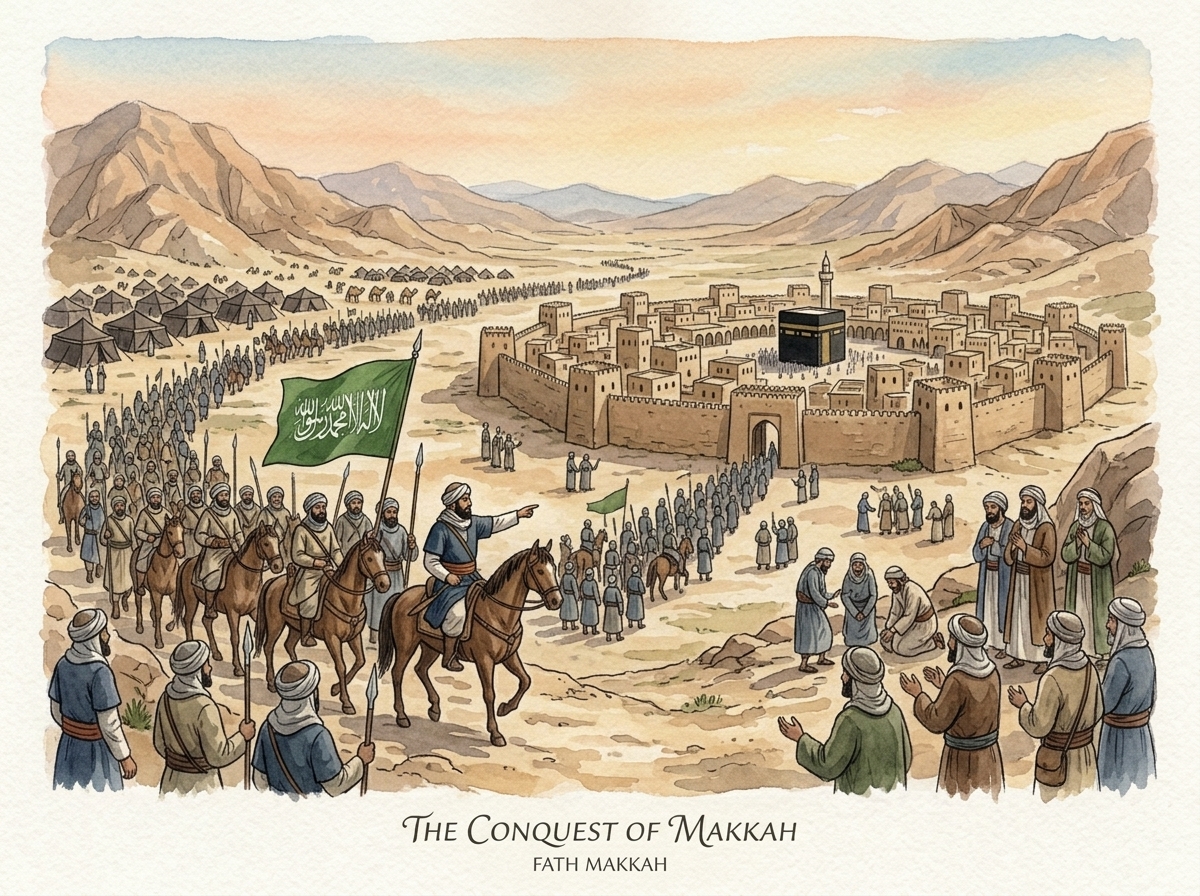
Muslim Army Sets Off asūlullāh marched forth in the month of Ramadān, and in the initial parts of the journey they were fasting, but when they were getting closer to Makkah, Rasūlullāh ﷺ ordered the Muslims to break their fast, and he took a cup of water and he drank it in front of them to give them the example. The army was 10,000 strong; this was the largest army assembled by Rasūlullāh ﷺ so far. All of the Muhājirīn and all of the Ansār were included, and many of the tribes surrounding Madīnah participated, such as Sulaim and Aslam and Ghifār and Muzainah; all of these tribes participated and that is why we have this large number of 10,000 strong, and these are the Sahābah of Rasūlullāh ﷺ who witnessed the great battle of Fath Makkah – the Conquest of Makkah. On their way, they reached an area called Marr Ad-Dahrān, and there were trees of Arāk; Arāk is the tree which Miswāk is taken from; the good Miswāk is the root of this
tree, but also the tender branches can be used as a Miswāk, so the tree is called Al-Arāk. There is a tiny fruit from this tree called Al-Kubbāth – very small, like a pea but smaller than a pea, and they are sweet but they also have that taste of Al-Miswāk in them, and they are edible. So the Sahābah were plucking this Kubbāth and Rasūlullāh ﷺ told them to take the black ones because they are the best, because it starts out as green and then it turns, I think, yellow, and then red and then black, so black is when it is ripe. Now, Al-Arāk does not grow in Makkah, it is outside of Makkah, so they told Rasūlullāh ﷺ,” You must have been a shepherd of sheep,” because it is the shepherds who eat Al-Kubbāth since it is outside of Makkah, they are the ones who usually harvest it and eat it. So Rasūlullāh ﷺ said, “Yes, and every Nabï has been a shepherd.” Every Nabï has been a shepherd of sheep, and we talked about the Hikmah – the wisdom, behind the Ambiyā' of Allāh being shepherds, we talked about that in one of the lectures of Makkah. ‘Abdullāh Ibn Mas‘ūd was climbing the tree – this was not a very high tree, it was a short tree – so ‘Abdullāh Bin Mas‘ūd was climbing to try and get the Kubbāth and his legs were showing, his shins; they were very, very slim, so some of the Sahābah were laughing at the thinness of his legs. So Rasūlullāh ﷺ said, “You are surprised by the thinness of the shins of ‘Abdullāh Ibn Mas‘ūd. In the name of Allāh, they are heavier on the scales on the Day of Judgement than the mountain of Uhud.” So ‘Abdullāh Ibn Mas‘ūd is going to be very heavy on the scales on the Day of Judgement, his deeds are very heavy, and Rasūlullāh ﷺ gave this Fadīlah to ‘Abdullāh Ibn Mas‘ūd – this virtue. And when they were walking, suddenly a rabbit jumped, so they followed it and one of the Sahābah was able to catch the rabbit, so they took it to Abū Talhah who slaughtered it and then they sent a piece of it to Rasūlullāh ﷺ and he ate it, so rabbit is Halāl.
Quraish Have No Idea about Movements of Rasūlullāh ﷺ
Up until that moment, Quraish had no idea about the movements of Rasūlullāh ﷺ;a huge army of 10,000 strong, yet Quraish were blind and deaf concerning the movements of Rasūlullāh ﷺ, while whenever Quraish would make a movement Rasūlullāh ﷺ would be alerted. So the
960 intelligence gathering of Rasūlullāh ﷺ and the Muslims was at a much higher calibre than Quraish, and that was a blessing from Allāh ﷻ that He gave the Muslims even though their resources were much less and the Kuffār in the area were much more; the number of Muslims until that moment was quite small, it was limited to Madīnah and the surrounding areas of Madīnah, the rest of Arabia were all Kuffār. Nevertheless, Rasūlullāh ﷺ had disciplined and trained the Sahābah to be alert and he would send them out scouting for information, while Quraish up until this moment had no clue about what was going on. Another reason which made the intelligence gathering of the Muslims better than Quraish is the loyalty that they had to Rasūlullāh ﷺ, so information would not leak. And as we have seen in the case of Hātib Ibn Abī Balta‘ah, that was a single case and Rasūlullāh ﷺ was alerted to it by Al-Wahī. So the Sahābah would never disclose information about the movements of the Muslims. One of the things that we suffer today is the lack of loyalty, and the lack understanding of Walā' and Barā'. So Muslims who claim to be Muslims are willing not only to give information on a single incident basis, but are willing to work long-term for the Kuffār giving them information about the Muslims, spying against the Muslims. And this is Nifāq; a person who does so is a Munāfiq, a person who gives up information about the Muslims, spies in the Masājid and collects information and delivers it to the Kuffār, how will he escape the wrath of Allāh ﷻ on the Day of Judgement? So Muslims need to fear Allāh, they need to have Taqwā, and they need to have the correct understanding of what Al-Walā' and Barā' means.
Abū Sufyān and Others Captured
So Rasūlullāh ﷺ was in this area of Marr Ad-Dahrān. Abū Sufyān himself, the leader of Quraish, along with Badīl Bin Warqā’ and Hakīm Bin Hizām, came out of Makkah searching for information, asking the travellers. At night, they were close to the Muslim army and they saw the lights of the Muslims, so Abū Sufyān was saying, “Who are these?” Badīl Bin Warqā’ said, “This is Khuzā‘ah preparing for war.” Abū Sufyān said, “Khuzā‘ah is much less than this.” To have all of these lights; this cannot be Khuzā‘ah. He said, “Adhallu Wa Aqall – They are more humble and few to have these
lights.” Abū Sufyān and Badīl and Hakīm were overseeing the Muslim army, but the Muslim guards were alert and they arrested the three of them and they took them to Rasūlullāh ﷺ;in one narration it says they were arrested, and that is a stronger narration, and in another narration it was Al- ‘Abbās Ibn ‘Abdul Muttalib who found them, but anyway, we will go with the narration that they were arrested. So they were taken to Rasūlullāh ﷺ. In one narration it says that ‘Umar Ibn Al-Khattāb saw Abū Sufyān so he wanted to kill him, but Al-‘Abbās had Abū Sufyān ride on the mule of Rasūlullāh ﷺ and he was rushing to get to Rasūlullāh ﷺ before ‘Umar Ibn Al-Khattāb could kill Abū Sufyān, until they entered into the place where Rasūlullāh ﷺ was, and ‘Umar tried to have Abū Sufyān killed while Al-‘Abbās was appealing to Rasūlullāh ﷺ to spare his life. And the argument kept on going on; Al-‘Abbās is trying to convince Rasūlullāh ﷺ to spare his life and ‘Umar Ibn Al-Khattāb is trying to convince Rasūlullāh ﷺ to allow him to be executed.
And then Al-‘Abbās got angry and he said, “O ‘Umar, if he was one of Banū ‘Adiÿ,” – Banū ‘Adiÿ are the clan of ‘Umar Ibn Al-Khattāb; Quraish is the tribe and then you have clans, so ‘Umar Ibn Al-Khattāb belongs to Banū ‘Adiÿ, so Al-‘Abbās is telling ‘Umar, – “If he was from amongst the clan of Banū ‘Adiÿ, you would not have said so, but you know that he is from Banū ‘Abd Manāf.” Banū ‘Abd Manāf are the family of Rasūlullāh ﷺ and also the family of Abū Sufyān; they are both descendants of ‘Abd Manāf. ‘Umar Ibn Al-Khattāb told Al-‘Abbās, “Mahlan Yā ‘Abbās – Wait ‘Abbās, your Islām is more beloved to me than the Islām of my father Al-Khattāb if he had become Muslim, because I know that Rasūlullāh ﷺ would become more pleased by the Islām of you than if my father had become Muslim.” So ‘Umar Ibn Al-Khattāb is making it clear to Al-‘Abbās that this is not how we Muslims think; we do not think on a tribal level, that is not our way of thinking. I am more happy for your Islām, because you are the uncle of Rasūlullāh ﷺ and it is more pleasing to Rasūlullāh ﷺ, so what pleases me is what pleases Rasūlullāh ﷺ, and what makes me angry is what displeases Rasūlullāh ﷺ.’ Umar Ibn Al-Khattāb here is giving Al-‘Abbās Ibn ‘Abdul Muttalib a lesson in how the Muslims think; we do not view
things from a nationalistic view or a family-based view or a clan view or a tribal view, we base things on Al-Walā' and Barā'. If a person is close to Allāh, then we are loyal to that person, if a person is far away from Allāh, then we are free and we disassociate ourselves from such a person.
The Islām of Abū Sufyān
Rasūlullāh ﷺ told them to leave and come back in the morning according to that narration, and when they met in the morning, Rasūlullāh ﷺ accepted the Islām of Badīl Bin Warqā’ and Hakīm Bin Hizām. Rasūlullāh ﷺ told Abū Sufyān, “Is it not about time Abū Sufyān that you recognise that there is no God but one?” Abū Sufyān said to Rasūlullāh ﷺ,” Mā Ahlamaka Wamā Akramak – You are merciful and you are generous.” And then Abū Sufyān said, “If there were any other gods besides Allāh they would have given us protection and have defended us.” So Abū Sufyān has accepted that there is no God but Allāh, there is no one worthy of worship but Allāh, he accepted that. And then Rasūlullāh ﷺ told him, “Is it not about time Abū Sufyān that you testify that I am the Messenger of Allāh?” Abū Sufyān said, “O Rasūlullāh ﷺ, there is something in my heart against this at the moment.” So I accept Ash'hadu Allā Ilāha Illallāh, but I still feel difficulty in accepting that Muhammad is the Messenger of Allāh. Al-‘Abbās told him, “Woe to you Abū Sufyān, become a Muslim before your head is chopped,” before you are executed. Abū Sufyān said, “Wa Ash'hadu Anna Muhammad Ar-Rasūlullāh ﷺ,” and he became a Muslim. Rasūlullāh ﷺ gave his instructions to Al-‘Abbās to hold back Abū Sufyān from leaving and to have him wait at the mountain-pass. Rasūlullāh ﷺ wanted Al-‘Abbās to hold back Abū Sufyān for a reason, and he wanted him to wait at the mountain-pass for a reason; Rasūlullāh ﷺ wanted to demonstrate to the leader of the Kuffār the strength of the Muslims. When Abū Sufyān would see the overwhelming forces that Rasūlullāh ﷺ had brought together to invade Makkah, that would stop and bring an end to any willingness or desire to resist. Because even though Abū Sufyān has become Muslim, he is a new Muslim and he is the leader of Quraish and he might have some interest there and the people in Quraish might want to fight, so Rasūlullāh ﷺ wanted these people – Abū Sufyān and the ones with him – to see with
their own eyes – because hearing something is not like seeing it – to see with their own eyes the 10,000 strong army of Rasūlullāh ﷺ because Rasūlullāh ﷺ did not want bloodshed in Makkah, so he wanted them to see how strong the Muslims are so that they would just surrender. Sa’d Ibn ‘Ubādah Makes Mistake at Moment of Enthusiam Rasūlullāh ﷺ divided the army into battalions, we can say, and every battalion had a Rāyah – had the banner, and they were divided according to their tribes, so Banū Sulaim were separate, Ghifār were separate, Muzainah were separate, etc.. And they were passing from this mountain-pass, because it was a narrow area, they were passing one after the other, and whenever one of these battalions would move through the mountain-pass, Abū Sufyān would ask Al-‘Abbās, “Who are they?” and Al-‘Abbās would tell him, “This is Ghifār,” Abū Sufyān would say, “Mā Lī Wa Mā Al-Ghifār – I have nothing to do with Ghifār,” and then Sulaim; “I have nothing to do with Sulaim,” Muzainah; “I have nothing to do with Muzainah,” until one battalion passed and it caught the attention of Abū Sufyān.
Subhān'Allāh, you can sometimes sense the strength of what you see. So Abū Sufyān saw this particular battalion and it caught his attention and he asked Al-‘Abbās, “Who are these?” Al-‘Abbās told him, “These are the Ansār.” And the banner of Al-Ansār was with Sa’d Ibn ‘Ubādah who was the leader of Al-Khazraj. When Sa’d saw Abū Sufyān, he told Abū Sufyān, “Yā Abū Sufyān, Al-Yawm Yawmul Malhamah, Al-Yawm Tustahallal Ka’bah – O Abū Sufyān, today is the day of the great battle, today is the day when the sanctuary of Al-Ka’bah would be violated.” Sa’d Ibn ‘Ubādah, was a great Sahābï of Rasūlullāh ﷺ, a leader of Al-Ansār, one of the men who gave Nusrah – victory, to Rasūlullāh ﷺ, however at that particular moment, enthusiasm probably led him to speak out and utter these words. Abū Sufyān and Al-‘Abbās and others, and it even says that ‘Umar Ibn AlKhattāb, they carried these words of Sa’d Ibn ‘Ubādah to Rasūlullāh ﷺ, so Rasūlullāh ﷺ said, “Kadhaba Sa’d – Sa’d lied.” Now, the word lie here in this context means he is mistaken, it does not mean literally lied, it means that he is mistaken, Sa’d is mistaken. “Kadhaba Sa’d, Walākin Hādhā Yawm
Yu‘azzimullāhu Fīhil Ka’bah – Sa’d has lied, but this is a day in which Allāh will glorify Al-Ka’bah.” The sanctity of Al-Ka’bah will not be violated. And Rasūlullāh ﷺ ordered that the banner be taken away from Sa’d Ibn ‘Ubādah and be given to his son Qais Bin Sa’d Bin ‘Ubādah. This is for two reasons, the first reason; Rasūlullāh ﷺ did not want Sa’d Ibn ‘Ubādah to have authority, and probably this would lead him into bloodshed in Makkah. You can see that Rasūlullāh ﷺ wanted to avoid shedding blood in Makkah, so Rasūlullāh ﷺ did not want the banner to remain in his hands. But at the same time and the second reason is that Rasūlullāh ﷺ did not want to anger or upset Sa’d Ibn ‘Ubādah. Sa’d Ibn ‘Ubādah is going to accept the orders of Rasūlullāh ﷺ no matter what, but probably there would be something in his heart; he might be upset that the banner was taken from him, so Rasūlullāh ﷺ gave it to his own son.
Khālid Bin Walīd Destroys Banū Bakr and Banū Hudhayl
Rasūlullāh ﷺ entered peacefully, there was no resistance, but the area in which Khālid Bin Walīd came in, there was resistance from Banū Bakr and Hudhayl. Banū Bakr and Hudhayl are tribes that live on the outskirts of Makkah, they did not live in Makkah itself. So they put up a fight. Khālid Bin Walīd just destroyed them, so they all just ran away; they gave up and that was the end of resistance. Therefore there is a difference of opinion among the scholars; Hal Futihat Makkah Sulhan Aw ‘Unwatan? – Was Makkah opened by force or was it opened through agreement? What are the implications of this difference of opinion? The implications are in matters of Fiqh, because when a land is opened by force then everything that belongs to the Kuffār turns into the property of Muslims, even themselves. So everything on top of the land becomes property of the Muslims if that land was opened by force, so the population could be enslaved and all of their property could be taken away and split among the Muslims – this is if it was opened by force. However if it was opened Sulhan – by agreement, then the Kuffār can have some right of ownership and they are not enslaved, then they remain free. So there is a difference of opinion among the ‘Ulamā' on Fath Makkah; some scholars say it was opened by force and some of them
say it was opened by agreement, and the reflection of it is regarding the property that exists in Makkah.
Rasūlullāh ﷺ and Sahābah Enter Makkah in Humility
Rasūlullāh ﷺ entered Makkah. Now, this is after an absence of eight years. Rasūlullāh ﷺ left Makkah eight years ago secretly, and there was a plot to kill him and Rasūlullāh ﷺ had to flee from the danger that existed in Makkah. Eight years and now Rasūlullāh ﷺ is entering Makkah victoriously. Rasūlullāh ﷺ and the Muhājirūn spent 13 years in Makkah suffering torture, evil words, boycott; all types of harm that you can imagine the Muslims went through, and now it is a chance for revenge, it is a chance to slaughter those who caused all of this punishment and torture and hardship on the Muslims. It could have been a chance for great celebrations of victory as different armies do whenever they conquer a new land, but how did Rasūlullāh ﷺ and the Muslims enter Makkah? Did Rasūlullāh ﷺ enter Makkah with ‘Mission Accomplished’ propaganda and celebrations and popping of champagne bottles as the Kuffār do? When Rasūlullāh ﷺ and the Sahābah entered into Makkah, the description that was given of Rasūlullāh ﷺ when he was entering is that he entered with humbleness, Khushū’, and he was reciting Sūrah Al-Fath, the Sūrah of Conquest, and his head was lowered so down that it could touch the Rahl of the camel; his beard was touching it, and he would recite the Āyāt and repeat them. He had a black turban on and he had a white flag banner, and he entered into Makkah in a state of humbleness, thanking Allāh ﷻ for the Conquest, praising Allāh ﷻ for what He has given him.
Rasūlullāh ﷺ Opens Doors of Al-Ka’bah and Has Al-Ka’bah
Cleansed
Rasūlullāh ﷺ then made Tawāf around Al-Ka’bah, and then he called ‘Uthmān Ibn Talhah to bring the key of Al-Ka’bah. They key of Al-Ka’bah belonged to Banū ‘Abd Ad-Dār. You see, Ka’b, the great grandfather of Rasūlullāh ﷺ, all of the different honours of Makkah were in his hand, and then when he passed away they were split among his children. So the
family of Rasūlullāh ﷺ had the responsibility of providing water to the Hujjāj; from the well of Zamzam they would provide the Hujjāj with water and that is called Siqāyah. And then the family of Banū ‘Abd Ad-Dār were the custodians of Al-Ka’bah, they held on to the key, so the key was with them. ‘Uthmān was a Muslim, and Rasūlullāh ﷺ told him to go and get the key; the key was with his mother. So he went, and in the beginning she refused and then he took the key and he brought it to Rasūlullāh ﷺ. Rasūlullāh ﷺ opened Al-Ka’bah and he entered and he saw a pigeon made out of wood; he destroyed it. There were images on the walls of Al-Ka’bah of angels, and Ibrāhīm using Istiqsām Bil Azlām which is the divining arrows, which is one of the Bid‘ah of Jāhiliyyah. Rasūlullāh ﷺ said, “Qātalahumullāh – May Allāh kill them, they portrayed our elder (meaning our grandfather Ibrāhīm) as using these divining arrows.” And then he ordered ‘Umar Ibn Al-Khattāb to wipe out all of these images from inside Al-Ka’bah, so ‘Umar Ibn Al-Khattāb soaked a cloth in water and then wiped out all of these images, so when Rasūlullāh ﷺ entered in Al-Ka’bah, it was clean from all of the innovations of Jāhiliyyah and Kufr. And then Rasūlullāh ﷺ came out from Al-Ka’bah and he stood on the door of AlKa’bah which was high, and by now all of the people were gathering around him.
The People of Makkah Voluntarily Come Out to Listen to Rasūlullāh ﷺ
And then Rasūlullāh ﷺ spoke to the crowd. The people of Quraish all came out now to listen to Rasūlullāh ﷺ. Let us go back a few years when Rasūlullāh ﷺ received the initial Revelation from Allāh ﷻ and was commanded to deliver the warning to his people; Wa Andhir ‘Ashīratakal Aqrabīn – And warn, O Muhammad, your closest kindred – that was in the beginning. So Rasūlullāh ﷺ stood on a mountain in Makkah and he said, “Wā Subāhā!” And this is the call to make when there is an emergency situation. You do not just say Wā Subāhā for nothing, you say it when there is something very urgent, because everybody is going to respond, it is a
serious call. So all of the people came, and those who could not come sent a representative to listen. Rasūlullāh ﷺ said, “Innī Nadhīrul Lakum Bayna Yadai ‘Adhābin Alīm – I am delivering a warning to you before a severe punishment will befall you.” When Rasūlullāh ﷺ said this, Abū Lahab said, “Tabballak! A'li Hādhā Da’watanā? – May you be cut off! Is this why you have summoned us?!” Abū Lahab was buying and selling – a businessman, and he left his shop and he came to listen to what Rasūlullāh ﷺ had to say and Rasūlullāh ﷺ had this Message to deliver to them, so he was upset and angry and the crowds left, and from that time on no one wants to listen to what Rasūlullāh ﷺ has to say, and imagine how difficult it is to deliver Da’wah to people who do not want to listen. But now, since Rasūlullāh ﷺ is leading an army, now since Rasūlullāh ﷺ has strength and since he is a head of state, everybody came voluntarily to listen; Rasūlullāh ﷺ did not call anyone. By the time Rasūlullāh ﷺ came out and turned his back and faced the people, all of the people of Makkah were under him listening to what Rasūlullāh ﷺ has to say and watching his every move. Because when Rasūlullāh ﷺ went to the well of Zamzam to drink from it and to make Wudū', the Sahābah were rushing to grab the water that would drip from his body and then they would wipe it over their skin. So the people of Quraish were saying, “We have never seen such a King before.” Now they are watching every single movement of Rasūlullāh ﷺ and they are reporting it; that is how we knew about this incident, it is because they reported it to us. Rasūlullāh ﷺ now is the same Rasūlullāh ﷺ then, but because Rasūlullāh ﷺ did not have strength in the beginning no one wanted to listen to what Rasūlullāh ﷺ had to say, but now it is different.
Rasūlullāh ﷺ’s Speech to Quraish – ‘Your Ways are Under My Feet’
So Rasūlullāh ﷺ delivered a short speech from the door of Al-Ka’bah, Rasūlullāh ﷺ said, “Alhamdulillāh – Praise be to Allāh, Sadaqah Wa’dah – who has fulfilled His Promise, Wa Nasara ‘Abdah – And He has helped His Servant, Wa Hazamal Ahzāba Wahdah – And He has defeated the
opposing parties alone.” And then Rasūlullāh ﷺ is instituting some new laws in Makkah; “Compensation for those killed by quasi-intent by whip or cudgel shall be compensated by a hundred camels.” This is Diyat Shibh Al- ‘Amd. And then Rasūlullāh ﷺ told them, “All privilege of ancestry and pride that existed in the Jāhiliyyah are finished.” Listen to this statement, “All privilege of ancestry and pride that existed in the Jāhiliyyah are finished.” These are the foundations of the society of Jāhiliyyah; the foundation, the constitution, the laws, the customs of the Arabs of Jāhiliyyah were based on this – privilege of ancestry and pride. In this one statement, Rasūlullāh ﷺ is bringing a new era, and he is telling the people who are listening under his feet, he is telling them that the time of Jāhiliyyah, the rules of Jāhiliyyah, the customs of Jāhiliyyah, are all behind your backs now, they are all finished. So Rasūlullāh ﷺ is bringing a new era, Rasūlullāh ﷺ is telling the Kuffār that Kufr is over with; I am not going to accommodate you, I am not going to accept your laws, I am not going to accept your customs and ways, it is all finished. In another narration Rasūlullāh ﷺ said, “Both these factors (meaning ancestry and pride) are beneath these feet of mine.” They are under my feet, they are over with. Rasūlullāh ﷺ did not try to win over the hearts of the people of Quraish by accepting some of their rules and customs – the same people of Quraish who would fight for their customs, who would die for their customs, who fought against Rasūlullāh ﷺ for 20 years for no purpose other than the purpose of protecting the old way; they were not religious people by the way, ya’nī even though they had 360 idols surrounding Al-Ka’bah they were not known to be religious people, but it was the status quo that they were trying to protect – Rasūlullāh ﷺ did not try to win them over by accepting some of Al-Jāhiliyyah, and in the first speech delivered in Makkah, Rasūlullāh ﷺ made clear that your ways are under my feet.
Rasūlullāh ﷺ Hands Back Key of Al-Ka’bah to ‘Uthmān Ibn
Talhah
Now, the key of Al-Ka’bah is in the hands of Rasūlullāh ﷺ.’ Ali Ibn Abī Tālib, from the family of Banū Hāshim, told Rasūlullāh ﷺ,” Yā
Rasūlullāh ﷺ Ijma’ Lanā Baynas Siqāyati Wal Hijābah – O Rasūlullāh ﷺ, combine for us the honours of providing the Pilgrims with water and holding on to the key of Al-Ka’bah.” And ‘Ali Ibn Abī Tālib said this because it was a great opportunity; these were very important things to the people of Quraish; holding on to the key of Al-Ka’bah was such a great honour, in fact that is what gave Quraish this prestige among all of the Arabs, it was because they were custodians of Al-Ka’bah. So ‘Ali Ibn Abī Tālib was trying to convince Rasūlullāh ﷺ, he took this opportunity and told Rasūlullāh ﷺ that how about we combine for us, for our family, the honour of holding on to the key of Al-Ka’bah? It is in your hands right now. Rasūlullāh ﷺ called ‘Uthmān and he gave him the key and he told him, “Khudhūhā, Khālidatam Mukhalladatal Lā Ya'khūdh'hā Minkum Illā Zālim – Take it forever, and no one will take it from you but an oppressor,” no one will take it from you but a tyrant. And that is why the key of Al-Ka’bah still exists among the descendants of ‘Uthmān Ibn Talhah until this day, and they are called Banū Shaibah; the key has been passing on from father to son until this day.
Rasūlullāh ﷺ Destroys Idols Surrounding Al-Ka’bah And then Rasūlullāh ﷺ, riding on his camel, was going around Al-Ka’bah, in one narration holding on to a stick and in the other narration holding on to his bow, and he was pointing towards these idols, these glorified idols, these sacred idols to the people of Quraish, and they are all watching, and Rasūlullāh ﷺ is going around and he is poking these idols in their eyes, and in one narration he was just pointing towards the idols and they were falling one after the other; if he points towards the face of the idol, it would fall off on its back, and if Rasūlullāh ﷺ points towards the back of the idol, it would fall off on its face, and Rasūlullāh ﷺ did that with the 360 idols surrounding Al-Ka’bah, and all of the Kuffār of Quraish were watching this monumental moment, when all of their gods that had been there for centuries and centuries, they were watching their idols falling down, breaking into pieces. Rasūlullāh ﷺ was saying and reciting the Āyah, “Jā'al Haqqu Wa Zahaqal Bātil, Innal Bātila Kāna Zahūqā – Truth has
come, and falsehood has departed. Indeed is falsehood, by nature, ever bound to depart.” Falsehood, error or evil is bound to disappear.
Rasūlullāh ﷺ Forgives Quraish
And then Rasūlullāh ﷺ asked the people of Quraish, “Mā Tazunnūna Annī Fa‘alum Bikum? – What do you think I will do with you?” The people of Quraish said what they believe is the case with Muhammad ﷺ;they know him, they said, “Akhun Karīm Wabnu Akhil Karīm – You are a noble brother and the son of a noble brother.” Rasūlullāh ﷺ told them, “Idh'habū Fa Antumut Tulaqā' – Go, you are the released ones.” You are At-Tulaqā' – you are released. Because you are in my hands, and by a point of my finger, by just waving my hand, I could order all of you to be executed, and that would happen if I want it to happen, but he told them, “You are released,” and that is why the people who became Muslim at the Conquest of Makkah are called At-Tulaqā' – The Released Ones, because Rasūlullāh ﷺ is the one who released them. “Idh'habū Fa Antumut Tulaqā' – Go, you are the released ones.”
The Unforgiven Blacklisted People
Rasūlullāh ﷺ released them all but there was a blacklist, there were exceptions. This blacklist included the names of ‘Abdullāh Ibn Khatl, ‘Abdullāh Ibn Abī Sarh, Maqīs Bin Sabābah, Al-Huwairith Bin Naqīz, and Sārah, Fartanah and Arnab. So there were four men and three women. Rasūlullāh ﷺ said about these, “Uqtulūhum Walawajattumūhum Mu‘allaqīna Bi Assāril Ka’bah – Execute them even if you see them hanging on to the clothes of Al-Ka’bah.” Why were these excluded from the rest of the people of Makkah?
‘Abdullāh Ibn Khatl, Fartanah and Arnab
With ‘Abdullāh Ibn Khatl, he became Muslim, he made Hijrah, and then Rasūlullāh ﷺ sent him to collect Sadaqah – Charity, with a man from Al-Ansār, and he had a servant. On the way, he was upset with his servant.
It says in one narration that he ordered the servant to prepare lunch and when it was time for lunch he asked him, “Where is lunch?” The servant told him, “I forgot,” so he killed him. Now, he knew that he was going to be punished for this, Rasūlullāh ﷺ was not going to let him go – in Islām there is justice; whether you are a slave or a nobleman, the Law of Allāh will apply to you – so ‘Abdullāh Ibn Khatl knew this in advance, he therefore decided to run away to Makkah and he committed apostasy, and he had two slave-girls whom he would teach to sing against Rasūlullāh ﷺ. So ‘Abdullāh Ibn Khatl was excluded because of his Riddah and because of his blasphemy against Rasūlullāh ﷺ. And his two slave-girls, and singers, Fartanah and Arnab, were included on the list because of their blasphemy against Rasūlullāh ﷺ –cursing Rasūlullāh ﷺ.
‘Abdullāh Ibn Abī Sarh
‘Abdullāh Bin Abū Sarh became Muslim and he would write Qur'ān for Rasūlullāh ﷺ;Rasūlullāh ﷺ had scribes, he would recite the Āyāt to them and they would write them down. ‘Abdullāh Ibn Abī Sarh then ran away and he became a Murtadd – he became an apostate, and he went as far as telling the people of Quraish that I would change Qur'ān; when I would write it down I would change the meanings of Qur'ān.
Maqīs Bin Sabābah
Maqīs Bin Sabābah’s brother was a Muslim, and in the Battle of Banū Al-Mustaliq he was killed by mistake by a man from Al-Ansār. So Maqīs made Hijrah and he became Muslim just to collect the blood-money of his brother. So Rasūlullāh ﷺ paid him the money, and after he received the money he ran away and became a Murtadd.
Al-Huwairith Bin Naqīz
When Al-‘Abbās Bin ‘Abdul Muttalib sent Fātimah and Zainab, the daughters of Rasūlullāh ﷺ, to Madīnah, Al-Huwairith provoked the camel which Zainab and Fātimah were on, and that led to both of them falling and Zainab having a miscarriage; the daughter of Rasūlullāh ﷺ had a miscarriage because of the actions of this man Al-Huwairith.
Sārah
Sārah was a slave-girl who belonged to someone in Makkah and she used to sing against Rasūlullāh ﷺ.
So we can see that everyone on this blacklist was excluded from the forgiveness of Rasūlullāh ﷺ for one of two reasons; either because they had committed Riddah – apostasy, or because of blasphemy. These are the two things that are unforgiven; Riddah and speaking in an insulting way against Rasūlullāh ﷺ, there is no forgiveness for both of these two crimes. And that is why Ibn Taymiyyah says that the rules concerning Riddah are more strict than the rules concerning Kufr. One example; in the case of a Kāfir who is a prisoner of war, the Imām has the right to execute him or to free him or to ask for ransom or to exchange him with Muslim prisoners of war or to enslave him; it is up to the Imām to choose one of these options, however with the Murtadd, Ibn Taymiyyah says there is only one option and that is to be executed. A Murtadd prisoner of war cannot be freed, cannot be enslaved, cannot be exchanged, he can only be executed, or if he becomes Muslim then he is freed, but if he refuses then there is only the option of execution. That is one example of how the rulings concerning apostasy are different than the rulings concerning Kufr.
‘Abdullāh Ibn Khatl was seen hanging on to the clothes of Al-Ka’bah and he was executed on the spot. Some narrations say that Fartanah was killed while Arnab became Muslim and she was forgiven. ‘Abdullāh Bin Abī Sarh sought refuge with his brother from breastfeeding, ‘Uthmān Ibn ‘Affān – Akhūhu Minar Radā‘ah. ‘Uthmān Ibn ‘Affān took ‘Abdullāh Ibn Abī Sarh to Rasūlullāh ﷺ and ‘Abdullāh Ibn Abī Sarh said, “I came to give you Bay‘ah.” Rasūlullāh ﷺ was quiet. He said, “I came to give you Bay‘ah.” Rasūlullāh ﷺ did not respond. The third time he said, “I came to give you Bay‘ah.” Rasūlullāh ﷺ accepted his Bay‘ah. And then when he left, Rasūlullāh ﷺ told the men who were there, “Is there no wise man among you who could have got up and killed him when you saw I was remaining silent?” So the Ansār said, “But O Rasūlullāh ﷺ, could you not have given us some signal?” Rasūlullāh ﷺ said, “Mā Yambaghī Li Nabï An Yaqtula Bil
Ishārah – Prophets do not kill by making signals.” Rasūlullāh ﷺ said that it is not appropriate for me, as a Prophet, to give you a signal. You already knew my Hukm – my ruling concerning him, so you could have killed him. It says in one narration that one of the Ansār already had his hand on the sword, he was ready to execute the man, but he was waiting for a signal from Rasūlullāh ﷺ. Subhān'Allāh, that was the Qadr of Allāh to spare the life of ‘Abdullāh Bin Abī Sarh, because he became a good Muslim after that, in fact it says that he died in Sujūd of Salātul Fajr, and he held some very high positions of authority in the times of ‘Umar Ibn Al-Khattāb and ‘Uthmān.
Maqīs Bin Sabābah was killed by his cousin. Al-Huwairith Bin Naqīz was also killed. Sārah; some say that she was forgiven. So we can see the important ruling here of the Hukm of Sabb Rasūlullāh ﷺ – the ruling of committing blasphemy against Rasūlullāh ﷺ.
Umm Hānī’s Protection Umm Hānī is the sister of ‘Ali Ibn Abī Tālib. Two of her in-laws sought refuge with her. ‘Ali Ibn Abī Tālib came in and said, “I will kill them!” Umm Hānī had them hide in her place and then she went to Rasūlullāh ﷺ who was bathing and Fātimah was screening him, and he was bathing from out of a container that still had marks of dough in it. Rasūlullāh ﷺ welcomed her and he greeted her very well and then he said, “What has brought you?” She said, “The son of my mother has said that he will kill the two men whom I have given protection.” Rasūlullāh ﷺ said, “Ajarnā Man Ajartī Yā Umm Hānī – We give protection to the ones you have given protection to O Umm Hānī.” So Rasūlullāh ﷺ approved her protection and he had spared the lives of her two in-laws. And Umm Hānī saw Rasūlullāh ﷺ pray eight Rak‘āt and every two Rak‘ah were separate, so the scholars had a difference of opinion; are these Rak‘āt Salāt Ad-Duhā or are they the Salāh of Conquest? Some of them said it is the Salāh of Conquest because no one has reported them except Umm Hānī in this particular day which was the Day of the Opening of Makkah, while some of them say that they are the Salāt Ad-Duhā because in the narration it says that he prayed them in the
time of Duhā.
Abū Quhāfah – The Father of Abū Bakr
Abū Quhāfah, the father of Abū Bakr, told his youngest daughter to take him on top of the mountain of Abū Qubais; this is a mountain in Makkah, and his sight was very weak, so she took him on top of the mountain. He told her, “O daughter, describe to me what you see.” She said, “Innī Arā Sawādan – I see a black mass.” He told her, “Those are the horsemen.” And then he asked her, “What do you see?” She said, “I see a man going back and fro.” So Abū Quhāfah said, “Dhālikal Wāzah – That is the man who gives instructions to the cavalry.” And then she said, “I see the black mass dispersing.” He said, “The orders have been given to the cavalry, let us rush back.” But they did not get home on time, they had met the cavalry on their way and Subhān'Allāh, one of the soldiers saw a silver necklace on the neck of the daughter of Abū Quhāfah so he ripped it apart from her neck. Abū Bakr As-Siddīq went to his father and he brought him to meet Rasūlullāh ﷺ. When Rasūlullāh ﷺ saw the old man, Rasūlullāh ﷺ told Abū Bakr, “Hallā Taraktash Shaykh Fa Akūnu Analladhī Ātīh? – Why did you not leave the Sheikh (old man) at home so that I would be the one who would come to him?” Abū Bakr said, “Huwa Ahaqq Ayyamshi Ilaik Min An Tamshiya Anta Ilaih – It is more befitting for him to come to you rather than you go to him.” So this shows you the respect that Rasūlullāh ﷺ had for Abū Bakr in offering to go and visit his father, and you can see the respect that Abū Bakr had for Rasūlullāh ﷺ, telling Rasūlullāh ﷺ that my father should come to you, not you go to him. And then Rasūlullāh ﷺ put his hand on the chest of Abū Quhāfah and he wiped his chest and said, “Aslim,” so he became Muslim. And then Rasūlullāh ﷺ told them to change the colour of his hair because his hair was described as being like Thuwāmah; Thuwāmah is a white bird, so all of his hair was grey.
Rasūlullāh ﷺ said, “Ghayyirūhu Walā Tuqarribūhus Sawād – Change the colour of his hair but do not make it black.” Therefore the ‘Ulamā' have derived the ruling that the old man should not die his hair black but should change it to a different colour, and that is the colour of Hannah which is red.
And some scholars said that if a person is young then they can die their hair black, but if they are at the age where it is natural for them to have grey hair, they should not die it black but they should die it with Hannah.
The daughter of Abū Quhāfah, the sister of Abū Bakr, told her brother that her necklace was taken away! So Abū Bakr said, “Ayyuhan Nās – O people, has anyone taken the necklace of my sister?” No one responded, so he told her, “Ihtasibi Yā Bunayya Fa Innal Amānata Fin Nāsil Yawma Qalīl – Seek the Ajr of it from Allāh, because trust is little in the people today.” Ibn Kathīr comments on this and says that the reason why Abū Bakr said this was because the army was large, and Ibn Kathīr is finding an excuse for whoever took the necklace, he said, “Probably he took it considering that it belongs to the people of war.” So what belongs to them is Ghanīmah. And he is also giving an excuse to Abū Bakr when he said that the trust today is very rare among the people, meaning he said it for that particular day and not in that era or time; that particular day because it was a large army and things could get out of hand when an army enters into a town and you have a lot of soldiers; these are things that happen with armies. So Abū Bakr was referring to that particular day and was not referring to the people in general.
There is No Inheritance between Two Different Religions
In Al-Bukhārī it says that Usāmah Bin Zayd asked Rasūlullāh ﷺ,” Aynal Maznil Ghadan? – Where are you going to spend the night?” Rasūlullāh ﷺ said, “Wahal Taraka Lanā ‘Aqīlum Mir Ribā’? – Did ‘Aqīl leave for us any property?” ‘Aqīl had taken over all of the inheritance so Rasūlullāh ﷺ had nothing left, and then Rasūlullāh ﷺ said, “Lā Yarithul Mu'minal Kāfir Walal Kāfirul Mu'min – The Believer does not inherit from the Disbeliever and the Disbeliever does not inherit from the Believer.” And this is the Hukm and ruling regarding inheritance; there is no inheritance between two different religions. And Rasūlullāh ﷺ said, and this is in Bukhārī, “Manzilunā Ghadan Inshā'Allāh Bi Khaifi Banī Kinānah Haythu Taqāsimu Al-Kufr – Tomorrow we are going to spend the night, by the will of Allāh, in Khaif Banī Kinānah, the place where they have vowed on Disbelief.” So Rasūlullāh ﷺ wants to replace the Kufr that happened in that place by
spending the night there and bringing the spirit of Īmān into that place. So if evil happened in that place, he will bring good to it.
These are some events that happened during Fath Makkah.xliv Rasūlullāh ﷺ Appoints Bilāl Ibn Rabāh as Mu'adhdhin We are finishing with some miscellaneous events concerning Fath Makkah Inshā'Allāhu Ta‘ālā. When Rasūlullāh ﷺ entered into Makkah, he chose a Mu'adhdhin – someone to call the Adhān, and the particular choice of Rasūlullāh ﷺ was Bilāl Ibn Rabāh. And Rasūlullāh ﷺ had Bilāl climb over Al-Ka’bah to deliver the Adhān. According to Yūnus Ibn Mukīr, “Amara Bilālan An Yu'adhdhina Liyaghīza Bihil Mushrikīn – Rasūlullāh ﷺ ordered Bilāl to give Adhān in order to anger the Polytheists.” Because Bilāl was seen as a slave, and now he is calling to the Salāh and he is climbing over Al-Ka’bah to it, and therefore there are some narrations of comments made by the people of Makkah showing their displeasure with the fact that Bilāl was the one who was calling the Adhān. Like one of them who said, “Can you see this black crow barking from on top of AlKa’bah?” And things like that; derogatory terms made by the Mushrikīn of Quraish. Rasūlullāh ﷺ intended to have Bilāl make the Adhān to show them, just what we were talking about before, the new era that Islām is bringing, where class and caste of Jāhiliyyah do not matter anymore, and it is Taqwā that makes a person high or low, it is according to how close they are to Allāh ﷻ, it is their Taqwā, it is their following of Islām.
Sahābah Remained in ‘Ibādah All Night
According to Sa‘eed Bin Musayyib, that particular day when the people entered into Makkah, it was not a day of celebration, it was not a day of partying, he says, “When the people entered into Makkah on the Day of Conquest, they remained in Takbīr (saying Allāhu Akbar) and Tahlīl (saying Lā Ilāha Illallāh) and Tawāf Bil Bayt (circling Al-Ka’bah).” They have been away from Al-Ka’bah for a long time and now they are pleased and happy that Allāh ﷻ allowed them to enter into Makkah and to worship Allāh according to the rules of Islām while Islām is dominant in Makkah. So they
were making Tawāf around the House, and all the way until the morning there was ‘Ibādah, all night; all night long there was ‘Ibādah. Wherever you go in Makkah, you can see people making Takbīr and making Tahlīl and making Tawāf around the House of Allāh. So Abū Sufyān went back to his wife and asked, “Do you think this is from Allāh?” It was an impressive scene, it was something that even affected these people of Quraish, people of Makkah who were just moments ago Kuffār. So Abū Sufyān asked his wife, “Atarayna Hādhā Minallāh? – Do you think this is from Allāh?” She said, “Yes, this is from Allāh.” And then Abū Sufyān met Rasūlullāh ﷺ and Rasūlullāh ﷺ told him, “You asked Hind, ‘Do you think this is from Allāh?’ and Hind told you, ‘Yes, I think this is from Allāh.’” Abū Sufyān said, “I testify that you are the Messenger of Allāh. No one overheard our conversation, there was no one there but me and Hind.”
Rasūlullāh ﷺ Bans Hunting and Uprooting in Makkah and
Madīnah
Rasūlullāh ﷺ said, as narrated by Al-Bukhārī, “Allāh has made Makkah a sanctuary the day He created the heavens and the earth. It is a sanctuary by Allāh’s having made it so and will remain such until the Judgement Day. Conflict in it was not made permissible for anyone before myself nor for anyone after me, and this only for a short time. In it, game may not be hunted, its trees may not be cut down, nor may its vegetation be uprooted, and items found in it belong to the finder only after announcement of the find.” Al-‘Abbās Ibn ‘Abdul Muttalib wanted to exclude from this rule a plant called Al-Idhghar, because Rasūlullāh ﷺ said you are not allowed to cut down trees, so Al-‘Abbās wanted to exclude Al-Idhghar because they use it for the dead; it is a fragrant tree, it has a nice smell to it, and apparently it is also used as fuel for blacksmiths, because in another narration it says Lil Qayn, so Rasūlullāh ﷺ said, “Except for Al-Idhghar,” Rasūlullāh ﷺ allowed them to cut down this particular plant or tree but nothing else. So Makkah, and also Madīnah, are Harām, and they are a sanctuary, and hunting is not allowed therein and uprooting trees is not allowed.
Abū Hurairah Narrates Story of Fath Makkah to Sahābah and AtTābi‘īn There is a Hadīth by Abū Hurairah; we will go through it Inshā'Allāh. Abū Hurairah says, “Delegations went to meet Mu‘āwiyah,” – so we are talking about a lot of time after the Fath of Makkah, we are talking about in the time when Mu‘āwiyah was Khalīfah – “and that was during the time of Ramadān, so we would prepare food for each other.” And this shows you the social aspect of the life of the Sahābah and the Tābi‘īn. These were delegations that were there, and rather than everyone having their meal alone, they would invite each other. So Abū Hurairah said, “I invite you to my place.” Now, it says in this narration about Abū Hurairah, “He would invite us the most.” So one of At-Tābi‘īn wanted to invite Abū Hurairah, so he said, “So I decided that I am going to invite them to my place this time.” Obviously these are not permanent dwellings, they are all visitors. “I prepared the food and then I met Abū Hurairah and I told him, ‘Invitation is at my place tonight.’ He said, ‘You beat me to it.’ I said, ‘Yes.’” When Abū Hurairah arrived at the gathering, he wanted to make it a beneficial gathering so he said, “Should I not tell you a Hadīth that belongs to you O people of Al-Ansār?” Apparently most of these people who were there were from Al-Ansār. So he talked about the story of the Conquest of Makkah, he said, “When Rasūlullāh ﷺ came to Makkah, he sent Az-Zubair on one of the two wings of the army and he sent Khālid Bin Walīd commanding the other wing and Abū ‘Ubaidah was commanding the foot-soldiers. So they entered into Makkah and Rasūlullāh ﷺ was in his battalion. He saw me and he said, ‘O Abū Hurairah.’ I told him, ‘Labbyika Yā Rasūlullāh ﷺ.’ He said, ‘No one but the Ansār should come to me.’” So this was a private gathering that Rasūlullāh ﷺ wanted to have with Al-Ansār. So Abū Hurairah went and invited the Ansār, he called them so they came and surrounded Rasūlullāh ﷺ from every direction. Rasūlullāh ﷺ said, “Quraish has mobilised a force of some men.” And these were people from the outskirts of Makkah who were there to fight, but they did not risk themselves going into the fight. So Quraish mobilised this force, but they themselves did not join and they said, “If they win then we will join, if they
lose then we are safe.” And you cannot win in this way; if you do not want to participate yourself, if you do not want to be in the frontline like Rasūlullāh ﷺ was and like the Sahābah were, then there is no hope of winning. So those who are hiding and sending their foot-soldiers to do all the work while they are cowering behind and hiding, they will not win. So these Awbāsh – these people who were supposed to fight for Quraish, they were defeated. Rasūlullāh ﷺ gave his orders to fight these Awbāsh and many of them were killed and then the fighting stopped. Anyway, they ended up meeting on As-Safā, and when they met with Rasūlullāh ﷺ, Rasūlullāh ﷺ said, “Man Dakhala Dār Abī Sufyān Fahuwa Āmin – Whoever enters into the house of Abū Sufyān, he is safe.” Rasūlullāh ﷺ announced that whoever enters into the house of Abū Sufyān is going to be safe. Now, the house of Abū Sufyān is obviously not going to be enough for all of the people of Quraish, but Rasūlullāh ﷺ wanted to give Abū Sufyān this honour to draw him closer to Islām, but he also said, “Wa Man Dakhala Manzila Aw Fahuwa Āminan – Whoever enters into his own house, he will be safe.” So no one will attack you in your house, but if we see you in the streets, then you will be killed. So it is like a curfew; nobody is allowed to leave their homes.
Al-Ansār’s Fear that Rasūlullāh ﷺ Will Leave them And after this conflict happened, the Ansār felt that because Rasūlullāh ﷺ was now back in his hometown, he might leave them and stay behind. Now he is with his clan, he is with his relatives, he is in Makkah, so he is going to leave us – that is the end. So Rasūlullāh ﷺ called them and he asked them, “Did you say so?” They said, “Yes.” Rasūlullāh ﷺ told them, “Innī ‘Abdullāhi Wa Rasūluh – I am the servant of Allāh and His Messenger. Hājartu Ilallāhi Wa Ilaikum – I made Hijrah to Allāh and to you. Wal Mahyā Mahyākum Wal Mamātu Mamātukum – Life is with you and death is with you.” So they came crying to Rasūlullāh ﷺ and they said, “Wallāhi Mā Qulnalladhī Qulnā Illaddann Billāhi Wa Rasūlih – By Allāh, we only said what we said because of our eagerness and desire to have you with us and our love of Allāh and love of His Messenger.” Rasūlullāh ﷺ said,
“Inallāha Wa Rasūlahū Yusaddiqānikum – Allāh and His Messenger believe you.”
Rasūlullāh ﷺ Forgives Safwān Ibn Umayyah
Safwān Ibn Umayyah was one of the leaders of Quraish. He fled because he thought he had done so much against Islām and Rasūlullāh ﷺ would kill him. ‘Umair Ibn Wahb was his close friend in Jāhiliyyah, and if you remember, we talked about ‘Umair Ibn Wahb; ‘Umair Ibn Wahb is the man whom Safwān sent to assassinate Rasūlullāh ﷺ, and when he arrived in Madīnah, Rasūlullāh ﷺ told him about his plan to come and assassinate him, so he was shocked that Rasūlullāh ﷺ knew the details of this plan and he ended up becoming Muslim. So now, when ‘Umair Ibn Wahb heard about Safwān running away he followed him. Safwān went to Jiddah to ride a boat and go to Yemen, so ‘Umair Ibn Wahb told him, “I have come to you from Rasūlullāh ﷺ, “because ‘Umair Ibn Wahb spoke to Rasūlullāh ﷺ and said, “O Messenger of Allāh, Safwān is the leader of his people, give him immunity.” So Rasūlullāh ﷺ said, “I will give him immunity.”
‘Umair Ibn Wahb said, “Give me a sign, a token.” So Rasūlullāh ﷺ gave him his turban as a sign of the fact that Rasūlullāh ﷺ is giving Safwān immunity. ‘Umair took the turban of Rasūlullāh ﷺ and he went to meet Safwān. Safwān told him, “Stay away from me!” ‘Umair said, “I have come to you from the most merciful and from the most compassionate man and the most forgiving, and his kingdom is yours and his position is yours and his honour is yours! He is your relative, and whatever good happens to Rasūlullāh ﷺ is good that is happening to you. And Rasūlullāh ﷺ has given you immunity.” He said, “You are lying to me.” He said, “This is a sign, this is the turban of Rasūlullāh ﷺ. “So Safwān came back with ‘Umair Ibn Wahb and he went to Rasūlullāh ﷺ and said, “This man is claiming that you forgive me and give me immunity?” Rasūlullāh ﷺ said, “Yes.” Safwān said, “Give me two months to think about it before becoming Muslim.” Rasūlullāh ﷺ told him, “I give you four months.” Safwān eventually became Muslim.
Khālid Bin Walīd Commits Mistake
Khālid Bin Walīd Mistakenly Kills Muslims
Rasūlullāh ﷺ had destroyed the idols and the Kufr of Makkah, and now Rasūlullāh ﷺ wanted to spread the sovereignty of Islām in the surrounding area. So it says in Al-Bukhārī that Rasūlullāh ﷺ sent Khālid Ibn Walīd in Ramadān to Banī Judhaimah – this is an Arab tribe close to Makkah – and he invited them to Islām. They were not educated enough to say ‘We become Muslim’ but they said, “Saba'nā.” When someone would become Muslim, the Kuffār of Quraish would say he has become a Sābi'. Sābi' is one of the religions of Jāhiliyyah and it was a derogatory term against anyone who would become Muslim, so they would never say that such and such has become Muslim, they would say such and such Saba'. Now, Khālid Ibn Walīd told them, “Become Muslim,” they said, “Saba'nā.” In reality they wanted to be Muslim but they were not learned enough to know that they should use the term ‘Aslamnā.’ They picked up this word that they heard everybody else say and they were repeating it. Khālid Ibn Walīd killed them, and he captured the rest and he handed over one prisoner to every soldier of his army. And then Khālid Ibn Walīd gave his instructions to the army, he told every soldier to execute his prisoner.
‘Abdullāh Ibn ‘Umar was in this army and he said, “Wallāhi Lā Aqtul Asīrī. Walā Aqtul Rajulum Min As'hābi Azīrah – In the name of Allāh, I am not going to kill my prisoner, and none of my companions are going to kill theirs.” ‘Abdullāh Ibn ‘Umar saw that this was a clear mistake on behalf of Khālid; these people have become Muslim and then they were killed, and then they were taken as prisoners, and now we are told to execute our prisoners? I am not going to do it. So it was a clear disobeying of the order of the Amīr on behalf of ‘Abdullāh Ibn ‘Umar. Now, ‘Abdullāh Ibn ‘Umar knows the teachings of Islām that you should obey the Umarā', that you should follow the Amīr, but he also knows that we should only follow the Amīr when the Amīr gives us an order that is Halāl; if he tells us to do something that is Harām, there is no obedience. And we know in armies that such a thing, mutiny, is such a dangerous thing to do, but ‘Abdullāh Ibn
‘Umar not only did it himself but he said also all of my companions, people who will listen to me, the people who came with me, they are not going to kill their prisoners. So the issue was raised with Rasūlullāh ﷺ, and Rasūlullāh ﷺ told ‘Abdullāh Ibn ‘Umar, “What you have done is right.” Rasūlullāh ﷺ approved ‘Abdullāh Ibn ‘Umar in his disobedience to the Amīr and then Rasūlullāh ﷺ raised his hands and said, “Allāhumma Innī Abra'u Ilaika Mim Mā Sana‘a Khālid. Allāhumma Innī Abra'u Ilaika Mim Mā Sana‘a Khālid – O Allāh, I declare that I am free of what Khālid has done. O Allāh, I declare that I am innocent of what Khālid has done.” Rasūlullāh ﷺ made it clear that what Khālid has done is wrong; these people should not have been killed, and Rasūlullāh ﷺ approved ‘Abdullāh Ibn ‘Umar in his actions. So the first lesson we learn here is that we should not follow Awliyā' Al-Umūr, Waliyyil Amr – the people in authority, when they tell us to do something Harām; they are to be disobeyed if they tell us to do something Harām.
The Man and Woman who Died
Another incident that happened with this Sariyyah; there was a man among them who did not really belong to that tribe, but he was there because the woman whom he loved was from that tribe, so that was the only reason why he was there. He was among the people who were arrested and his hands were tied, so he told the Muslim soldier who was guarding him, “Just allow me to go and have a final word with those women over there (and he pointed at them) and then do with me whatever you want,” ya’nī just a last sight. The Muslim allowed him so he went and he said, “Aslimī Hubaish Qabla Nafādhal ‘Aish.” Aslimī means accept or become Muslim, Hubaish was her name, Qabla Nafādhal ‘Aish means before life is over. She said, “Fadaituka – I would sacrifice myself for you.” And then he was taken and executed. She saw that and she came over him and sighed once or twice and then she fell next to him dead. When this story was related to Rasūlullāh ﷺ, Rasūlullāh ﷺ said, “Amā Kāna Fīkum Rajulun Rahīm? – Was there not a merciful man among you?” Not only was the killing wrong, but also you killed this man in such a way. And Rasūlullāh ﷺ felt sorry for these
people and what happened to them and therefore Rasūlullāh ﷺ sent ‘Ali Ibn Abī Tālib to pay the Diyah.
Rasūlullāh ﷺ Pays Blood-Money to Families of Muslims Killed
So ‘Ali Ibn Abī Tālib was sent by Rasūlullāh ﷺ to pay blood-money or compensation for all those who were killed, because the ones who were killed were Muslims. They made a mistake by saying Saba'nā but in reality what they meant was Aslamnā. They were paid for everything. Anything that was missing, their belongings that were taken – ‘Ali Ibn Abī Tālib compensated them for everything; blood-money in addition to any belongings that were taken from them. And then there was some left over money with him; he gave it to them just in case. So this is how Rasūlullāh ﷺ dealt with this situation. These were Muslims who were killed by mistake; they were paid blood-money.
Rasūlullāh ﷺ Did Not Fire or Punish Khālid Bin Walīd
But pay attention to what Ibn Kathīr has to say after he mentions this incident, he says, “He (Khālid Ibn Walīd) killed many of them and he killed most of the prisoners also, nevertheless Rasūlullāh ﷺ did not fire him from his position, but Rasūlullāh ﷺ kept on appointing Khālid in positions of responsibility as an Amīr, even though Rasūlullāh ﷺ announced and declared that he is free and innocent of what Khālid had done. And Rasūlullāh ﷺ paid compensation for the mistakes of Khālid that were done in blood or wealth. In this, there is evidence for one of the opinion of the scholars that when the Imām commits a mistake, the money is not paid from his money but from the treasury of the Muslims, Wallāhu A’lam. And that is why Abū Bakr As-Siddīq did not change him (or did not fire him) in the time of Riddah – during the days of apostasy – and Abū Bakr excused him when he killed Mālik Bin Nuwairah (who was supposedly Muslim) and he took over his wife Umm Tamīm.” And we talked about this in the lecture series of Abū Bakr As-Siddīq that Khālid Ibn Walīd killed Mālik Ibn Nuwairah and then he took his wife Umm Tamīm. ‘Umar Ibn Al-Khattāb was angry by the actions of Khālid Ibn Walīd and said, “I’dhiluhū! Fa Inna Fī Sayfihī Rahāqā – Change him! Because his sword is severe.” Abū Bakr
As-Siddīq said, “I am not going to sheath a sword that was unsheathed by Allāh ﷻ on the Mushrikīn – Polytheists.” This was a sword drawn by Allāh on the Kuffār, I am not going to put it down.
Therefore we can learn from this Al-Hadyah An-Nabawī – the Sunnah in dealing with the mistakes of the Muslims in battle. These were Muslims and they were compensated; they were Muslim and they were compensated for the mistake of Khālid Bin Walīd. Khālid Ibn Walīd was not imprisoned, he was not fired from his position; why? Because there is Ta'wīl; he did not assume them to be Muslims, but if a leader kills Muslims and he knows that they are Muslim then this is a different situation; here the Hukm would be different. The situation we are talking about is where the issue was clear to people like ‘Abdullāh Ibn ‘Umar and the ones with him that these are Muslim, but with Khālid Ibn Walīd, he definitely did not consider them Muslim. No one should assume that Khālid Ibn Walīd ordered Muslims to be executed – that is impossible, that is not the case; Khālid Ibn Walīd considered them to be Kuffār. A Muslim is never handed over to the Kuffār and a Muslim is never betrayed, because Rasūlullāh ﷺ says, “Al-Muslimu Akhil Muslim, Lā Yakhdhiluhū Walā Yaslimuhū Walā Yazlimuh – A Muslim is the brother of a Muslim, he does not give him up, he does not betray him, and he does not oppress him.” So the way Rasūlullāh ﷺ dealt with this situation is that Rasūlullāh ﷺ made it clear that he disagrees with it, but he did not punish Khālid Ibn Walīd for it but he paid the blood-money to the families of the deceased. And again, the reason why Rasūlullāh ﷺ paid them was because the deceased were Muslim, they were not even Kāfir. And I tried to clarify this ruling because I think there is a lot of confusion surrounding it. Unfortunately some Muslims value the blood of Al-Kuffār more than the blood of the Muslims, and they are willing to hand over their Muslim brothers to the Kuffār. In fact not only hand them over to the Kuffār but they are willing to fight their Muslim brothers. And this is because the understanding of Walā' and Barā' in this time is very weak; this is one aspect of ‘Aqīdah in which the Muslims need to concentrate on, they should know who the loyalty belongs to and who the Muslim should be free from.
Rasūlullāh ﷺ Sends Khālid Ibn Walīd to Destroy Al-‘Uzzā
Rasūlullāh ﷺ sent Khālid Ibn Walīd to Destroy Al-‘Uzzā. Al-‘Uzzā was one of the great gods of the Mushrikīn in those days; Al-Lāt Wal-‘Uzzā, Hubal – these are among some of the famous idols that belonged to the Mushrikīn, they considered them to be among their greatest deities. Rasūlullāh ﷺ destroyed the false gods – the idols surrounding Al-Ka’bah – and now Rasūlullāh ﷺ wants to destroy Al-‘Uzzā which was outside of Makkah. Khālid Ibn Walīd went there and the custodians of Al-‘Uzzā ran away. They did not stand to fight, but in fact the one who was responsible for Al-‘Uzzā put the word around the neck of Al-‘Uzzā and told Al-‘Uzzā, “Defend yourself against Khālid, and if you do not defend yourself then you deserve what will happen to you.” Khālid Ibn Walīd came to Al-‘Uzzā and he destroyed it. When he came back, and this narration is in Al-Bayhaqī, Rasūlullāh ﷺ asked him, “What did you do?” He said, “I destroyed Al- ‘Uzzā.” Rasūlullāh ﷺ told him, “You did nothing, go back.” Khālid Ibn Walīd went back and now he found a naked woman with her hair messed up and she was throwing dirt on herself and she was yelling. Khālid Ibn Walīd put her to the sword and killed her, and then when he went back to Rasūlullāh ﷺ Rasūlullāh ﷺ asked him, “What did you do?” He said, “I found a naked woman and I executed her.” Rasūlullāh ﷺ said, “That was Al- ‘Uzzā; you have killed her.” So Al-‘Uzzā was some type of Jinn or Shaitān; it was an idol from the outside but there was a Jinn or Shaitān living inside it and that Shaitān came out in the form of this naked woman, so when Khālid Ibn Walīd executed her, that was the end of Al-‘Uzzā. Therefore there was some superstition attached to Al-‘Uzzā because there was this living spirit in it, this Shaitān or Jinn, that probably played a role in the deceiving of the people. Rasūlullāh ﷺ said, “There will be no more ‘Uzzā after this day.”
Rulings from Fath Makkah
Some of the Ahkām in Fath Makkah where Rasūlullāh ﷺ stayed for 18 days, and in one narration 19 days.
Shortening of Salāh and Breaking of Fast
During this period, he would not fast and he would shorten the Salāh. Therefore, for example in the Shāfi‘ī Madhhab and some of the other scholars, they have taken from this the ruling that the traveller can shorten the Salāh and break the fast for 18 days because of this narration that is in Bukhārī. Obviously there is a difference of opinion; some of them say three days and here it is 18 days, and then you have Ibn Taymiyyah for example who says, “As long as you are customarily considered to be a traveller, you can break your fast and shorten the Salāh.”
Rasūlullāh ﷺ Applies Hadd Even on the Noble
Then there was another incident, and this is the incident of the woman from Banī Makhzūm who was caught stealing, and Banū Makhzūm are a prominent family in Quraish, the family of Khālid Bin Walīd who are among the leaders of the society, and a member of this clan, a noble woman, committed the Hadd of stealing, so Rasūlullāh ﷺ ordered that the punishment of cutting the hand be applied to her. Her people and Quraish were very concerned about this, they were used to the fact that the weak, the slaves, the people who do not have protection, they are punished, but if you belong to the nobility then there are ways out, we could sort out a deal, find a way out for her. So they wanted to appeal the punishment and they wanted someone to speak to Rasūlullāh ﷺ, and the person whom they chose was the son of Zayd Ibn Hārithah, Usāmah. They knew that Usāmah Bin Zayd was very close to Rasūlullāh ﷺ – Rasūlullāh ﷺ used to love his father and Rasūlullāh ﷺ loved Usāmah greatly after his father Zayd Ibn Hārithah was a Shahīd in the Battle of Mu'tah – so because of this strong relationship between Rasūlullāh ﷺ and Usāmah Bin Zayd, they chose him to speak to Rasūlullāh ﷺ. Usāmah Bin Zayd agreed and he spoke to Rasūlullāh ﷺ about it. Talawwalu Wajha Rasūlullāh ﷺ – The face of Rasūlullāh ﷺ changed, Faqāla Atukallimunī Fī Haddim Min Hudūdillāh?! – and he said, “You speak to me in a punishment (Hadd) from among the punishments of Allāh?!” Usāmah said, “Istaghfar Lī Yā Rasūlullāh ﷺ! – O Rasūlullāh ﷺ, seek my forgiveness!” And that day Rasūlullāh ﷺ stood and
gave a Khutbah and he said after praising Allāh, “Innamā Ahlakan Nāsa Qablakum Annahum Kānū Idhā Saraqa Fīhimush Sharīf Tarakū Wa Idhā Saraqa Fīhimud Da‘īf Aqāmū ‘Alaihil Hadd – The thing that destroyed people before you was that when the noble men among them would steal they would leave him, and when the weak among them would steal they would establish the punishment against them. Walladhī Nafsu Muhammadim Biyadih, Law Anna Fātimata Binta Muhammadin Saraqat Laqada’tu Yadahā – In the name of whom my soul is in His Hands, if Fātimah the daughter of Muhammad would steal, I would cut her hand.” And then Rasūlullāh ﷺ ordered that the hand of that woman be cut, and it says in the Hadīth that she repented after that and she got married, and ‘Ā'ishah would say, “She would visit me after that if she needed something from Rasūlullāh ﷺ, and I would speak to Rasūlullāh ﷺ on her behalf.”
Our Life is Messed Up because the Law of Allāh ﷻ is Not Established So Rasūlullāh ﷺ is telling us a law that governs the life of men. If in a particular society there is a double standard in applying justice where the weak are punished while the strong are spared, Allāh ﷻ will destroy such a society. Nowadays, brothers and sisters, not only do we have a double standard in applying the Law of Allāh, we do not have the Law of Allāh altogether! So if Allāh would destroy a society and take away the Barakah from such a society, take away the blessing from it just because they have a double standard in applying the Law of Allāh, what do you think will happen to us now because we do not have the Law of Allāh altogether? There is a Hadīth that says that applying one Hadd of the Hudūd of Allāh – Hadd is the criminal law in Islām – applying one Hadd is better than 40 days of rain. There is more blessing in applying the Hudūd of Allāh than rain for 40 days. How much Barakah are we missing now? And that is why our life is messed up. We have a lot of resources, we have wealth, we have such a wide expanse of land – look at how large the Muslim world is – but there is no Barakah in their life; that is because we do not have the Hudūd of Allāh applied. And we never tasted the blessing of living under an Islāmic system to compare; you see, that is the problem. But for those who did experience Jāhiliyyah
and Islām, they would truly value living under the Islāmic system. For example, there was an old woman who ran into Abū Bakr As-Siddīq when he was Khalīfah and she asked him, “How long will this affair last?” She was talking about the great life that they were living in under the Islāmic law. So she asked Abū Bakr, “How long will this affair last?” Abū Bakr told her, “Mastaqāmat ‘Alaiÿ A'immatukum – As long as your leaders follow it.” As long as the leaders are following Al-Haqq, you are going to enjoy the blessings. And then this woman is a Bedouin, she does not have any knowledge, so she asked Abū Bakr, “And who are these A'immah?” Abū Bakr told her, “They are the leaders among you.” So dear brothers and sisters, we should all make it an objective of ours to try to establish the Law of Allāh ﷻ on earth, to try to establish the Islāmic system, to try to establish Khilāfah; this is a responsibility on every Muslim, we want to live the blessing of the Islāmic system.
No Hijrah after Fath Makkah
Rasūlullāh ﷺ said after the Conquest of Makkah, “Lā Hijrata Walākin Jihād Wa Niyyah – There is no more Hijrah but Jihād and intention.” Before the Conquest of Makkah, Hijrah was mandatory, it was one of the most important things a Muslim should do; anyone who became Muslim should make Hijrah from Makkah to Madīnah, or from any other part of Arabia that they were in, they should immigrate to Madīnah. After (Fath) Makkah, people would come to Rasūlullāh ﷺ and want to make Hijrah, and Rasūlullāh ﷺ would tell them that there is no more Hijrah; Khalās, the Hjrah is over, and the people who did it received the Ajr. It is now too late to do Hijrah but now Hijrah is replaced with Jihād; the thing that takes the place of Hijrah and the Ajr of Hijrah is Jihād Fee Sabeelillāh. Rasūlullāh ﷺ says in Bukhārī, “Lā Hijrata Walākin Jihād Wa Niyyah, Wa Idhas Tunfirtum Fanfirū – There is no more Hijrah but Jihād and intention, and if you are called to fight then you should respond.” Another man came to Rasūlullāh ﷺ and he wanted to give Bay‘ah to Rasūlullāh ﷺ to make Hijrah, Rasūlullāh ﷺ said, “Awbāyi‘uhū ‘Alal Islāmi Wal Jihād – I will take Bay‘ah from him on Islām and Jihād.” There is no more Hijrah. So the rule that applies after the Conquest of Makkah is Islām and Jihād Fee Sabeelillāh.
‘Atā' Ibn Abī Rabāh, one of At-Tābi‘īn, said, “I visited ‘Ā'ishah and we asked her about Hijrah, she said, ‘There is no more Hijrah now. The Believer used to flee with his religion to Allāh and to the Messenger of Allāh because of fear of going through Fitnah (they would fear that they would lose their religion), but today Allāh ﷻ has made Islām prevalent so the Believer can worship Allāh wherever he wants, but you should fight Jihād Fee Sabeelillāh and you should have the intentions to do so.’”
Ibn Kathīr comments on this and says, “So there is no more Hijrah except if there are circumstances that necessitate Hijrah because of being close to the people of Harb – the people of war, the Kuffār – and the inability to show the religion among them. In this situation, Hijrah becomes mandatory to the land of Islām, and this is something that is agreed upon among the scholars.” So Ibn Kathīr says there is no more Hijrah except if we run into a situation that is similar to the situation of the Muslims back then, then in this case Hijrah would be necessary. And he gives us the clarification of what he means, and that is living among the Kuffār if a person is not able to show his religion. If a person can declare his religion publicly – not only the aspects that are individually practised, but he can declare all aspects of Islām – in this case Hijrah is not mandatory, but if a person cannot worship Allāh as he should, then he must make Hijrah to the land where he can worship Allāh ﷻ. Nowadays we do have clear land of Kufr and clear land of Harb, but we do not have a clear land of Islām, therefore the rule that applies now is that a Muslim should make Hijrah to the place where they can worship Allāh the best. So it is a relative issue; if a Muslim is living in a particular place and he is able to worship Allāh as he should, then he can remain there, but if he is not, then he should search for the place where there is the least fear on his Dīn – not his Dunyā, his Dīn – and he should make Hijrah to that place.
‘Amr Bin Salamah Narrates Events of Fath Makkah
We come to the final Hadīth in this section. Ibn Kathīr mentions this Hadīth as the closing of the chapter of Fath Makkah. This Hadīth talks about
‘Amr Bin Salamah. ‘Amr Ibn Salamah was not from Makkah, he belonged to another tribe, and he describes the situation back then, he says, “Whenever the travellers would travel by, we would ask them about this man (referring to Muhammad ﷺ (. “So the news about Muhammad was all over Arabia, and it was the news of the day, so people would ask the travellers about any new news about Muhammad ﷺ;that was the major event, the Da’wah of Rasūlullāh ﷺ. So it was not an obscure Da’wah, it was the breaking news for the people all over. So ‘Amr Ibn Salamah said, “We would ask the travellers about this man and they would say, ‘He claims that Allāh has sent him and he is receiving Revelation, and he just received the Revelation of this and that.’” So these travellers would mention some of the Āyāt of Qur'ān; they were up to date, so they would mention these Āyāt of Qur'ān. ‘Amr Ibn Salamah was a child at that time and he would hear these dialogues, he would hear these conversations and he would remember those Āyāt, he would memorise the Āyāt of Qur'ān even though his people were Kuffār at the time, but the people were carrying the Āyāt of Qur'ān around. Even though they were Kuffār, but it was the news for them; Rasūlullāh ﷺ received this, Rasūlullāh ﷺ received that. ‘Amr continues, “I used to memorise those words as if they would stay inside my breast.” These words, the words of Qur'ān, would just enter in his breast and stay there. “The Arabs were waiting for the Conquest before becoming Muslim.”
The Arabs were watching; they saw two parties in this conflict, Quraish on one side and Muhammad on the other, and they were waiting to see the result. That is the situation with many people; they do not search for the truth but they look at who is more victorious; they look at who is more victorious and they follow that victorious party. “They were waiting to see who would win, and they would say, ‘If he wins against his people, leave him and his people alone. If he defeats his people then he is a Nabï and he is truthful.’” And by the way, this is not a correct attitude towards the Da’wah of the Ambiyā', but that is what the people used to say. We know from the Hadīth of Rasūlullāh ﷺ that there were some Ambiyā' who did not have any followers; does that make them wrong? No. We know the Hadīth of
Rasūlullāh ﷺ that on the Day of Judgement there will be a Nabï with 10, there will be a Nabï with five, there will be a Nabï with three, there will be a Nabï with two, there will be a Nabï with one follower and there will be a Nabï without any followers altogether. That does not make their Da’wah a failure, it does not mean that they did not know how to do Da’wah; no, because Allāh ﷻ says: Innaka Lā Tahdī Man Ahbabta Walā Kinnallāha Yahdī Mayyashā' – Indeed, O Muhammad, you do not guide whom you like, but Allāh guides whom He wills. So the fact that a Nabï did not have any followers, that was the Qadr of Allāh, but he did his job fully in conveying the Message. Anyway, so they waited until Rasūlullāh ﷺ defeated his people Quraish. Now, obviously the ones who became Muslim earlier, the ones who accepted Islām earlier, they searched for the truth and they found it and they accepted Islām; their Ajr and their level in the Eyes of Allāh is much higher than the ones who became Muslim after the victories of Islām were becoming very clear, and that is why it says in Qur'ān that the ones who fought Jihād Fee Sabeelillāh and spent before the Conquest are better and higher in status than the ones who became Muslim after that and spent and fought Fee Sabeelillāh. So there is a difference between becoming Muslim before Conquest and the ones who became Muslim after.
Anyway, ‘Amr Bin Salamah said, “When Rasūlullāh ﷺ opened Makkah, every tribe was rushing to become Muslim, and my father became Muslim before my people. When he came back he said, ‘I came to you, in the name of Allāh, from the Nabï. He is truly a Prophet of Allāh. And he told us to pray this Salāh at that time and this Salāh at that time. (So Rasūlullāh ﷺ gave the father of ‘Amr Ibn Salamah instructions on how to pray). So when the time of Salāh approaches then one of you should make Adhān, and the one who should be your Imām is the one who knows the most Qur'ān among you.’ So they searched and they found out that no one knew more Qur'ān than me because of what I learned from the travellers. They made me their Imām, and I was six years old or seven years old at the time.” And he became the Imām; he knew the most Qur'ān among them.
Amr Ibn Salamah said, “I would lead them in Salāh and I was wearing a Burdah.” A Burdah is like a square garment. “And when I would make Sujūd, it was too short.” This garment that ‘Amr Ibn Salamah was wearing was too short, so when he would go in Sujūd what would happen is that this garment would rise and his behind would show. “So one woman stood up and said, ‘Would you not cover from us the butt of your reciter?’” So when she made that embarrassing statement against ‘Amr Bin Salamah! In fact in another narration he says, “I used to lead them in Salāh in a Burdah (or a thobe) that had a big tear from behind, so when I would make Sujūd my butt would stick out of that tear.” And that is why this woman made that statement against him and said that in front of everyone! She said, “Cover from us the butt of your reciter.” So ‘Amr Ibn Salamah, who was now the Imām, said, “They brought for me a thobe.” Now, Subhān'Allāh, the Imām has a new thobe, he is very happy with it, and this is what he said, “And nothing had ever made me so happy as that shirt did.” He was so happy with the new thobe that they bought him as an Imām to cover him up in his Salāh, to cover up his ‘Awrah. And this Hadīth is in Bukhārī.
This is the end of the Ghazwah of Fath Makkah.