The Battle of the Trench
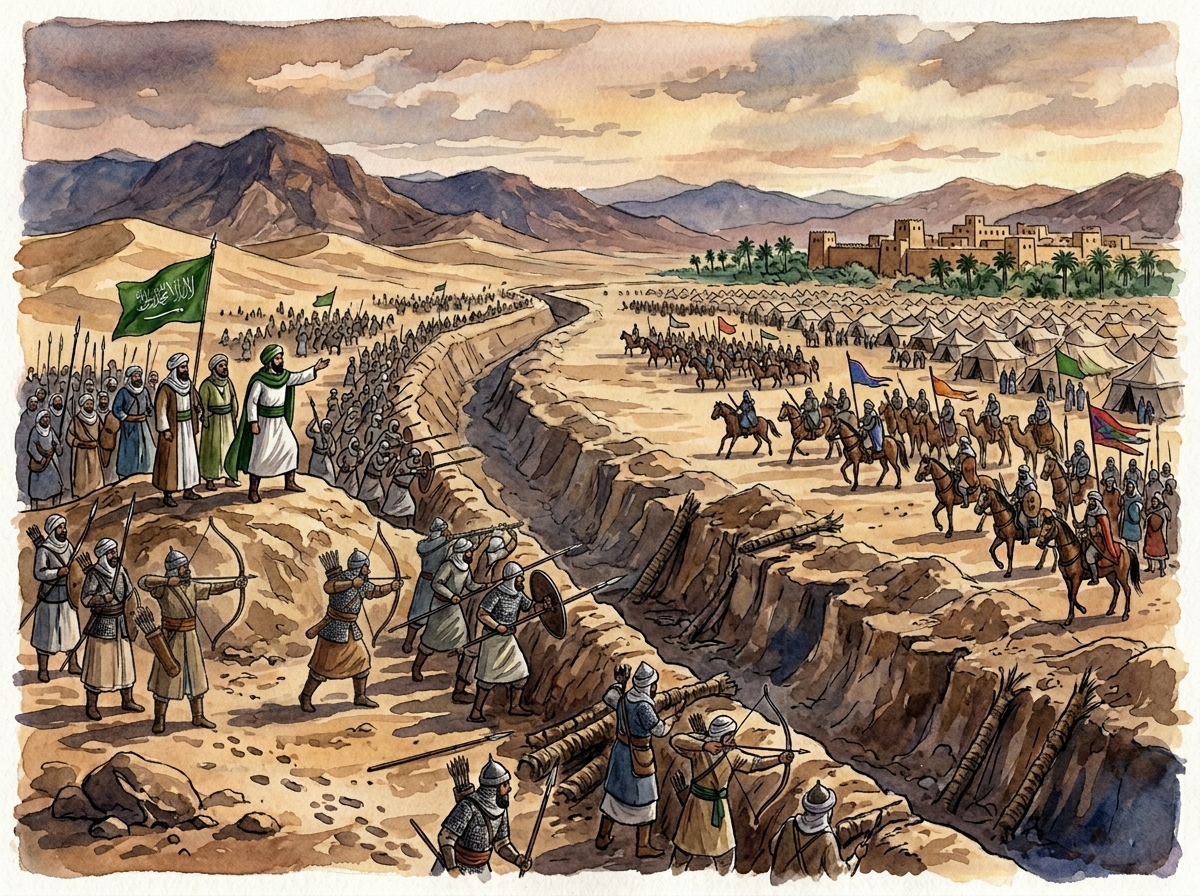
The also has the name of Ghazwatul Ahzāb.
Ahzāb are the confederates or the parties or the clans; it is translated differently but these are the two names of the battle; Al-Khandaq and Al-Ahzāb.
Jews Gather a Formidable Force
What was the reason? Ibn Is'hāq says, “What happened at Al-Khandaq was that a group of Jews brought together a coalition of clans against the Messenger of Allāh.” So this was a coalition that was pulled together by the Jews; they went to Makkah, they went to the tribes of Ghatafān, and they brought together quite a formidable army; 10,000 strong – the largest army ever assembled against Rasūlullāh ﷺ up to that point. The agreement was that Ghatafān would supply 6,000 men in exchange of the Jews paying them the entire date harvest of Khaibar for one year. So with Ghatafān, they were in it for money; mercenaries. The ones who had an intention of fighting against Muhammad ﷺ were the people of Quraish and the Yahūd, but Ghatafān were from far away and they just came in because the Jews promised them money. And the Jews would go to Makkah and the people of Makkah would ask them – because they were the learned men; you see, the Arabs used to consider that the Jews were the wise learned men because they, the Arabs, were illiterate – so Abū Sufyān and the leaders of Quraish asked, “Well you are the learned men, you are the People of the Book, so tell us, who is right, us or Muhammad? Who is on the right path?” The Jews would tell them, “You are.” Allāh ﷻ revealed: Have you not seen those who were given a portion of the Scripture, who believe in superstition and false objects of worship and say about the Disbelievers, "These are better guided than the Believers as to the way"? Those are the ones whom Allāh has cursed; and he whom Allāh curses - never will you find for him a helper. Now, one would wonder, what in the world would make the Jews claim that the Pagan Idol-Worshippers were more guided than the Muslims? The Jews have much more in common with the Muslims than they have with the Pagan Idol-Worshippers; there is nothing in common with the People of the Book and the Pagan Idol-Worshippers, but there is a lot in common between them and the Muslims, so what would make them take such a position? That would go back to the reasons that we talked about earlier, the stand that the Jews took from very early on against Rasūlullāh ﷺ for the various reasons of jealousy and hatred, etc..
News Reaches Rasūlullāh ﷺ
Rasūlullāh ﷺ was following the news, and again, we said that he had his men spread out all over, gathering intelligence for him. So the news reached Rasūlullāh ﷺ prior to them advancing towards Madīnah that a huge army is coming your way. Rasūlullāh ﷺ holds a Shūrā session, and Salmān AlFārsī has a suggestion, he said, “O Messenger of Allāh, in our land in Persia, if we feared the cavalry, we would dig a trench or a moat. O Messenger of Allāh, why do we not dig a moat or trench?” Rasūlullāh ﷺ
and the Muslims liked the idea, and the project started. Now, it would have been impossible for them to dig this moat all around Madīnah because they just did not have the manpower for that, so they had to choose the locations which were vulnerable; that location was north of Madīnah, which sounds strange because Makkah is to the south, but the thing is that Madīnah had a natural protection from the east and west, and that was what is called AlHarrah – these are tracks of volcanic rocks; very sharp, very edgy – and boulders all over, so it is difficult for an army to march through. And then from the south you have the dwellings and the farmland which also makes it difficult to penetrate, so the danger is from the north, and that is where they dug the trench.
Muslims Dig the Trench
Every 10 men were given 40 feet of land to dig, and they split into groups and they started the work. It was very difficult; the Muslims were hungry, they were poor, there was lack of food, and there was lack of numbers too to dig this trench. Anas Ibn Mālik said, “The Messenger of Allāh went out to the trench and found that the Muhājirūn and the Ansār were busy digging. It was a very cold morning and they had no slaves to do that work for them. When he saw what they were suffering from, the hard labour and their hunger, he said, ‘O Allāh, their life is indeed that of the Afterlife. Forgive the Ansār and the Muhājirūn.” They are having difficulty in Dunyā but their life does not belong to this world, it belongs to the Afterlife.
Rasūlullāh ﷺ himself participated in the digging. Al-Barā' narrates in AlBukhārī, “On the Day of Ahzāb when Rasūlullāh ﷺ was digging the trench, I saw him carrying dirt until there was so much dirt on his stomach I could not see his skin anymore.” Rasūlullāh ﷺ was right there with his followers in the field, working with them. This is the leadership example that Rasūlullāh ﷺ is giving us; he was not aloof from the people, he would not treat himself specially, he was trying to be one of them when Rasūlullāh ﷺ was the best of humanity,.
Rasūlullāh ﷺ would get so hungry that he would have to tie a stone to his stomach to suppress the hunger; to elevate the pain he would tie this rock
to his stomach – that was how difficult it was on him and how hungry he was. But his spirit was high, and he would elevate the spirits of the Sahābah and he would chant with them, so they would recite these lines of poetry, and Rasūlullāh ﷺ would go along with them and recite these words, they would say, “O Allāh! Without You we would not have been well-guided, nor would we have been charitable, nor would we have prayed, so do send tranquillity upon us and make us stand firm when we meet the foe. They have wronged us, if they want trouble, we will meet them.” And Rasūlullāh ﷺ would stretch the final words.
Rasūlullāh ﷺ Receives News of Banū Qurayzah’s Potential
Betrayal
There were guards around the clock, guarding the trench and guarding Madīnah, and the Sahābah would take turns in guarding. The difficulties were increasing rather than decreasing; you have this army coming forward made up of Quraish and Ghatafān, and then there was a very serious problem, and this could not have come at a worse time; the dwellings of Banū Qurayzah, the last Jewish tribe remaining in Madīnah, were part of the protection, were part of the plan of protection that Rasūlullāh ﷺ had for Madīnah, so their fortresses were used as a protection from the army advancing from that area. Rasūlullāh ﷺ was receiving news that Banū Qurayzah themselves were betraying their agreement with Rasūlullāh ﷺ and were going to join with the Confederates. This would have been a disaster because they were supposed to be part of the protection, so if that gate is opened, then the Muslims are going to be in serious trouble. So Rasūlullāh ﷺ sends Az-Zubair Bin Al-‘Awwām to investigate the matter. Az-Zubair Ibn Al-‘Awwām brings back information that they are bringing in their livestock and they are paving their roads, which is an indication for preparation for war. Rasūlullāh ﷺ wanted to investigate the matter further so he sends Sa’d Ibn Mu‘ādh, Sa’d Ibn ‘Ubādah, ‘Abdullāh Bin Rawāhah and Khawwāj Bin Jubair. He told them, “Go and investigate the matter and bring me news of whether Qurayzah have betrayed or broken their agreement with me. If that is the case, do not weaken the people; come and deliver the news
to me secretly. If you find that they are still up to their word and agreement and they are keeping the agreement, then make the news public.” And we learn a lesson here from Rasūlullāh ﷺ that sometimes you want to keep away some news from the people. If it is detrimental news, if it is a news that would demoralise them, if it would weaken them, it might be Maslahah to keep it away from the army; Rasūlullāh ﷺ wanted to keep it secret if that was the case, but if it is good news that they are still keeping the agreement then to make it public.
Banū Qurayzah’s Betrayal Confirmed by Sahābah Sa’d Ibn Mu‘ādh, Sa’d Ibn ‘Ubādah, ‘Abdullāh Bin Rawāhah and Khawwāj go there and they came back and they tell Rasūlullāh ﷺ two words, “‘Azl Wal Qārrah.” ‘Azl Wal Qārrah, if you remember, are the two tribes that betrayed the men whom were sent by Rasūlullāh ﷺ, the ones who betrayed the men and killed them. So this was an indication from these men that Qurayzah have broken the agreement, and Rasūlullāh ﷺ got the point and made preparations for that. Rasūlullāh ﷺ sends out two groups; one with 200 men, the other one with 300 men, as guards, and they would go around the area of Banū Qurayzah to show them that we are still here and we are still strong and we are willing to fight, so it was a show of strength. And the Muslims were able to intercept 20 camel loads of dates, figs and barley that were going towards the army of Ahzāb, and their point of origin was Banū Qurayzah. So this makes it clear that Banū Qurayzah have betrayed Rasūlullāh ﷺ, they have committed treason; they are now supplying the army of the enemy.
The Extreme Difficulty on the Muslims
So it was very difficult on the Muslims, extremely difficult, probably the most difficult situation they have been through. Allāh ﷻ describes it to us, Allāh says: Remember when they came at you from above you and from below you, and when eyes shifted in fear, and hearts reached the throats and you assumed about Allāh various assumptions. So here
the eyes were shifting in fear; you know, there was this disorientation going on. And Allāh says that the hearts reached the throats, which means that the hearts were pounding so fast it was as if you can feel it in your throat; that was how difficult the situation was. And you assumed about Allāh various assumptions. So some people were making assumptions about Allāh, like Allāh has promised us in vain, and that Allāh ﷻ will not give us victory, and that this religion is not true and we made a mistake; so all of these doubts were coming into the hearts, and obviously the ones who were having these dangerous doubts in the Religion were Al-Munāfiqūn.
Allāh ﷻ also says, and these Āyāt are from Sūrah Al-Ahzāb: And when the Believers saw the companies, they said, "This is what Allāh and His Messenger had promised us, and Allāh and His Messenger spoke the truth." And it increased them only in faith and acceptance. This was the response of the Believers. When the Believers saw all of these dangers being thrown at them, that increased their Īmān rather than decreased it, because they knew that Allāh ﷻ will test them, so they saw this as part of the test, therefore it only confirms what we already knew would happen, but with the Munāfiqīn, it made them doubt even more in the authenticity of Islām. So you can see how one event brought forth different reactions from the two camps, the Believers and the Non-Believers. You see, when it comes to fear, the fear was across the board; the Believers were afraid and the Munāfiqīn were afraid, but what is different is the reaction to that fear. You see, fear is a natural human instinct, it is natural for a human being to feel fear, Mūsā himself felt fear, Allāh ﷻ said: Fa'awjasa Fī Nafsihī Khīfatam Mūsā – And he sensed within himself apprehension, did Moses. Allāh ﷻ said that he felt fear in his heart, but the thing is, with Mūsā the fear was restricted to the heart, it did not show up in his actions; his actions were full of Īmān. So that is the difference between Al-Mu'minūn and Al-Munāfiqūn; the Munāfiqūn acted negatively upon their fear while the Believers acted positively, they said this is what Allāh ﷻ has promised us! We expected this would happen.
Ibn Is'hāq said, “Thereupon, the anxiety and fear increased. Their enemy came at them from above and below, so the Muslims were very confused. Dissension arose to the point where Mu‘attib Bin Qushail commented, ‘Muhammad used to promise us that we would eat the treasures of Qisrah and Caesar, and now we do not even feel safe going to the toilet.’” So this is an example of the response of a Munāfiq, he said what is Muhammad talking about? Rasūlullāh ﷺ – and we will talk about this – when they were digging the trench, he gave glad-tidings that this Ummah would open the Persian Empire and the Roman Empire. He Mu‘attib said, ‘What is Muhammad talking about? We cannot even feel safe going to the toilet and he is promising us that we will conquer lands thousands of kilometres away from us?!’
Allāh ﷻ Reveals Āyāt Describing Characteristics of Al-Munāfiqūn
And the Āyāt of Qur'ān described Al-Munāfiqūn, and I will go through these Āyāt because these are the characteristics of Al-Munāfiqūn yesterday and today, they do not change. Allāh ﷻ says: And when a faction of them said, "O people of Yathrib, there is no stability for you here, so return home." And a party of them asked permission of the Prophet, saying, "Indeed, our houses are unprotected," while they were not exposed. They did not intend except to flee. So the Munāfiqūn here do not want to stay next to the trench, they do not want to stay in the camp, they want to go back home and the excuse is, ‘We need to go and defend our homes.’ So they were pretending that they were going to go and fight, but Allāh ﷻ said: They did not intend except to flee. That was their intention, to run away.
And if they had been entered upon from all its surrounding regions and Fitnah had been demanded of them, they would have done it and not hesitated over it except briefly. This Āyah means that if the
Munāfiqūn are pressured a bit, they are going to give up Islām. If the enemy ask them to become Non-Muslim, they are going to do that.
And they had already promised Allāh before not to turn their backs and flee. And ever is the promise to Allāh that about which one will be questioned. Say, O Muhammad, "Never will fleeing benefit you if you should flee from death or killing; and then if you did, you would not be given enjoyment of life except for a little." In this Āyah, Allāh is saying that death is destined upon you, so running away from it would not change it a bit. Now, let us assume that it is even going to change it, how long are you going to live? Your life as a human being is very short, so what are you running away from? And then Allāh says: Say, "Who is it that can protect you from Allāh if He intends for you an ill or intends for you a mercy?" And they will not find for themselves besides Allāh any protector or any helper. The Munāfiqūn are looking for help in the wrong place, they are looking for help from the Yahūd, they are looking for help from the Kuffār; Allāh is saying only Allāh is An-Nāfi’ and Ad-Dār, only Allāh can benefit you and only Allāh can harm you. And then Allāh says: Already Allāh knows the hinderers among you and those Hypocrites who say to their brothers, "Come to us," and do not go to battle, except for a few, indisposed toward you. And when fear comes… You see, this is the reaction when in times of difficulty; what do they do? …you see them looking at you, their eyes revolving like one being overcome by death. But when fear departs, they lash you with sharp tongues, indisposed toward any good. This is a quality of Nifāq; in times of fear, their eyes are rotating, they are going around in circles because of fear, they are confused, they are afraid, but when fear goes away they are very loud, they talk a lot. And then Allāh says: Those have not believed, so Allāh has rendered their deeds worthless, and ever is that, for Allāh, easy.
not go by what people say in times of peace. You see, in times of peace, anybody and everybody can talk, but what happens in times of difficulty, in times of Fitnah? The Munāfiqūn stay quiet, they are afraid, they are terrified, but when fear goes away, they lash out at everyone, they start criticising so and so, talking against so and so. So their bravado only comes out in the wrong time.
They think the companies have not yet withdrawn. And if the companies should come again, they would wish they were in the desert among the Bedouins, inquiring from afar about your news. These Munāfiqūn, if the armies would attack Madīnah once again, they would wish that they were not in Madīnah and they were with the Bedouins watching the news on their TV sets, listening to it on their radio sets. They would wish they could hold the remote control in their hands and flip through the channels and listen to the news or watch the news about the Muslims, but they do not want to be there. And then Allāh says: And if they should be among you, they would not fight except for a little.
These are signs of Nifāq.
Muslims Suffer from Extreme Hunger
The Muslims were suffering hunger. In Al-Bukhārī, Anas Ibn Mālik said, “They would bring a handful of barley and some ill-smelling fat as a meal for them. Hungry as they were, it stuck in their throats and smelled bad.” So what was the food? Some barley, and then they had animal fat which was very old, long expired, smelled bad, it was rotten. And they would swallow it and it would stick to their throat. You know how animal fat sticks to the throat if you eat fat? Especially if it is cold, it sticks to your mouth and your teeth and your throat and all. And because it smelled bad they could still smell it, but they were so hungry that they were eating this horrible food. Al-Wāqidī describes this situation that was going on and he talks about the fear that everyone was feeling, the hunger that everyone was feeling, the low spirits, especially because of what the Munāfiqūn were doing; bombarding
the Muslims with only bad news, and then you have this disaster coming from the quarters of Banū Qurayzah, the news that they have broken their agreement with Rasūlullāh ﷺ, so it was very difficult. And the Muslims had to work day and night, Muhammad Ibn Maslamah said, “Kāna Laylunā Bil Khandaqi Nahārā – Our night during the Khandaq was daytime.”
Meaning we had to work around the clock; night was no different than day. So it was very stressful, and you know how when people are lacking, how they lose concentration and they fail to think straight. So Allāh was testing them, Allāh was testing them to the limit.
Skirmishes in the Battle of Al-Khandaq
Fighting did occur; you had duels, you had enemy trying to break through the trench from time to time. One incident that happened, a challenge to single combat, was ‘Amr Bin ‘Abd Al-Wud, and ‘Amr Bin ‘Abd Al-Wud was one of the heroes of Quraish, a strong powerful man. So he challenges the Muslims, “Send me forth one of your men.” The one who went forth was ‘Ali Ibn Abī Tālib. ‘Amr asked him, “Who are you?” He said, “I am ‘Ali.” He asked, “Ali the son of ‘Abd Al-Manāf?” He said, “No, I am ‘Ali the son of Abū Tālib.” He said, “Nephew, there are among your uncles men who are more mature than you, I feel sorry spilling your blood.” ‘Ali Ibn Abī Tālib said, “But I do not feel sorry spilling your blood.” ‘Amr Bin ‘Abd Al-Wud wanted someone more senior to come and meet him, stronger, with more experience, and he said, ‘I would not want to spill your blood my young nephew.’ ‘Ali Ibn Abī Tālib said, ‘I would be very happy to spill yours.” So ‘Amr was very upset and Ibn Is'hāq said he drew out his sword as if it was a brand of fire, and they exchange blows, and ‘Amr strikes the shield of ‘Ali Ibn Abī Tālib, and the blow was so hard that the shield ended up hitting the head of ‘Ali; that was how powerful it was, but on the other hand, because it was such a powerful blow, the sword got stuck in the shield and ‘Ali Ibn Abī Tālib struck ‘Amr in the neck, and he fell down dead, and the Sahābah made Takbīr, and that is when Rasūlullāh ﷺ knew that ‘Ali Ibn Abī Tālib won. Sa’d Ibn Abī Waqqās was a good marksman, so he had in his sights this enemy soldier who was holding two shields and was sort of teasing the
Muslims; he would move down the shield a bit so that the upper part of his head would show and then he would cover it again and then pull it down and up and down. So Sa’d aims at the man and fires his shot while the shield was down, and it hits the man right in his forehead. So the man falls down and his legs go up, and Rasūlullāh ﷺ saw that and laughed! The way the man fell down was funny, so Rasūlullāh ﷺ laughed.
Sa’d Ibn Mu‘ādh, ‘Ā'ishah said he was a tall and large man, and he was wearing armour but his arms were not covered, so ‘Ā'ishah said, “When I saw him, I was really worried about his arms.” And Subhān'Allāh, he was shot by an arrow in his arm and it cut the main vein or artery in his arm, and he was seriously injured.
So these were some of the skirmishes that happened during the Battle of AlKhandaq.
Rasūlullāh ﷺ Tries to Break the Coalition
Rasūlullāh ﷺ tried to break the coalition; that was part of his strategy. So what he did was that he tried to negotiate a deal with Ghatafān. Ghatafān are these tribe from An-Najd who came and participated in the coalition with a force of 6000. Now, the entire coalition was 10,000, so they are more than half of the entire coalition. So Rasūlullāh ﷺ was trying to work a deal with them. Rasūlullāh ﷺ met with their two leaders and he proposed to them that they withdraw from the coalition, in exchange, Rasūlullāh ﷺ is going to pay them one third of the harvest of Madīnah. They agreed and they wrote up a document, but they did not finalise it by bringing the witnesses. Rasūlullāh ﷺ calls Sa’d Bin Mu‘ādh and Sa’d Bin ‘Ubādah who are the heads of Al-Ansār, and he makes Shūrā with them, and notice here that Rasūlullāh ﷺ only made Shūrā with them, and this shows you that Shūrā is not done with everyone; Shūrā is done with the pertaining people to every situation. Now, since Rasūlullāh ﷺ is here offering one third of the harvest of Madīnah which belongs to Al-Aws Wal-Khazraj, he needs to seek their counsel, so he told them what he proposed to Ghatafān. They responded by saying, “Messenger of Allāh, is this something that you wish to do, something Allāh has ordered you to do and which we must put into
effect, or is it something you are doing for our sake?” If it is something from Allāh ﷻ, we will accept it, but if it is your opinion and you are doing it for our sake, let us know. Rasūlullāh ﷺ said, “Yes, I am doing it for your sake.” Sa’d Ibn Mu‘ādh said, “Messenger of Allāh, we used to be Disbelievers in Allāh and worshipped idols along with those people, not worshipping nor knowing Allāh. At the time, they would never have dreamed of eating a single date of ours except as our guest or after purchase. Should we give them our property now after Allāh has honoured us with Islām, led us to Him, and given us esteem through you and through Him? We will have none of this! By Allāh, all we will give them is the sword until Allāh decides between us and them.” Sa’d Ibn Mu‘ādh and Sa’d Ibn ‘Ubādah are saying that these people would not have dreamed of getting one date off us except if they would pay the price for it or if we gave it to them as our guests, and now we are just going to give it to them for free so that they leave? We do not want to have anything to do with this. Rasūlullāh ﷺ said, “As you wish.” So Sa’d Ibn Mu‘ādh took the document from Rasūlullāh ﷺ and he erased the writing from it saying, “Now let them fight us.” Now let them fight us. So brothers and sisters, again, you can see the Ansār and how they would approach matters. Rasūlullāh ﷺ was willing to negotiate this matter but the Ansār said no, we are going to fight, let us just fight. May Allāh ﷻ have His mercy on them. So this is the issue with Ghatafān. Obviously, the whole thing did not go through.
Allāh’s Help Arrives through Nu‘aim Bin Mas‘ūd Now, because the Muslims, through their Īmān, qualified in the Eyes of Allāh ﷻ for victory, Allāh was going to help them. You know, you could be at a disadvantage compared to your enemy, and from every angle you look at it, there is no way you are going to win, but because you deserve to win, since you have fulfilled the requirements of winning in the Eyes of Allāh ﷻ, Allāh ﷻ is going to find a way out for you. Wamay Yattaqillāha Yaj‘allahū Makhrajā. Wa Yarzuqhu Min Haythu Lā Yahtasib – And whoever fears Allāh - He will make for him a way out. And will provide for him from
where he does not expect. If you have Taqwā in Allāh ﷻ, Allāh will find a way out for you, and will provide you from avenues you never expected. So underline here the words you never expected; it is going to come from a place, a quarter, that you did not expect. You looked at all of the variables, you assessed the situation, there is no way you can make it, but Allāh knows what you do not know.
A man came to Rasūlullāh ﷺ, his name was Nu‘aim Bin Mas‘ūd, this man was from Ghatafān. He comes to Rasūlullāh ﷺ and says, “Messenger of Allāh, I have accepted Islām but my people do not know of this. Give me whatever orders you wish.” Here, this man comes out of nowhere and says I am a Muslim, and Subhān'Allāh! This appears to be the wrong time to become a Muslim; the Muslims are under siege, it appears that they are losing, and you want to become Muslim? Well that is because he was a soldier of Allāh; Allāh was bringing this man forward because he was one of soldiers of Allāh ﷻ. Wamā Ya’lamu Junūda Rabbika Illā Hū – And none knows the soldiers of your Lord except Him. Only Allāh knows His soldiers, we do not know them. So he comes to Rasūlullāh ﷺ and says, “Order me. Give me your orders.” The Messenger of Allāh said, “You are only one man; use trickery to relieve us of them if you can. War is deception.” Rasūlullāh ﷺ is telling Nu‘aim that if you join us, we are going to be 3001, it does not really make a difference, you are just one man, but since they do not know that you have become Muslim, go back; go back and try to weaken them because war is deception. In other words, Rasūlullāh ﷺ is saying that you can use deception if that will support the cause of relieving us of them.
Nu‘aim left and he went to the Jews of Banū Qurayzah. Now, the thing here with Nu‘aim is that he had good relations with the Jews, good relations with Quraish, and since he was from Ghatafān he had good relations with his people. Nu‘aim Bin Mas‘ūd was a well-known man, a trusted man, so he went to Banū Qurayzah and he told them, “You know me
and I know you, and you know our friendship and you know that I would only give you a sincere advice. What you have done is wrong. You have decided to fight against Muhammad ﷺ but you are living in Madīnah, your women and children and property are here, while Quraish and Ghatafān are coming over to fight but their women, children and property are somewhere else. Now, Quraish and Ghatafān are going to try and seize the opportunity to defeat Muhammad ﷺ, but if that opportunity does not arise, they are going to pack up and leave, and you know what will happen if they leave; Muhammad ﷺ will attack you first since you are right there with him in Madīnah, and you know that you cannot face off alone against Muhammad ﷺ. “They said, “Well, what you are saying is true, what shall we do?” He said, “You want to make sure that Quraish and Ghatafān are willing to fight until the end, until you achieve the objective, not just try to win and if it does not work out then they leave; no, you want to make sure that they will stay behind and fight with you and not betray you and leave.” They said, “Alright, well tell us how we can guarantee that.” He said, “Ask them to leave some of their men with you as assurance,” meaning you take some of their men as hostages. And this was a practice that existed in those days; you could borrow money and then you could leave your child as a security, so it was not something that strange, it did exist in those days. So Nu‘aim here is saying, “Ask them to hand over some of their men, both from Quraish and from Ghatafān, and hold them with you as an assurance, as a guarantee, that they are going to fight until the end.” They said, “That is a good idea. We agree, we will do that.”
Now Nu‘aim leaves the Jews and he goes to Quraish and he tells them, “You know how close our friendship is and you understand that I would be sincere in my advice to you and I would only tell you the truth. I have come here because I have something to disclose to you, and I want you to keep this information classified.” They said, “Yes Nu‘aim, we trust you and we know that, go ahead.” He said, “The Jews have regretted the fact that they have abrogated their agreement with Muhammad ﷺ, and now they are involved in negotiations with him to bring back the agreement. And they have offered Muhammad to hand over some of your men to him to be executed as a sign
of their sincerity and repentance of their deed.” So Nu‘aim is here telling Quraish that the Jews are sorry that they have broken their agreement with Rasūlullāh ﷺ and they are willing to make that up by handing over some of your men to him, so if the Jews come to you asking for hostages, do not give them any. And then he went to Ghatafān and tells them the exact same thing.
Now, the siege was taking a long time and Quraish were getting fed up. Now remember, Quraish did not come to Madīnah to lay siege to it, they came in to fight, and they were surprised to find this moat in front of them, the trench. So they did not come in with supplies to last for a siege, they came in for a fast battle, get it over with and leave, so they were not prepared to wait for a long time. So ‘Ikrimah Bin Abī Jahl was sent to head a delegation to go and meet with the Jews of Banū Qurayzah. He went to them and said, “We are getting tired of this long siege, our camels and horses are dying and we want to wage an all-out war on Muhammad, so get yourselves ready and we shall attack today.” The Jews said, “No, you know that we do not fight in the Sabbath, and some of our people who did fight in the Sabbath, this and this happened to them.” They went on talking about the history of staying away from fighting on the Sabbath, and then they said, “And we are worried that you might not stay the course, and to ensure that you are willing to fight until the end, we want you to hand over some of your men as a guarantee.” ‘Ikrimah goes back and conveys this information to Abū Sufyān. Abū Sufyān said, “This is it! This is what Nu‘aim told us, that the Jews have betrayed us and they want to hand over our men to Muhammad ﷺ. “So Abū Sufyān answers back and said, “We are not going to hand over even one man, not one single person.” The Jews said, “This is exactly what Nu‘aim told us, these men are not serious and they are going to leave us alone to suffer the attacks of Muhammad ﷺ. “And the same thing happened with Ghatafān, and therefore one man, one single man, was successful in breaking up this coalition. The coalition that was brought together by the Yahūd, headed by Huyaÿ Ibn Akhtab, was now broken through one of many soldiers of Allāh ﷻ. And as I said, this help appears as if it came out of nowhere, but it was part of the Qadr of Allāh ﷻ because the
Muslims have passed the test. The Muslims have passed the test of Īmān, of perseverance, of endurance, patience, trust in Allāh ﷻ. Since they had passed all of these requirements, now Allāh ﷻ is going to find a way out for them. Just like when Mūsā and Banū Isrāīl were faced with the sea in front of them and Fir‘aun from behind them, it was a test for them to see if they believe in the promise of Allāh ﷻ that He will save them and protect them or not; many of them failed, some of them did pass, and after the test was over that is when Allāh ﷻ told Mūsā all you have to do is strike the sea with your stick and it will split, so the whole thing was a test. Nu‘aim Ibn Mas‘ūd, single-handedly, brought an end to this coalition.
Lessons from Incidences of Ghatafān and Nu‘aim Bin Mas‘ūd
Study and Know the Enemy and their Objectives
Rasūlullāh ﷺ negotiated with Ghatafān because they were there only for financial gain, but the Jews and Quraish were fighting a war of ‘Aqīdah, their objective was to bring down Islām from its foundations, and therefore he did not even attempt to negotiate with them. So you need to know the objectives of your enemy; is the enemy fighting because of ‘Aqīdah or is the enemy fighting for another reason, or is it a combination of both? You see, with Ghatafān, they were drawn into this because they are going to make money, and if they can make money off Muhammad then so be it, we will leave, and they agreed, but Rasūlullāh ﷺ never attempted to do that with the Jews or with Quraish because they were fighting from the standpoint of ‘Aqīdah. Quraish were fighting to defend their religion and to take revenge of those men from Quraish who became Muslim, and the Jews were also fighting from an ‘Aqīdah point of view. So it is important to know and to try to study the enemy.
Do Not Make Enemies – Neutralise them The Second Lesson: Rasūlullāh ﷺ told Sa’d Bin ‘Ubādah and Sa’d Bin Mu‘ādh that the reason why he was making this offer was because he saw that the Arabs are ‘as if they are shooting you from one single bow.’ Meaning that they have unified against you and I want to break up that coalition. Innī Ra'aytul ‘Araba Ramatkum An Qawsin Wāhidah. So the lesson here is that the Muslim leader needs to have Hikmah, and if it is possible to neutralise a particular party and some of the enemies of Islām rather than have them all face at once, that can be part of the strategy. And the Muslims should not try to make enemies, but they should try to neutralise the enemy as long as this is done without giving up some of our principles. Why fight everybody at once? That was where Rasūlullāh ﷺ was coming from, he was trying to break up this coalition; Ghatafān, we can deal with them later, let us deal with the priority now which is Quraish and Al-Yahūd. Now, one can argue that this was before the ruling of Allāh: Wa Qātilul Mushrikīna Kāffah – And fight against the Disbelievers collectively, but even then, if the Muslims do not have the capability of doing that, they can strategise and rank them according to how dangerous they are as enemies of Allāh ﷻ.
The Leader Should Put the Right Person in the Right Place to do the
Right Thing
Next Lesson: The leader should have the capability of taking advantage of the abilities of his soldiers. So Rasūlullāh ﷺ here did not invite Nu‘aim to come over and just give him a sword and give him a spear and tell him, ‘Well, go and fight.’ No, Rasūlullāh ﷺ knew where to use Nu‘aim Bin Mas‘ūd. So the leader needs to know the qualities of his followers and put each person in the right place; put the right person in the right place to do the right thing.
Du‘ā' – A Powerful Weapon Rasūlullāh ﷺ was using a powerful weapon against the enemies of Allāh ﷻ, and that is Du‘ā'. Rasūlullāh ﷺ was saying, “O Allāh! Revealer of the Book, quick to take account, defeat the clans. O Allāh! Defeat them and shake them!” And Allāh ﷻ accepted the Du‘ā' of Rasūlullāh ﷺ and He assisted the Muslims with soldiers they did not see. Allāh ﷻ says: O you who have believed, remember the favour of Allāh upon you when armies came to attack you and We sent upon them a wind and armies of angels you did not see... Allāh sent armies that they did not see; the Malāikah and wind were all armies sent by Allāh ﷻ, and we will talk about wind later on in the story of Hudhaifah. …And ever is Allāh, of what you do, Seeing. So Allāh ﷻ is now sending soldiers from His armies to defend the Muslims.
The Muslims, by the way, also had a battle-cry in Khandaq, and that was, “Hāmīm Lā Yunsarūn! – They will not be victorious! They will not be victorious!”
Hudhaifah Bin Al-Yamān
The story of Hudhaifah, and I will read to you two narrations, one is narration of Ahmad and the other one is narration of Muslim. In the narration of Ahmad, which is a bit more detailed, it says that a man from Kūfah asked Hudhaifah Bin Al-Yamān, “Have you actually seen the Messenger of Allāh, and were you really a Companion of his?” So this happened in the time of At-Tābi‘īn. Hudhaifah said, “Oh yes nephew.” The Tābi‘ī asked, “And how did you get by?” How did you treat him? How did you deal with him? Hudhaifah said, “It was difficult for us, I swear by Allāh, but we tried our best.” This Tābi‘ī said, “I swear, if we had lived at his time, we would never have let his foot so much as touch the ground, we would
have carried him on our shoulders.” This Tābi‘ī heard stories about how the Sahābah were with Rasūlullāh ﷺ and he felt that if Rasūlullāh ﷺ came in their time they would have treated him much better than the Sahābah, he said we would have carried him on our shoulders, we would not even let his feet touch the ground. Now, Hudhaifah wants to teach this man a lesson and make him understand that it is easier said than done. You know, yes, now because we brought Islām to you – it was the Sahābah who brought it to AtTābi‘īn – now because Islām was brought to you and you understand how great Rasūlullāh ﷺ is and you see the fruits of his mission and you see the Khilāfah that he established, now you say, ‘Well, if we were living then we would have done so and so,’ but this Tābi‘ī does not understand that these were men who were living with Rasūlullāh ﷺ and they had to fight their fathers, they had to fight their brothers, they had to fight their clans, they had to give up their wealth, they had to sacrifice their lives, so it was not easy. Yes, it is easy now to say that we would have carried Rasūlullāh ﷺ on our shoulders, but if you were there you would have maybe acted differently. So Hudhaifah wants to give him an example of how the situation was, and how difficult it was, he is telling him about the reality, he said, “Nephew, I swear I see us now with the Messenger of Allāh at Al-Khandaq, and after he had prayed for a part of the night, he turned to us and asked, ‘Who will volunteer to go and see what the enemy is doing and then come back?’ The Messenger of Allāh stipulated that if the volunteer would come back, he would ask Allāh that the man be his Companion in Paradise, but so severe was the fear, cold and hunger, that not one person volunteered.” Rasūlullāh ﷺ is asking for a volunteer, and this volunteer will be with him in Jannah, all what you have to do is go and visit the camp of the enemy and come back. Hudhaifah said none of us stood up, none of us volunteered; why? Because we were so terrified, it was cold, we were so hungry, and when you are in a situation like that you cannot think straight, so none of us stood up. He then said, “Since no one had risen, he called upon me, and once he had done so I had no alternative but to do so.” So now Rasūlullāh ﷺ is not asking for a volunteer, he said, ‘Hudhaifah, you go.’ “He then told me, ‘Hudhaifah, go and infiltrate the enemy, go and see what they are doing, but
do not cause any trouble, then return to us.’” Hudhaifah said, “So I did. The gale and Allāh’s soldiers were greatly damaging them, leaving them no fire nor pots nor tents upright.” The wind was so strong it was blowing everything. “Abū Sufyān arose and said, ‘Quraish, every man check out the person sitting next to him.’” Abū Sufyān was worried that in such a condition where the wind is blowing so fiercely, the enemy could possibly try to infiltrate us, so Abū Sufyān said, “Let everyone check the person next to him.” Hudaifah said, “At this, I took the hand of the man next to me and asked him his name.”
So Hudhaifah acted very quickly; rather than have somebody ask him, he asked the man next to him – a very smart move, it saved him his life. “He told me who he was. Abū Sufyān then said, ‘We are not in a permanent camp, our horses and camels are dying, and Banū Qurayzah are at odds with us, and we have heard things about them that we do not like. You can see what we have lost due to the gale, how our cooking pots will not stand upright, and we cannot keep fires burning and our tents standing; you should leave as I am about to do.” That was it, they were giving up. “He then went to his camel which was hobbled, mounted it, struck it so that it arose on three legs since he only un-hobbled it when it was standing. If it had not been for the promise that the Messenger of Allāh made me make not to cause trouble, I could have shot him with an arrow.” Because remember Rasūlullāh ﷺ told him, ‘Do not cause any trouble; just go, gather information and come back.’ Hudhaifah went on, “So I returned to the Messenger of Allāh and found him standing in Prayer shrouded in a wrap belonging to one of his wives. When he saw me, he asked me to come in to sit at his feet and threw an end of the wrap over me. He then bowed and prostrated while I was under it. When he was finished, I related the news to him. When Ghatafān heard what Quraish had done, they hurried off home.” So now everyone left. This is the narration of Ahmad.
In the narration of Muslim, it is narrated by Yazīd At-Taymī from his father who said, “We were with Hudhaifah when a man told him, ‘If I had been alive with the Messenger of Allāh, I would have fought alongside him heroically. So Hudhaifah said, ‘Would you indeed? Is that the case, now
claiming that you would have fought fiercely with Rasūlullāh ﷺ ‘?And then Hudhaifah told him, ‘Once we were there at the Battle of Al-Ahzāb with Rasūlullāh ﷺ. It was night time and there was a fierce cold gale blowing. He asked us, ‘Is there no man who will bring me the news of the enemy and be with me at Judgement Day?’ When none of us responded, he asked the same question a second and a third time. Then he said, ‘Hudhaifah, you go and bring us news of the enemy.’ Since he had called upon me by name, I had no alternative but to get up. He then said, ‘Bring me news of them without giving them any cause for alarm about me.’ So I left and made my way to them, feeling as if I was walking through a public bath (meaning he was feeling hot). I found Abū Sufyān there warming his back to the fire. I placed an arrow in the centre of my bow and was about to release it when I remembered how Rasūlullāh ﷺ had told me not to give them any alarm about it. If I had shot it, I would have hit him. I then left to return to Rasūlullāh ﷺ, and again, the feeling of walking in a bath overcame me. When I arrived back, I felt very cold and chilled once again. I told this to him and he put over me part of the cloak he was wearing as he prayed. He slept right on through till morning, when he spoke to me saying, ‘Up you get sleepy head.’’”
So Hudhaifah here is telling this man that this was our situation, so you need to ask yourself whether you would have fought alongside Rasūlullāh ﷺ heroically. Now you are saying that, years later; only Allāh ﷻ would know what would happen if you were there at that difficult moment, whether you would have been with the Munāfiqīn or with the Mu'minīn. So we should try to avoid making all these big claims of what we can do and how we are going to give victory to Islām – just do it, do not talk about, do it. That is our problem today; everyone is proposing a solution, everyone is saying that I am going to do this and do that for the Religion, and nothing gets done. Now Ghatafān and Quraish just left; that was it. Rasūlullāh ﷺ wakes up next day in the morning and takes a look at the empty campground; no one is left. Quraish and Ghatafān have left as if there was no Ahzāb, so Rasūlullāh ﷺ said, “Lā Ilāha Illallāh, Wahdah, Sadaqa Wa’dah, Wa Nasara ‘Abdah, Wa Hazamal Ahzāba Wahdah – There is no one worthy of
worship except Allāh, His promise came true, and He gave victory to His servant, and He defeated the coalition alone.” It was Allāh who defeated the coalition, and He did it alone.
Miracles in Ghazwat Al-Khandaq
We have been talking about miracles in the Ghazawāt, what are the miracles that happened in Ghazwat Al-Khandaq?
Increasing of Food
When the Muslims were digging the trench, Jābir Ibn ‘Abdillāh saw the condition of Rasūlullāh ﷺ;people were tying one stone to their stomachs and he had two stones tied to his stomach, so he goes back to his wife and he tells her, “I have seen Rasūlullāh ﷺ in an intolerable condition. Do you have any food for him?” She said, “All what I have is some barley and a small goat.” Jābir goes and slaughters the goat and he tells his wife to prepare some dough for baking bread, and while the meat was cooking and she was baking the bread, he goes to Rasūlullāh ﷺ and tells him, “I have some food for you, so you can come along with one or two of your Companions.” Rasūlullāh ﷺ asked him, “How much food do you have?” He told him how much he had. Rasūlullāh ﷺ said, “Oh, that is plenty. Tell your wife not to move the soup (the meat was cooked with soup) from its place until I come.” And then Rasūlullāh ﷺ stands up, and to the amazement of Jābir, Rasūlullāh ﷺ said, “O Muhājirūn! O Ansār! Jābir has prepared some food for you.” Jābir has told Rasūlullāh ﷺ to come along with one or two people, and Rasūlullāh ﷺ has invited the entire camp! All of you are invited to Jābir’s house. So Jābir runs back home very embarrassed; what in the world are we going to do? And you know when you invite people and there is not enough food, that is very embarrassing. So he goes to his wife and tells her, “You know what, Rasūlullāh ﷺ is coming along with all of Ahlul Khandaq; everyone is coming!” He was worried. So she said. “Did he ask you how much food we have?” He said, “Yes.” “And you had told him?” He said, “Yes.” She said, “Allāh and His Messenger know best.” Jābir said, “Those words comforted me.” He knows best; you already told him how much food you have.
Rasūlullāh ﷺ comes in, and he would pour the soup and the meat, and then he would crush bread over it, so he was doing the dishing. And he told the Sahābah to come in and not crowd each other, to come in in groups because they were very hungry and you could have a stampede, so Rasūlullāh ﷺ told them to slow down and to come in in groups. They would come in in groups of 10; Rasūlullāh ﷺ would prepare the food for them and bring it to them, they would eat and then they would leave. Another 10 would come in; Rasūlullāh ﷺ would prepare the meal for them and so on and so forth. In one narration it says that 800 people ate from that meal, and when they were done, Rasūlullāh ﷺ went back and the pot was full as it was and the bread was still baking in the oven, so Rasūlullāh ﷺ told the wife of Jābir to feed her neighbours. This was a miracle of Rasūlullāh ﷺ –increasing the food, Takthīrut Ta‘ām.
Rasūlullāh ﷺ Receives Glad-tidings Another miracle: when they were digging the trench, a boulder stood in their way and they could not move it or break it, in fact it was breaking their axes, so they came to Rasūlullāh ﷺ and told him about it. Rasūlullāh ﷺ went there, grabbed an axe and said “Bismillāh” and struck it. A lightning came out and Rasūlullāh ﷺ said, “Allāhu Akbar!” He then struck it again; light came out and he said, “Allāhu Akbar!” He struck it a third time and then it disintegrated into dust and Rasūlullāh ﷺ said, “Allāhu Akbar!” So Salmān asked him, “O Messenger of Allāh, why were you saying Allāhu Akbar and what was that light coming out like lightning from this boulder?” Rasūlullāh ﷺ said, “The first time I struck it, I was given the glad-tidings of conquering the Roman Empire, and I could see the red palaces of Syria from right here. The second time I said Allāhu Akbar, I was given the glad-tidings of conquering the Persian Empire, and I was able to see its white palace from right here. And the third time I said Allāhu Akbar, I was given the glad-tidings of conquering Yemen, and I was able to see the gates of San‘ā' from right here.” Now, notice here that Rasūlullāh ﷺ is giving them these glad-tidings in the worst of times, when the morale was low, when you look around you and all what you see is defeat, when you are besieged; but that is
the whole point of giving a glad-tiding, that is when glad-tidings should be given, it is when you are weak, when you are almost going to give up. So now if the Ummah is weak, divided, defeated, we should give the gladtidings that Rasūlullāh ﷺ has given us. Rasūlullāh ﷺ said, “Sayablughu Hādhad Din Mā Balaghal Laylu Wan Nahār – This Religion will reach as far as night and day can reach. Allāh has shown me the entire earth and He told me that the kingdom of my nation will reach all of it.” So victory belongs to this Ummah, and it is coming.
Rasūlullāh ﷺ Predicts ‘Ammār’s Death Rasūlullāh ﷺ saw ‘Ammār Bin Yāsir working hard and he told him, “Yā ‘Ammār, Taqtulukal Fi'atul Bāghiyah – Yā ‘Ammār, you will be killed by the aggressing party.” That is all; you will be killed by the aggressing party. ‘Ammār lives through the time of Rasūlullāh ﷺ, lives through the era of Abū Bakr, ‘Umar, ‘Uthmān, and then in the time of ‘Ali he joins in the army of ‘Ali and was killed by the army of Mu‘āwiyah. So this Hadīth tells us that the party of ‘Ali was right while the party of Mu‘āwiyah was wrong, and this was news of Al-Ghaib that Rasūlullāh ﷺ was given by Allāh ﷻ, and he was told that ‘Ammār will be killed by the aggressing party. Now, both of them are Muslim parties, but one of them was right and one of them was wrong.
Lessons from Story of Hudhaifah
Let us talk briefly about lessons from the story of Hudhaifah which we just mentioned.
Discipline
First of all: The discipline. It is very important for the Muslim who is working in a Jamā‘ah to have discipline. Rasūlullāh ﷺ told him, “Do not cause any trouble.” So even though Hudhaifah had Abū Sufyān in his sights
and he could have shot him and killed him, he stopped because of the order of Rasūlullāh ﷺ –that is discipline.
Karāmah of Not Feeling the Cold
Number Two: He did not feel cold throughout this journey, and that is a Karāmah.
Fast Response
Number Three: His fast response. As soon as Abū Sufyān said that everyone should check out the man next to him, Hudhaifah was the one who took the initiative and did that.
Difference between Theory and Reality
Finally, the difference between theory and reality. You know, that Tābi‘ī was talking about theory while Hudhaifah was talking about reality, and there is a difference between the two. So do not assume things until they happen, and do not have too much confidence in yourself and in your Īmān until you are tested, because one cannot know the results until after the exam is given.
Lessons from Ghazwat Al-Khandaq
Lesson One: Allying of Jews with Al-Mushrikīn against Muslims is
Contradictory but Expected
Lesson One: For the Jews to ally themselves with the Mushrikīn against the Muslims is contradictory. Why would they ally themselves with AlMushrikīn when they are closer in terms of similarity of religion to the Muslims? But even though it is contradicting, we should not be surprised, and that is still repeating until this day. Contradicting theories or political views will come together to fight the Religion of Truth. Can you not see today that the West, the democratic West, the West of the human rights, the West that claims to be fighting for the sake of spreading democracy, is allying itself with the most autocratic and oppressive regimes on the face of
the earth?! For the sake of what? For the sake of fighting Islām. So one should not be surprised.
Lesson Two: Make Use of the Available Technology
Lesson Two: A Muslim should make use of available technology.
Rasūlullāh ﷺ approved the idea of Salmān Al-Fārsī bringing in a foreign idea, an idea that belonged to Kuffār – it belonged to the Persians – but since it is not in an issue of religion and it is a matter of strategy, Rasūlullāh ﷺ adopted that idea which was novel to Arab warfare.
Lesson Three: Example of Leadership Given by Rasūlullāh ﷺ
Lesson Three: The example of leadership given by Rasūlullāh ﷺ. He was digging the trench with them; not for the sake of bringing the TV cameras to show the leader as part of the people and make a big political propaganda out of it; no, Rasūlullāh ﷺ was doing it sincerely and to give us the example of how a leader should act. He goes hungry like they did, and when he finds food, he shares it with them; he did not just invite the one and two that Jābir said, but he invited the whole camp to go and eat with him.
Lesson Four: Rasūlullāh ﷺ Raising Morale through Nashīd
Lesson Four: He was raising the morale through Nashīd, they were chanting those words of poetry to raise up the spirit. So the leader should have the highest spirit among the group because he is the person whom the followers take refuge in when things get tough, so if they find that the leader is weak and the leader has already given up, they will do the same.
Lesson Five: Rasūlullāh ﷺ was Optimistic Even after News of Qurayzah’s Treachery Lesson Five: The reaction of Rasūlullāh ﷺ to the news of Qurayzah’s treachery. We talked about when he sent out Sa’d Bin Mu‘ādh, Sa’d Bin ‘Ubādah and ‘Abdullāh Bin Rawāhah to go and check out if Qurayzah have broken their agreement with Rasūlullāh ﷺ, and he told him, “If you find that to be the case, then hint it to me without letting the people know; do not
weaken their morale.” Now, when the news was delivered to Rasūlullāh ﷺ, he said, “Abshirū – Receive the glad-tidings.” So Rasūlullāh ﷺ was optimistic even at that moment, and this would give confidence to the Sahābah.
Lesson Six: Difficult Times Show what is in the Hearts of Men Lesson Six: Difficult times show what is in the hearts of men. Talking about Al-Khandaq, Ibn Is'hāq said, “When conditions worsened, so did the attitude of many people and they began saying ugly things.” So the attitude changed under the stress and they started saying ugly things, in terms of ugly things in ‘Aqīdah, ugly things about Islām, ugly things that showed weakness in the personality, weakness in the trust in Allāh ﷻ. So one needs to prepare themselves for difficult situations; do not go by your conduct in times of ease, but you need to prepare yourselves for times of difficulty, because that is when the truth comes out.
Āyāt Regarding Al-Mu'minīn We talked about the Munāfiqīn and we recited the Āyāt relating to the Munāfiqīn; what about the Mu'minīn? What about the Believers? What did Allāh say about them in the context of Al-Ahzāb? Allāh ﷻ says, and these Āyāt are in Sūrah Al-Ahzāb which is the Sūrah named after The Coalition – Al-Ahzāb, Allāh ﷻ said: There has certainly been for you in the Messenger of Allāh an excellent pattern for anyone whose hope is in Allāh and the Last Day and who remembers Allāh often. And when the Believers saw the companies, they said, "This is what Allāh and His Messenger had promised us, and Allāh and His Messenger spoke the truth." And it increased them only in Faith and acceptance. Among the Believers are men true to what they promised Allāh. Among them is he who has fulfilled his vow to the death, and among them is he who awaits his chance. And they did not alter the terms of their commitment
by any alteration - That Allāh may reward the truthful for their truth and punish the Hypocrites if He wills or accept their repentance. Indeed, Allāh is ever Forgiving and Merciful.
There has certainly been for you in the Messenger of Allāh an excellent pattern for anyone whose hope is in Allāh and the Last Day and who remembers Allāh often.
What was the context of this Āyah? You see, this Āyah is saying: Laqad Kāna Lakum Fī Rasūlillahi Uswatun Hasanah – You have a good pattern of conduct in Rasūlullāh ﷺ for you to emulate, for you to imitate in your lives. So this Āyah is asking us to follow the Sunnah, this is the Āyah in Qur'ān that tells us to follow the Sunnah; we have an example in Rasūlullāh ﷺ – follow it. Now, was this Āyah revealed because one of the Muslims did not use the Miswāk? Was this Āyah revealed because one of the Muslims did not have their thobe above the ankle? Was this Āyah revealed because one of the Muslims did not grow a beard? All of this is part of Sunnah, but was this the reason why the Āyah was revealed? The reason why the Āyah was revealed according to Ibn Jarīr At-Tabarī is because Allāh was reprimanding the Believers who stayed behind and did not go and join the camp that was right next to the trench, so Allāh was telling them, ‘You should follow the Sunnah of Rasūlullāh ﷺ and go and be with him.’ And Ibn Abī Hātim narrates that As-Suddī said – Suddī being one of the Mufassirīn – he said that it means here Muwāsāf Al-Qitāl – you should be standing next to him in fighting, in Qitāl. This was the context in which the Āyah was revealed. So nowadays it is unfortunate to hear people talk about Sunnah but they completely neglect the issue of Jihād Fee Sabeelillāh as being part of the Sunnah of Rasūlullāh ﷺ. We should not over-emphasise some parts of Sunnah and neglect others; Sunnah should be taken as a whole package. And then we prioritise among the Sunnah; so we say all is important, but some are more important than others, and since the Āyah was revealed in this context, definitely this will be the most important Sunnah of all. The next Āyah:
And when the Believers saw the companies, they said, "This is what Allāh and His Messenger had promised us, and Allāh and His Messenger spoke the truth."
You see, when the Munāfiqīn saw the coalition, they said, ‘Allāh has lied to us, Rasūlullāh ﷺ has lied to us, he is telling us that we are going to conquer the Persian Empire and the Roman Empire and we cannot even feel safe going to the toilet.’ So they were having doubts in the promise of Allāh. What was the reaction of the Believers? They said, ‘This is exactly what Allāh and His Messenger promised us.’ What does this mean? Allāh says in Sūrah Al-Baqarah: Or do you think that you will enter Paradise while such trial has not yet come to you as came to those who passed on before you? They were touched by poverty and hardship and were shaken until even their Messenger and those who believed with him said, "When is the help of Allāh?" Unquestionably, the help of Allāh is near.So it tests them to the limit until they start asking, ‘O Allāh, when are you going to give us victory?’ So the Sahābah said, ‘This is what Allāh promised us; Allāh spoke about this in Sūrah Al-Baqarah and here it is happening, it is happening just as we were promised.’ So it only added to their Īmān, because they saw the promise of Allāh being fulfilled in front of their eyes. So you can see how the same event brought forth a different reaction from the Believers and a different reaction from the Munāfiqūn, and it increased them only in Faith and acceptance.
So this was the reaction of Al-Mu'minūn. Inshā'Allāhu Ta‘ālā we will now talk about Ghazwat Banū Qurayzah, and that should be our final talk in this series of lectures on the Seerah of Rasūlullāh ﷺ