Important Events
Marriages of Rasūlullāh ﷺ and Khadījah
the next important event is the marriage of Rasūlullāh ﷺ to Khadījah. Khadījah was a well-known and prosperous woman in Makkah, she was wealthy. She was not married, she was old in age, and she used to hire a man to travel for her and do business, because the trade of the people of Makkah used to be based on travelling to Yemen and Syria, Ash-Shām, Allāh ﷻ describes that in Sūrah Quraish: For the accustomed security of the Quraysh - Their accustomed security in the caravan of winter and summer. Let them worship the Lord of this House, Who has fed them, saving them from hunger and made them
safe, saving them from fear. They had a journey of winter and a journey of summer; one to Yemen and one to Ash-Shām.
Khadījah Hires Rasūlullāh ﷺ
So Khadījah would hire men to work for her and take care of her business. She happened to hire Muhammad; she heard about his honesty and she was running into trouble with a lot of men who were not being honest, so she wanted to hire someone who was trustworthy. She heard about Muhammad ﷺ so she hired him, and she had her servant accompany Muhammad ﷺ, her servant’s name was Maisarah. Muhammad ﷺ went to Ash-Shām, did business for her, came back, and Maisarah reported back to his master. Maisarah went to Khadījah and told her, “This man’s trustworthiness and honesty is amazing, it is outstanding,” and he was praising Muhammad ﷺ.
Rasūlullāh ﷺ Marries Khadījah
Well, Khadījah became very interested in Muhammad; his character was admirable. Khadījah, who was a wealthy woman, who was sought after by the noble men of Quraish, she said, “I want to marry you,” and Rasūlullāh ﷺ agreed. Rasūlullāh ﷺ was 25 and she was 40, the difference was 15 years; she was his senior. And Rasūlullāh ﷺ never married anyone else before Khadījah passed away. All of the surviving children of Rasūlullāh ﷺ were from Khadījah; Fātimah was the daughter of Khadījah, she bore six children for him; Zainab, Ruqayyah, Umm Kulthūm, Fātimah, Al-Qāsim and ‘Abdullāh. And none of them ended up having descendants except Fātimah, and that is where the lineage of Rasūlullāh ﷺ is continuing; through the descendants of Fātimah and ‘Alï. Rasūlullāh ﷺ’s Love for Khadījah Rasūlullāh ﷺ loved Khadījah so much, and Rasūlullāh ﷺ kept his loyalty to Khadījah even after she passed away; he would always remember her, always mention her name, and that sometimes would cause jealousy among
the other wives of Rasūlullāh ﷺ. But Rasūlullāh ﷺ had so much love and admiration for Khadījah and so much respect for her because Khadījah is the one who stood up for him and supported him when everybody else betrayed Muhammad ﷺ. ‘Ā'ishah, who was the most beloved to Rasūlullāh ﷺ after that, she would sometimes feel this jealousy. In Sahīh Muslim it says that ‘Ā'ishah said, “I did not become jealous of any of the wives of the Prophet ﷺ except Khadījah, and I have not seen her. The Messenger of Allāh ﷻ used to at times slaughter a sheep and say, ‘Send it to the friends of Khadījah.’” So not only did Rasūlullāh ﷺ always remember her, he kept on maintaining a relationship with the friends of Khadījah. ‘Ā'ishah continues, “And one day I angered him by replying out of jealousy of Khadījah, so he said, ‘I have been given by Allāh her love.’” Once he mentioned the name of Khadījah, so ‘Ā'ishah was upset, Rasūlullāh ﷺ responded and said that this is something from Allāh, I was given her love, it is not something that I control; Allāh has put her love in my heart.
In another Hadīth narrated by Ahmad and At-Tirmidhī, ‘Ā'ishah said, “The Messenger of Allāh used to, at many times, not leave his home without praising Khadījah.” This is amazing, how much love Rasūlullāh ﷺ had for her. “One of the days he praised her, and out of jealousy I said, ‘Was she not but an elder woman that Allāh has replaced her for you with what is better?’ He became angered and said, ‘No! By Allāh, He did not replace me with anyone better, for she had faith in me when the people rejected, she believed me when the people belied me, she made comfortable with what she had when the people denied me, and Allāh has blessed me with children from her.’” So Rasūlullāh ﷺ would become angry when he would hear anything against Khadījah. And this shows us an aspect of the personality of Rasūlullāh ﷺ; his loyalty to the people who were close to him. This was years after Khadījah passed away; opportunist people take advantage of a person, and whenever that person is gone, that is the end of the relationship. Rasūlullāh ﷺ would always remember his old friends, old relatives; Hamzah Bin ‘Abdul Muttalib, Khadījah, Mus‘ab Bin ‘Umair. In fact, Subhān'Allāh, one amazing thing that brings a person to tears is that before
Rasūlullāh ﷺ passed away, one of the last things he did was to go and visit the cemetery of his friends who died in the Battle of Uhud. The 70 Companions who died in the Battle of Uhud, when Rasūlullāh ﷺ felt that he would be leaving Dunyā soon, he went to the cemetery and made Du‘ā' for them, and he was saying in that Du‘ā' that soon we will meet. Rasūlullāh ﷺ was missing them so much, and was asking Allāh ﷻ to bring him with them and to join them together in Jannah.
So Rasūlullāh ﷺ had this strong relationship with his Sahabah and loyalty, and he never forgot his wife Khadījah who stood with him in moments of difficulty, he never forgot that, and he would continuously make Du‘ā' for her and mention her name. And Khadījah was a special person; Khadījah, when she was living, Jibrīl descended on Muhammad ﷺ and said, “Khadījah is going to approach you now and she is carrying for you some food, when she arrives, tell her that Allāh is giving her Salām, and tell her that I am giving her Salām.” That is how special Khadījah was; Allāh sends down Jibrīl to tell Khadījah that I am giving Salām to you, and Jibrīl is then adding his own Salām to the statement and telling Muhammad ﷺ, “And tell her that Jibrīl is giving her his Salām.” And then Jibrīl said, “And give her the glad-tidings of a palace in Paradise.” So she was granted a place in Jannah.
Khadījah among Four Greatest Women who Ever Lived Khadījah is one of the four greatest women that ever lived. Rasūlullāh ﷺ says that the greatest women that ever set foot on the face of the earth are four; Maryam Bint ‘Imrān, Khadījah Bint Khuwaylid, Fātimah Bint Muhammad, and Āsiyah Bint Muzāhim; these are the greatest women. The greatest among them is Maryam by the verse in Qur'ān: And mention when the angels said, “O Mary, indeed Allāh has chosen you and purified you and chosen you above the women of the worlds.” She is the greatest woman by the statement of Qur'ān. Second is Khadījah, she is number two; she was the second greatest woman. Number three; Fātimah Bint Muhammad, and number four; Āsiyah Bint Muzāhim. And all of these four women had something to do with a Nabï; two of them were ones who brought up Ambiyā' – Maryam brought up ‘Īsā, she was his mother, and Āsiyah brought up Mūsā. And then Khadījah was the wife of a Nabï, and Fātimah was the daughter of a Nabï.
Answering Orientalists – The Professional Enemies of Islam
Rasūlullāh ﷺ reached the age of 25, and in his Seerah, Rasūlullāh ﷺ was known as being chaste in an environment that was corrupt. And the reason why I am bringing this up is because some of the orientalists, the ones who are professional enemies of Islām, use that as a way of showing their animosity towards Islām, it is their role in life, they try to attack the person of Rasūlullāh ﷺ, and one of the areas that they attack is his marriage life. They talk a lot about his marriage to ‘Ā'ishah, they talk about the fact that he married 12 women, and they try to accuse Muhammad of being a womaniser. So let us look at the marriage life of Rasūlullāh ﷺ, let us study it.
Number One: Rasūlullāh ﷺ Remains Chaste in an Environment that is Corrupt Number One: Rasūlullāh ﷺ reaches the age of 25 in an environment where Zinā' – adultery and fornication, is widespread. And you might have read the Hadīth of ‘Ā'ishah which is in Bukhārī where she talks about the four different types of relationships that existed between men and women; one of them was the traditional marriage, the other one was brothels that were legal in Makkah, and they would have flags on top of them as signs for anybody who is interested in this corrupt behaviour, and then they had this other type of relationship where a woman would sleep with a group of men which could go up to 10, and then if she becomes pregnant and she delivers, then she could call these men in and she could just pick any one out of them and say that you are the father of the child. And the fourth type was where they had this strange relationship where a man would allow his wife to sleep with a noble man in order to have some noble lineage. So it was quite a corrupt environment; young men would party and sleep with women with whom they had no legal relationship. Rasūlullāh ﷺ lives up to the age of
25 and he was able to fight the tide and stay away from all of this corruption, all the way until he reached the age of 25. So that is number one.
Number Two: Rasūlullāh ﷺ Marries Woman Fifteen Years his Senior
Number Two: At the age of 25, he chooses to marry a woman who is 15 years older than himself, and she is divorced. Now, Rasūlullāh ﷺ, being from the noble family of Banū Hāshim, he could have chosen for himself any woman he wanted in Makkah, and if he was interested in these desires, he would have chosen for himself a young woman to marry rather than marrying a lady who is 15 years older than him; she was 40 years old when Rasūlullāh ﷺ married her.
Number Three: Rasūlullāh ﷺ remains with Khadījah until he reaches the age of 50, and we know that the age in which men would have strong desires towards women would be from a young age to around the age of 50; that is the young age of a man when the desires would be the strongest. So for Rasūlullāh ﷺ to remain married to Khadījah in a very happy marriage – and it is not reported at all that Rasūlullāh ﷺ had any intentions of marrying anyone else, he did not even contemplate the idea, there are no reports of that – so for Rasūlullāh ﷺ to continue with Khadījah from the age of 25 to the age of 50, is a clear indication that Rasūlullāh ﷺ had none of those thoughts in his mind, and I think this completely destroys that argument.
After Khadījah passes away, Rasūlullāh ﷺ remains as a bachelor for about two to three years. Later on, he marries another widow, As-Sayyidah Sawdah. The reasons for him marrying Sawdah are because Sawdah was in Abyssinia, she came back to Makkah, and her husband passed away. So Rasūlullāh ﷺ, out of care for his Companions, he married her; husband died, she does not have anyone to provide for her, so Rasūlullāh ﷺ marries her. And she was quite old in age, because later on in Madīnah, we know that Sawdah ended up giving up her night to ‘Ā'ishah because she was very old in age.
Wisdom behind Rasūlullāh ﷺ’s Many Marriages: Suddenly, within the last 10 years of the life of Rasūlullāh ﷺ, Rasūlullāh ﷺ married many women to the extent that when he died, he left behind nine widows. So how come this change? From the age of 25 to 50 he only married Khadījah, but then within the last 10 years of his life he marries and he leaves behind nine widows. What are the reasons?
Number One: Forging Alliances with Different Tribes
When we study the marriage life of Rasūlullāh ﷺ, we need to look at the life of Rasūlullāh ﷺ comprehensively. The Messenger of Allāh Muhammad ﷺ devoted all of his efforts – underline all – all of his efforts, for the promotion of Islām. Everything that he would do, even his decisions in marriage, would be based on the benefit of Islām. Whatever Rasūlullāh ﷺ did in his life, the intention of it was to promote the Religion of Allāh. He would not do anything to purely satisfy his human desires, he would do it to please Allāh ﷻ. Therefore we need to look at his marriage life in this light. He married a few of his wives to forge alliances with different tribes, to bring them closer to Islām, like his marriage of Juwairiyyah which ended up making the whole tribe of Banū Mustaliq becoming Muslim.
Number Two: Caring for his Companions
Caring for his Companions, his followers, like the example we gave of Sawdah.
Number Three: Strengthening of Ties with his Closest Companions
Rasūlullāh ﷺ wanted to strengthen his ties with his closest Companions. Rasūlullāh ﷺ had a strong brotherly feeling towards his Companions, and there was a special group among them with whom Rasūlullāh ﷺ wanted to have a stronger relationship, and that was not only an Islāmic brotherhood but to add to it family ties. And for someone who did not experience Islāmic brotherhood, it is difficult for them to appreciate this. What if you have lived like Rasūlullāh ﷺ with his Companions for 23 years? What bond would develop between them? They were, Subhān'Allāh, together in moments of
ease and in moments of difficulty, on the battlefield and in times of peace, they would eat together, travel together. The relationship that Rasūlullāh ﷺ had with the Sahābah was so strong. When we get into the Madīnah era and we talk about the time when Rasūlullāh ﷺ passed away and the feelings of loss that the people of Madīnah had, it is something that we cannot even describe. So Rasūlullāh ﷺ wanted to strengthen the relationship between him and his close Companions. So Rasūlullāh ﷺ married the daughter of Abū Bakr, and he married the daughter of ‘Umar Ibn Al-Khattāb, and he married his daughter to ‘Uthmān Ibn ‘Affān, and when this daughter of Rasūlullāh ﷺ passed away, he married ‘Uthmān to another of his daughters, and then she passed away, and Rasūlullāh ﷺ said, “If I had 99 daughters, I would marry them to ‘Uthmān Ibn ‘Affān one after another.” Rasūlullāh ﷺ wanted to have this relationship between him and ‘Uthmān Ibn ‘Affān. And he married his most beloved daughter Fātimah to ‘Alï Ibn Abī Tālib. So now he had a family relationship between him and the four Khulafā'; Abū Bakr, ‘Umar, ‘Uthmān and ‘Alï.
Number Four: Conveying the Religion
Number four, and this is very important; conveying the Religion. We are to follow the Sunnah of Rasūlullāh ﷺ. He has a Sunnah as a statesman, a Sunnah as a teacher, a Sunnah as an Imām, a Sunnah as a military leader, and he has a Sunnah as a family man. Now, we have hundreds of Companions to convey to us his Sunnah as a statesman, hundreds of Companions to tells us how he acted as a military leader, we have hundreds of Companions to tell us how we was as a teacher and as an Imām; how many do we have to tell us about his family life? How many? Rasūlullāh ﷺ did not have a lot of children who survived him, only Fātimah, so who would convey to us his family life? It is his wives. Now, if Rasūlullāh ﷺ only had one wife, first of all, it would be difficult on this one wife to recall every aspect of the family life of Rasūlullāh ﷺ. Number two, she could easily be discredited because we only have one source, and we know the vicious attack that is being directed at Abū Hurairah because the enemies of Islām know that if they can discredit Abū Hurairah they can completely destroy over 5,000 of the sayings of Rasūlullāh ﷺ; by discrediting one man, they could undermine 5,000 of the Ahādīth of Rasūlullāh ﷺ. And we already know that that has happened for a fact, there is an attack on Abū Hurairah.
And the family life of Rasūlullāh ﷺ was one of the most important aspects of his Sunnah because it relates to every one of us; not every one of us will be an Imām, not everyone will be a military leader, not everyone will be a statesman, not everyone will be a teacher, but almost everyone in the Ummah will be a member of a family. So how will they learn on how to conduct their lives as members of a family without receiving information about how Rasūlullāh ﷺ was a family man? Therefore Rasūlullāh ﷺ had multiple wives so that they would convey to us this body of knowledge of how Rasūlullāh ﷺ acted in his private life. Many of the Sunnan relating to how Rasūlullāh ﷺ treated his wives, how he treated his servants, how he ate, how he dressed, how he would spend his time at home, his ‘Ibādah at night; that was all conveyed to us by the wives of Rasūlullāh ﷺ. So it is not only limited to the section of family Sunnah, but it also relates to the ‘Ibādah; how Rasūlullāh ﷺ would spend his nights – how did we know that? It was through the wives of Rasūlullāh ﷺ.
So having multiple wives, first of all, they compensate each other, so if one of them forgets, the other would remember. Number two, you have more than one chain of narration; it is coming through multiple sources rather than one. And number three, it becomes impossible to discredit, because now we have more than one person involved. And that is an extremely important thing for us, and remember, Allāh ﷻ has sent Muhammad ﷺ as a living embodiment of Qur'ān, and therefore Allāh guaranteed that his Sunnah will reach to us because it is part of the promise of Allāh to protect Qur'ān; the protection of Qur'ān is not only that the words of Qur'ān will be protected but also part of its interpretation by Rasūlullāh ﷺ would survive, and that was done through the Sahābah and most importantly through the wives of Rasūlullāh ﷺ. So for us, the Ummah, it was very critical that Rasūlullāh ﷺ had multiple wives, and that was why he was excluded from the ruling of having four or less wives; Allāh ﷻ has allowed him to have
more because of the special circumstances of Muhammad ﷺ, this was done and destined by Allāh ﷻ as a protection of His religion.
Controversy Surrounding Rasūlullāh ﷺ’s Marriages to ‘Ā'ishah and Zainab Now, the two most controversial marriages of Rasūlullāh ﷺ are his marriage to ‘Ā'ishah and his marriage to Zainab Bint Jahsh; these are the most targeted marriages of Rasūlullāh ﷺ. We do not have a lot of complaints about his marriage to Umm Salamah or Umm Habībah or Sawdah, but there are a lot of attacks directed at his marriages to ‘Ā'ishah and Zainab Bint Jahsh. ‘Ā'ishah because Rasūlullāh ﷺ married her at the age of six, and the marriage was consummated at the age of nine. And the attack against Zainab Bint Jahsh is because she was married to his adopted son and then Rasūlullāh ﷺ married her later on. So these are the two marriages where you have a lot of controversy, so let us look at these two particular cases.
Subhān'Allāh, it so happens that the two particular marriages that are targeted are the only two marriages of Rasūlullāh ﷺ that were divinely instructed; none of the other marriages of Rasūlullāh ﷺ were instructed by Allāh except these two. His marriage to Zainab was instructed in Qur'ān in Sūrah Al-Ahzāb: And remember, O Muhammad, when you said to the one on whom Allāh bestowed favour and you bestowed favour, "Keep your wife and fear Allāh," while you concealed within yourself that which Allāh is to disclose. And you feared the people, while Allāh has more right that you fear Him. So when Zayd had no longer any need for her, We married her to you in order that there not be upon the Believers any discomfort concerning the wives of their adopted sons when they no longer have need of them. And ever is the command of Allāh accomplished. In this Āyah, Allāh states: So when Zayd had no longer any need for her, We married her to you. So it is in Qur'ān.
21 Al-Ahzāb: 37
And the marriage of Rasūlullāh ﷺ to ‘Ā'ishah was divinely inspired through the dream which Rasūlullāh ﷺ saw, and this dream is mentioned in Bukhārī. Rasūlullāh ﷺ says, “Jibrīl came to me, and I saw you (‘Ā'ishah) wearing a silk dress, and when I uncovered you – (this is in the dream, before Rasūlullāh ﷺ marries her) – when I uncovered you, I saw you, and Jibrīl told me, ‘This is your wife in Dunyā and in Ākhirah.’” So Rasūlullāh ﷺ saw a woman, and when he took a look at her, it was Ā'ishah, and then Jibrīl told him, “This is your wife in Dunyā and in Ākhirah.” And Rasūlullāh ﷺ saw this dream twice, and we know that the dreams of the Ambiyā' are all Revelation; Ru'yal Ambiyā' Wahī – Rasūlullāh ﷺ says that the dreams of Ambiyā' are Revelation. So the marriage of Rasūlullāh ﷺ to ‘Ā'ishah is instructed by Allāh, and the marriage of Rasūlullāh ﷺ to Zainab was instructed by Allāh.
Response to Muslims
So you have two types of people who would attack this; one type would be Muslims who have weak faith and they wonder how Rasūlullāh ﷺ would do something like this. The response to them would be; it was not Rasūlullāh ﷺ who did it, he was commanded by Allāh to do it. So as a Muslim, do you believe in the command of Allāh or not? It was an exceptional situation that is not allowed for you, that is why it is not part of the Sunnah of Rasūlullāh ﷺ; we cannot marry more than four, that is not part of the Sunnah that we follow, and also his situation with ‘Ā'ishah is also not something that is allowed for us, it was an exception that was made for Rasūlullāh ﷺ for particular reasons which I will talk about. But for a Muslim this would be the response, that these were divinely commanded by Allāh ﷻ therefore we have no right to question them, it was not something that was initiated by Muhammad ﷺ, it was done by Allāh.
Response to Kuffār
Now, for the ones who are not Muslim and are attacking Rasūlullāh ﷺ and saying that this is an act of, you know, all of the horrible accusations that are directed at Rasūlullāh ﷺ, the response will be that your problem is not really that Rasūlullāh ﷺ married ‘Ā'ishah, your problem is that you do not
believe that he is the Messenger of Allāh, you do not believe that he was receiving Revelation, so your problem runs deeper. The issue of bringing up ‘Ā'ishah is just a front in order to attack Islām; even if Rasūlullāh ﷺ did not do it, you would still be attacking him. As with the response to the Muslims, we can still say that this was divinely instructed, but the response will be, ‘Well how convenient it is, whenever there is something that seems strange, you say that God commanded it,’ – that could be a response; they would say, 'Well these particular two marriages that we are attacking, you say that God is the One who instructed them.' The response will be that we need to then discuss the issue of whether Rasūlullāh ﷺ was a Prophet of Allāh or not, and that would settle the argument. If he is the Prophet of Allāh, then we have no right to question what Allāh ﷻ told him to do. If we establish that he was a Messenger of Allāh receiving Revelation from Allāh, then whatever Allāh ﷻ tells him to do, we should accept it. If Allāh tells one of us to stand against the wall with one foot up in the air until we die, we have no right to question that; it is God who is instructing us to do it, who am I to go against what my Creator wants me to do? Allāh owes nothing to us and we owe everything to Him. Therefore if something is instructed by Allāh, I do not have to understand why it is that I am instructed to do this, I just have to do it.
So I hope that we get the point here, that the enemies of Islām are attacking the marriage of Rasūlullāh ﷺ to ‘Ā'ishah. Even if that did not happen, the attack would still continue, because their problem is that they do not believe in Islām, they do not believe that Muhammad ﷺ is the Messenger of Allāh, they do not believe that he was receiving Revelations from Allāh. So it is pointless to argue on the point of ‘Ā'ishah because there is a major problem, and that is they do not accept him altogether, and that would take us back to the accusations of the people of Quraish that were thrown at Muhammad; Allāh ﷻ revealed: We know that you, O Muhammad, are saddened by what they say. And indeed, they do not call you untruthful, but it is the verses of Allāh that the wrongdoers reject. They are not disbelieving you; they are disbelieving the Message of Allāh.
They are attacking you because you are the Messenger. They are not attacking your personality just because of your personality, they are attacking you because you are conveying the Message of Allāh to them. So these attacks that are hurdled at Muhammad ﷺ are because he is the Messenger of Allāh.
The Significance of Rasūlullāh ﷺ’s Marriage to ‘Ā'ishah Marriage of Rasūlullāh ﷺ to ‘Ā'ishah is one of the Greatest
Blessings of Allāh on the Ummah
Now, the marriage of Rasūlullāh ﷺ to ‘Ā'ishah; how come it was so important? Let me make this statement first; one of the greatest blessings of Allāh on us as Muslims, again, one of the greatest blessings of Allāh on us as Muslims, is that Rasūlullāh ﷺ married ‘Ā'ishah. This particular marriage that some people have doubts in their hearts due to the fact that Rasūlullāh ﷺ marries a girl who is six years old, they do not realise that it would have been a disaster on the Ummah if Rasūlullāh ﷺ did not marry ‘Ā'ishah, it is one of the best things that has happened to us.
Ā'ishah Possessed Mind of a Scholar and had an Informal
Relationship with Rasūlullāh ﷺ
‘Ā'ishah had a mind of a scholar; she had a very bright mind, was very intelligent, and she had an inquisitive nature. ‘Ā'ishah describes herself and says, “The Companions of Rasūlullāh ﷺ used to hear the Hadīth of Rasūlullāh ﷺ and they would immediately follow it, while I would ask Rasūlullāh ﷺ questions about it.” ‘Ā'ishah, being the wife of Rasūlullāh ﷺ and being the most beloved of his wives, had this informal relationship with Rasūlullāh ﷺ, so she could afford to question him and ask him, while the others were very respectful of Rasūlullāh ﷺ and they would not dare do that. So it needed someone who had this intimate relationship with Rasūlullāh ﷺ to be able to ask questions and to enquire about the certain statements of Rasūlullāh ﷺ. And if you remember, we talked about ‘Amr Ibn Al-‘Aas, and we said how much he loved Rasūlullāh ﷺ, and when he was dying he said, ‘If you would ask me to describe to you Rasūlullāh ﷺ
I would not be able to do so, because I had such love and admiration and respect for him; I lived with him for years and I could not even look him straight in the eye because of the deep respect that I had for Rasūlullāh ﷺ. But ‘Ā'ishah, being very young and playful at that age, and having a very close relationship with Rasūlullāh ﷺ, Rasūlullāh ﷺ could say something and she would ask, and she would argue with Rasūlullāh ﷺ; no one else could afford to do that. So we learned so much because of that. Plus, ‘Ā'ishah had the mind of a scholar, and she became one of the greatest scholars of Islām. Among the top seven narrators of Hadīth, ‘Ā'ishah comes number four; ‘Ā'ishah is one of the top seven narrators of the Ahādīth of Rasūlullāh ﷺ. Number one is Abū Hurairah; 5,000 plus, number two, ‘Abdullāh Ibn ‘Umar; 2,600, number three, Anas Ibn Mālik, number four, ‘Ā'ishah; 2,200. So really the differences between ranks four, three and two is not much, Abū Hurairah is the one who is outstanding, he is almost double the second place. Open any book of Fiqh; it is impossible study a book of Fiqh without going through the name of ‘Ā'ishah, her narrations and her opinions in Fiqh, in every Fiqh – Hanafī, Shāfi‘ī, Hanbalī, Mālikī – ‘Ā'ishah, her knowledge is there. So we have learnt so much from ‘Ā'ishah.
Destiny of Allāh ﷻ that Rasūlullāh ﷺ Marries ‘Ā'ishah It was the destiny of Allāh that Rasūlullāh ﷺ would marry ‘Ā'ishah, and just as it was a divine inspiration to Rasūlullāh ﷺ, and maybe he did not think about it before, it was a surprise to Abū Bakr. When Rasūlullāh ﷺ went and proposed to Abū Bakr that he wants to marry his daughter, Abū Bakr As-Siddīq was surprised, he said, “I am your brother,” meaning we are very close in age, “I am your brother.” Rasūlullāh ﷺ said, “You are my brother and your daughter is appropriate for me”. This was a command from Allāh ﷻ, and Subhān'Allāh, it was a blessing from Allāh ﷻ on this Ummah. Sometimes something would appear to be in a certain way, however if we would just dig a little bit deeper, we would see something completely different; But perhaps you hate a thing and it is good for you.So we
should be very proud and happy that Rasūlullāh ﷺ married ‘Ā'ishah, and we should be thankful to Allāh that that happened, rather than having these doubts in our hearts and having this fear and inhibition; it is a blessing of Allāh ﷻ on us.
Just a final comment, Rasūlullāh ﷺ did not marry any virgin woman except ‘Ā'ishah, and Rasūlullāh ﷺ never married any woman who was young except ‘Ā'ishah; it was an exceptional case. If we want to study the marriage life of Rasūlullāh ﷺ that was initiated by him, we need to look at every wife except ‘Ā'ishah and Zainab, and you will know who were the women that Rasūlullāh ﷺ was marrying, like Sawdah.
Umm Habībah
Umm Habībah was one of the wives of Rasūlullāh ﷺ, she is the one who migrated to Abyssinia and her husband ‘Ubaidillāh Bin Jahsh converted to Christianity, and she went through a miserable time. They were very difficult moments on Umm Habībah, being the daughter of Abū Sufyān, the head of Quraish. So later on her husband passed away, and Rasūlullāh ﷺ sent a letter with ‘Amr Bin Umayyah Ad-Damrī to send to An-Najāshī, asking An-Najāshī to marry him to Umm Habībah. Because Rasūlullāh ﷺ had sympathy for what Umm Habībah went through, Rasūlullāh ﷺ wanted to marry her even though she was hundreds of miles away. The scholars say that was the furthest marriage of Rasūlullāh ﷺ; she was in Abyssinia and he was in Madīnah. So it was symbolic to first of all take care of Umm Habībah, and also, Umm Habībah was the daughter of Abū Sufyān, so Rasūlullāh ﷺ wanted to bring the staunchest enemies of Islām closer, he wanted to soften their stance. And when Abū Sufyān heard of the news that Rasūlullāh ﷺ married his daughter, even though Abū Sufyān was now the leader of Quraish – he was their leader in fighting Islām – Abū Sufyān was happy that this marriage took place, he said, “And who is better to marry than Muhammad ﷺ.” Abū Sufyān knew the lineage of Muhammad ﷺ so that is how he looked at it. He was thinking he is from Banū Hāshim, it is an honour for us to marry our daughter to someone from Banū Hāshim; our issue with him is because of religion. So he was proud
and happy that his daughter got married to Muhammad ﷺ. So that softened Abū Sufyān a little bit, it brought him closer to Islām. Alongside this, Rasūlullāh ﷺ also intended in taking care of Umm Habībah in those difficult moments that she was going through.
Umm Salamah
Another marriage of Rasūlullāh ﷺ would be that of Umm Salamah.
Umm Salamah was also one of the ones who made Hijrah to Abyssinia, then they came back and they went to Madīnah. Later on, Abū Salamah passed away, and Rasūlullāh ﷺ married Umm Salamah.
Rasūlullāh ﷺ – The Father of this Ummah So he would take care of the wives of his Companions who died, and these were older women, but Rasūlullāh ﷺ is the Father of this Ummah, just like his wives are called Mothers of the Ummah. What is the name given to the wives of Rasūlullāh ﷺ? Ummahātil Mu'mineen – The Mothers of the Believers. So Rasūlullāh ﷺ viewed himself as a caretaker of this Ummah. Even if he does not have a direct blood-relationship with this Ummah, he still felt that he is their father. So he would take care of their needy, he would take care of the hungry, and that is the statement that came up in the conversation that happened between Asmā' Bint ‘Umays and ‘Umar Ibn Al-Khattāb, when ‘Umar Ibn Al-Khattāb said, “We have more rights to Rasūlullāh ﷺ than you, because we made Hijrah before you.” Asmā' Bint ‘Umays had just arrived from Abyssinia. Asmā' Bint ‘Umays responded by saying, “No, that is not true. You were with Rasūlullāh ﷺ; Yut‘imu Jā‘i'akum – he was feeding the hungry among you, Wa Yu‘allim Jāhilakum – and was teaching the ignorant among you.” So Rasūlullāh ﷺ was the father of this Ummah, and that is how his marriage life, even, is a reflection of that.
People of Quraish Decide to Use Halāl Money Only
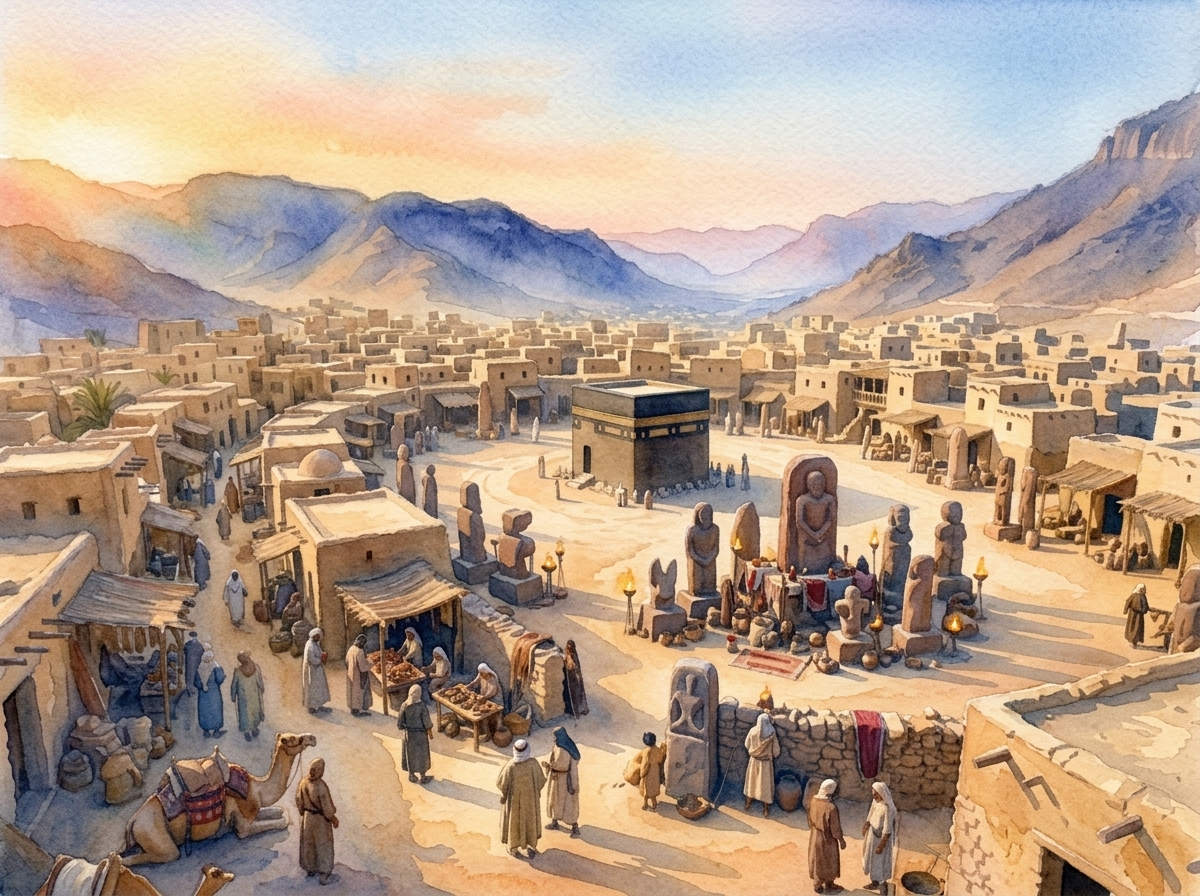
Now, the People of Quraish knew that money from interest was no good, and they made a decision that they were only going to use Halāl money in the rebuilding of Al-Ka’bah; they were not going to use money from interest or money from prostitution, because at the time, to show their corruptness, prostitution was a common business. And by the way, there is a Hadīth that is narrated by Al-Bukhārī where ‘Ā'ishah talks about the types of marriages that existed in Arabia, we will refer to it later on. But prostitution was something that existed, and you would have men hiring their slave-girls as an income-generating source for them, but they knew that this was not good, yet they would do it. They would deal with interest, but they knew that this was not good. So they decided that they were not going to use this money in the rebuilding of Al-Ka’bah.
Al-Ka’bah was Originally Rectangular in Shape Al-Ka’bah originally was a bit of a rectangle rather than a square, it was rectangular in shape. Because the people of Quraish ran short of funds, they ended up shortening Al-Ka’bah from one side, so they made it a square rather than a rectangle to save money. The area of Al-Ka’bah which they left out is what we refer to today as Al-Hijr – the enclosed area in that semi- circle. If you ever visited Al-Ka’bah, you would see that on one side of Al- Ka’bah there is a semi-circle; that used to be part of the original building of Al-Ka’bah. And Al-Ka’bah also had two gates, and they made it into one. And they raised the doorstep, so now in order to get access to the door you have to climb; the gate was made very high. Rasūlullāh ﷺ says in this Hadīth where he talks to ‘Ā'ishah, “Do you not know that your people had insufficient funds for the expenses? If it were not for the fact that your people were only recently Unbelievers, I would have torn down the Ka’bah and made for it one door on the east and another on the west, and I would have included the Hijr area within it.” When Rasūlullāh ﷺ opened Makkah, he was thinking about reconstructing Ka’bah on the original foundations, but then he told ‘Ā'ishah that the reason I am not going to do this is because your people just became Muslim, their Islām is soft, their
Īmān is weak, and it might be for a Fitnah for them, it might cause them a problem if I reconstruct Al-Ka’bah. So he did not do it.
Dā‘iyah Needs to Take Condition of People into Consideration There is an important lesson to learn from this Hadīth, and that is that the Dā‘iyah needs to take the condition of the people into consideration. Even though Rasūlullāh ﷺ wanted to do this i.e. build the Ka’bah, but he did not do so because he was worried that it might affect the Īmān of the people. So as a person who is calling to Islām, you need to take into consideration the condition of the people who you are directing the Message to. ‘Abdullāh Ibn Mas‘ūd says that if you tell the people something that is beyond their comprehension or understanding or Īmān, it might be a trial for some of them, it might cause a backlash with some people. Sometimes we throw out information on a particular subject which is absolutely true and valid, but because the people are not ready for it yet, because their Īmān is weak, it causes a backlash with them. Some things people just are unable to grasp.
Quraish Raised Door High to Control Access to Al-Ka’bah Now, Rasūlullāh ﷺ said to ‘Ā'ishah that the reason your people Quraish made the door so high was because they wanted to have control of who would go in and out, it was an issue of power. They did not want to make the door low so that it would be accessible to anyone; they made it high so that they could control who would go in and out, it was a matter of influence, having authority. So the door of Al-Ka’bah was raised. Rasūlullāh ﷺ said, “If I would rebuild it, I would lower the gate and I would make for it two gates, so that people could come from one side and leave from the other,” rather than having to come in and out from the same door.
Second Rebuilding of Al-Ka’bah and Placement of the Black Stone Rasūlullāh ﷺ participated in the rebuilding of Al-Ka’bah, and at the time he was maybe around 35 years old – that is a rough estimate. So now the people of Quraish were building Al-Ka’bah, they reached to the holiest part of Al-Ka’bah which is the Black Stone, and now a dispute erupts among them; who will have the honour to place the Black Stone in its spot? Because when they were rebuilding Al-Ka’bah every tribe took responsibility of building one side of it, they all wanted to participate in this honour, but with the Black Stone they disputed; every tribe wanted to have the honour of putting it in its place. Banū ‘Abd Ad-Dār gathered all of their men and they came in front of Al-Ka’bah with a pot of blood, and they placed it in front of everyone and they all stuck their hands in the blood and pulled it out. In other words, they were telling everyone that this is what will happen if we do not place the Black Stone in its place, so it is like pledging to die and to fight; we will do it, otherwise this is what will happen, blood will flow. Even though that was a drastic measure and quite a threat, but that was not enough to deter others. Another tribe went and brought in their own pot of blood, and they started sticking their hands in and pulling them out. And then everybody was bringing their own pots of blood, and it was four or five days and they could not solve the problem and war was about to erupt between them.
And then the eldest man among them, Umayyah, had a suggestion. He came and said, “Let us agree that the first man to walk in towards Al-Ka’bah will be given complete authority in judging between us.” So they all gathered next to Al-Ka’bah and they were waiting for the first person to come, and the first person to walk in was Muhammad ﷺ. They all stood up and said, “As-Sādiqul Amīn, Radīnā! Radīnā! – The truthful and the trustworthy, we all agree!” Now, they had already agreed that they would give complete authority to the person who would come in, but they were so happy that this person was Muhammad ﷺ because they knew that he would not be biased in his ruling. You know, it would be expected that if someone came from a particular family he would give authority to his family to place it in its place, and that was the expected thing, that we are going to leave it randomly for
the first one to come in and his family would take it, but when they saw that it was Muhammad ﷺ, they were so happy because they knew his fairness, so they told him, “We give you complete authority in solving this dispute.” Rasūlullāh ﷺ asked them to bring a piece of cloth; he picked up the Black Stone and he placed it on this cloth. And then he asked a representative from each clan to hold the cloth from one side each, and then they all raised it up together at the same time, therefore every one of them would participate in lifting the Black Stone, and when they all lifted it up, then he, with his blessed hands, picked up the Black Stone and placed it in its place. So it was Rasūlullāh ﷺ who put the Black Stone in its spot. So that was the second time Al-Ka’bah was rebuilt.
Third Rebuilding of Al-Ka’bah Rasūlullāh ﷺ opened Makkah and then he said that if it was not for the fact that the people were new Muslims, I would have rebuilt it on the foundations of Ibrāhīm. Years later, ‘Abdullāh Ibn Az-Zubair became the Amīr of Makkah, and he knew of this Hadīth because ‘Ā'ishah was his aunt. ‘Abdullāh Ibn Az-Zubair’s mother was Asmā' Bint Abī Bakr, the sister of ‘Ā'ishah, so ‘Ā'ishah was his aunt, and he was familiar with this Hadīth, so he decided to rebuild Al-Ka’bah on the original foundations, because now the people had been Muslims for a long time, they were not new Muslims anymore, therefore they would be able to handle the situation. He decided that he was going to rebuild Al-Ka’bah, especially since Al-Ka’bah was burnt, because Al-Hajjāj Bin Yūsuf As-Saqafī had laid siege on Makkah. At that time there was a war between ‘Abdullāh Ibn Az-Zubair and Banī Umayyah in Syria, and the army general of Banī Umayyah had laid siege on Makkah, and one of the catapults had hit Al-Ka’bah and it caused some damage and it burnt Al-Ka’bah. Now, that damage could have been fixed without tearing down Al-Ka’bah, but ‘Abdullāh Ibn Az-Zubair wanted to take advantage and rebuild Al-Ka’bah on the original foundations, which he did, and he fulfilled the description that was given by Rasūlullāh ﷺ in the Hadīth, that he would lower the gate and have an eastern door and a western door and expand the size of Al-Ka’bah towards Al-Hijr – which he did. So that was the third time Al-Ka’bah was rebuilt.
Fourth Rebuilding of Al-Ka’bah ‘Abdullāh Ibn Az-Zubair ended up losing the war and he was killed. Al- Hajjāj Ibn Yūsuf took over. The Khalīfah of that time, ‘Abdul Malik Ibn Marwān, was not familiar with this Hadīth, so he gave his commands to take back Al-Ka’bah to the way it was before ‘Abdullāh Ibn Az-Zubair, so Al- Ka’bah was shortened again according to the way the people of Quraish built it. After the Khilāfah of Banī Umayyah, Banū Al-‘Abbās were the family of Khulafā'. One of the Khulafā' of Banī ‘Abbās was thinking about rebuilding Al-Ka’bah again on the original foundations and he consulted Al-Imām Mālik. Imām Mālik told the Khalīfah, and he gave him a very wise answer, “We do not want Al-Ka’bah to be a toy in the hands of kings; they keep changing its size every now and then. Even though the plan of Rasūlullāh ﷺ and his desire was to build it on the foundations of Ibrāhīm, but let us keep it the way it is and not change it anymore.” Because it was going back and forth on the foundations of Ibrāhīm, and then the way Quraish built it, and then again on the foundations of Ibrāhīm, and Imām Mālik said that the people have known Al-Ka’bah and they have known these stones the way they are; do not keep on changing it, keep it the way it is. And that was a very wise advice from Al-Imām Mālik which the Khalīfah followed.
Ka’bah of Today is Built on the Foundations of Quraish So the Ka’bah that we have today is built on which foundation? The foundations of Ibrāhīm or the foundations of Quraish? Quraish. But Alhumdulillāh that is something good. Why? If Al-Ka’bah was built on the original foundations of Ibrāhīm, we would have been deprived the chance of praying inside Al-Ka’bah, but since it is shortened, that area which is enclosed by the semi-circle is actually part of Al-Ka’bah, so when you pray in that area, it is as if you have prayed inside Al-Ka’bah. And you know that Rasūlullāh ﷺ did pray inside Al-Ka’bah; when he opened Makkah, he prayed eight Rak‘ah inside Al-Ka’bah. So now we have a chance to pray in Al-Hijr, otherwise we would have to get permission to get inside Al-Ka’bah and it would be very cumbersome and difficult, but now you can pray inside Al-Hijr and it will count as if you prayed in Al-Ka’bah.
Size of Al-Ka’bah has Always Remained Constant Now, over the times, the height of Al-Ka’bah has increased, but the size of it has remained constant. Now, with the stones that Al-Ka’bah is built from, many of them are remnants of the original stones that were used by Ibrāhīm, but not all of them; some other ones were introduced later by Quraish and others.
The Black Stone is the Original Stone given to Ibrāhīm But the Black Stone is the original stone that was used by Ibrāhīm, the Black Stone has never changed, it is the original stone that was given to Ibrāhīm. And there are many stories about the Black Stone itself; some say it originated from Jannah. There is a Hadīth that is authentic that says that the Black Stone was white, but then it turned black because of the sins of the sons of Ādam. And there is a Hadīth that says that the Black Stone is the Right Hand of Allāh on Earth. So the Black Stone is very special, it is very honoured, and it is very respected, and it is the only part of Al-Ka’bah that is kissed and is the only part of Al-Ka’bah that is pointed to from a distance. Some people point to the Yemeni corner which is wrong, Al- Yemeni corner you can touch it when you are passing by it, but one should not point towards it or greet it from a distance, that is only for the Black Stone.
So this is the history of Al-Ka’bah.
Rasūlullāh ﷺ Would Spend Time in Solitude
The Prophet ﷺ would leave Makkah and spend time in the Cave of Hirā', in a mountain that is fairly close to Makkah, a few kilometers away from Makkah. Rasūlullāh ﷺ would take with him provisions – some food – and he would go and stay in seclusion, solitude, in this cave, worshiping Allāh ﷻ. And from the cave, it is said that you were able to see Al-Ka’bah in those old days. So Rasūlullāh ﷺ would spend days and nights continuously in the cave worshiping Allāh ﷻ before Prophethood, so he knew Allāh ﷻ and he was worshipping Allāh ﷻ in that cave. And this was a chance for
Rasūlullāh ﷺ to do reflection and contemplation in the creation of Allāh, and this was training for him. Allāh ﷻ was training him through these moments of reflection and contemplation because they purify the heart. Sa‘eed Hawwā comments on this, he says: “Solitude was the tradition of some who seek the guidance of Allāh with the Remembrance of Allāh and worship. It was used to illuminate the hearts and remove its shadows by disconnecting it from its heedlessness and desires. Some would advise this in the beginning of the journey to Belief as this was the example of Prophet ﷺ when he spent time in solitude before and at the beginning of his Apostleship.”
So as a Muslim you are recommended to spend time alone in Dhikr, for example, early in the morning, after ‘Asr, between ‘Asr and Maghrib on Friday. So you should spend time alone remembering Allāh in solitude, and our scholars talked about the benefits of solitude. Now, one should not go into the extremes of leaving the society completely or immersing oneself in the society completely, he should have a middle road. So you spend some time with people socialising, but you also spend time alone between you and Allāh. Qiyām Al-Layl is a chance for solitude; praying at night alone when everyone is asleep, so it is something between you and Allāh. There is an element of sincerity there that might not exist with other ‘Ibādāt that are done collectively. So now you are doing this alone, nobody can see you, you are not showing off. Who are you doing it for? You are doing it for Allāh. So it is very important for one to spend this time in solitude to purify the heart, because the scholars say that too much socialisation, too much laughing, too much attachment to Dunyā, obscures the heart and throws veils on it, and the way to purify the heart is by spending some time worshipping Allāh ﷻ in solitude. And Allāh ﷻ says about Tafakkur: Indeed, in the creation of the heavens and the earth and the alternation of the night and the day are signs for those of understanding. Who remember Allāh while standing or sitting or lying on their sides and give thought to the creation of the heavens and the earth, saying, "Our Lord, You did not create this aimlessly; exalted are You above such a
thing; then protect us from the punishment of the Fire."26 So Allāh is saying here that His servants contemplate in the creation of the heavens and Earth, and they say, ‘O Allāh, You have not created this in vain, there is purpose in creation, there is wisdom in everything that exists.