The Farewell Hajj
The Only Hajj Rasūlullāh ﷺ Made from Madīnah
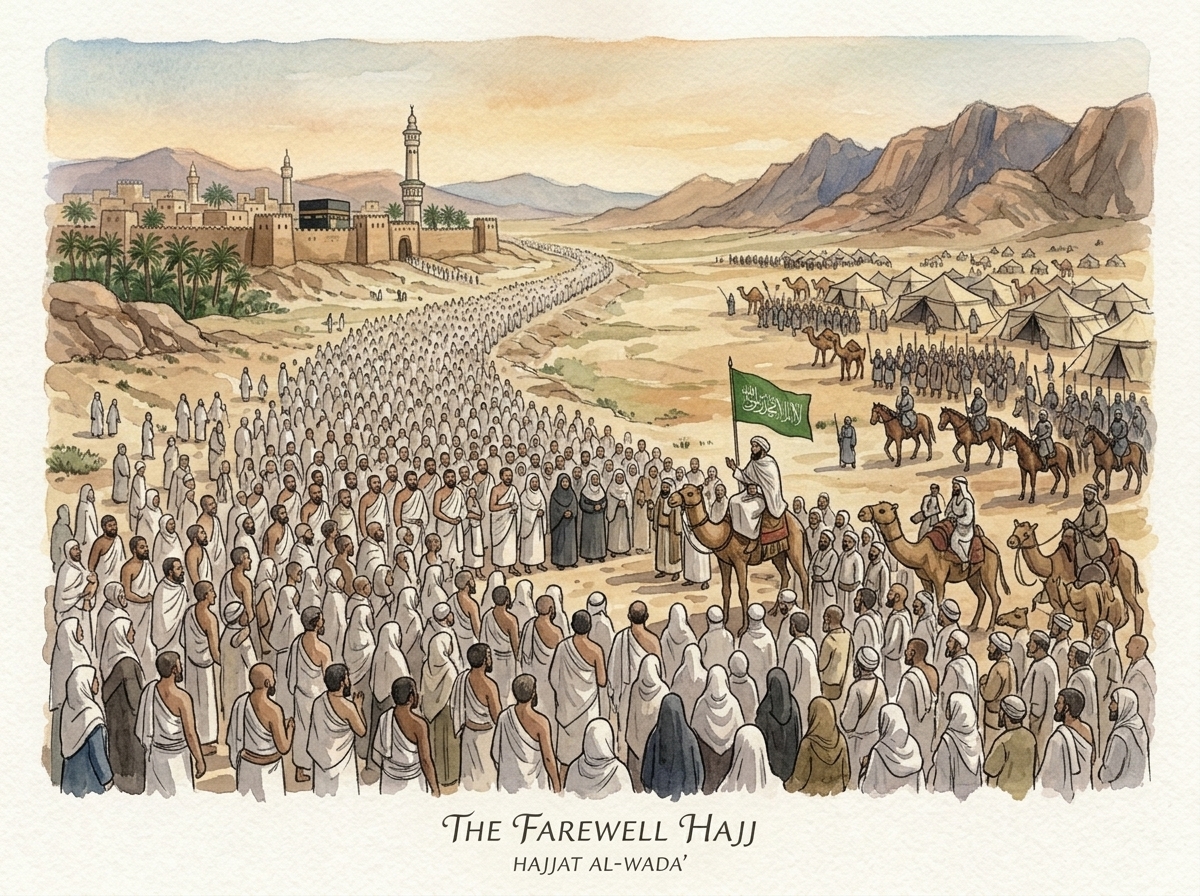
Rasūlullāh ﷺ made Hajj in the 10th year of Hijrah, and this is called the Farewell Hajj because it is the Hajj where Rasūlullāh ﷺ delivered to the Ummah his final words, and it was a time when all of the Muslims congregated and had a chance to hear and see from Rasūlullāh ﷺ for the last time. And it is also called Hajjatil Islām – the Hajj of Islām, because it is the only Hajj Rasūlullāh ﷺ made from Madīnah. Rasūlullāh ﷺ did make Hajj while he was in Makkah before Prophethood and after Prophethood, but this was the only Hajj he did in Madīnah and it was 10 years after his Hijrah. Rasūlullāh ﷺ made Hajj riding on his camel and he had very humble riding equipment; saddle that is used for the camel, and Rasūlullāh ﷺ said, “Hajjatun Lā Riyā'a Fīhā Walā Sum‘ah – A Hajj with no show.” Rasūlullāh ﷺ made his Hajj simple, and that is how Hajj should be; simple clothes, and a Muslim should use Hajj as
a chance to get out of the accustomed ease that he has otherwise in his life, it is a time to experience a bit of hardship, and Rasūlullāh ﷺ made his Hajj very simple. In the time after Rasūlullāh ﷺ passed away and the condition of the Muslims was improving very much financially, so now people were coming to Hajj with more fancy things, so Ibn ‘Umar was with his companions and then a group of Hujjāj coming from Yemen passed in front of Ibn ‘Umar, and it says in Musnad Al-Imām Ahmad that when these men from Yemen passed in front of Ibn ‘Umar, they had very simple riding saddles on their camels and they were wearing very simple Ihrāms and clothes, so Ibn ‘Umar said to the people who were with him, “Whoever wants to see the most similar travellers this year to Rasūlullāh ﷺ and his Companions when they made Hajj, then look at these.” So if you go to Makkah today and you go to Madīnah today in the time of Hajj, you would see extravagance, you would see fancy Hajj, you would see the VIP Hajj, and Hajj which is supposed to be equal for everyone has become a place where you can clearly see the difference between rich and poor in their accommodation and in their transportation and in other aspects also, and that is not how it was in the time of Rasūlullāh ﷺ.
‘This Day I Have Perfected for you your Religion’
When Rasūlullāh ﷺ was in ‘Arafah, Allāh ﷻ revealed to Muhammad: This day I have perfected for you your religion and completed My favour upon you and have approved for you Islām as religion. When ‘Umar Ibn Al-Khattāb was Khalīfah, a Jew came to ‘Umar and said, “O Amīrul Mu'minīn, if this verse was revealed to us, we would have taken that day as a day of celebration, as a day of Eid.” Because it is such a great Āyah when you think about it; you know that your religion now is complete, every Muslim now knows that his religion that he is following is a complete religion, everything is in there. ‘Umar Ibn Al-Khattāb said, “I know when that Āyah was revealed, it was revealed on ‘Arafah and it was on Friday.”
Obey Leader who Rules with Book of Allāh Even if he Be Slave with
Chopped-Off Limbs
In Sahīh Muslim, Umm Al-Husain says, “I made Hajj with Rasūlullāh ﷺ, and then I saw him when he threw the stones in Jamratul ‘Aqabah, and then he came back riding on his camel and with him was Bilāl and Usāmah; one of them was leading the camel and the other one was raising his clothes over the head of Rasūlullāh ﷺ to provide him with shade from the sun. And then Rasūlullāh ﷺ said many things and I remember from the things that he said, ‘If a slave with chopped off limbs is appointed as a leader over you and he is leading you with the Book of Allāh, then listen to him and obey.’” An-Nawawī says, “Whoever has all of these qualities in him, he is at the lowest level,” meaning he is a slave, and his limbs are cut. So Rasūlullāh ﷺ is telling us that even if such a person is appointed over you, as long as he is ruling with the Book of Allāh, you should listen and obey. Umm AlHusain continues, “And Rasūlullāh ﷺ ordered to follow the ones who are appointed over us as long as they are doing so with the Book of Allāh.” AnNawawī says the meaning of this is, “As long as they are following Islām and they are inviting people to the Book of Allāh, regardless of what they are applying in their own selves and regardless of how their character is.” So the meaning of this is if the laws are according to the Book of Allāh, and if they are implementing the Rule of Allāh and inviting others to it, it does not matter how their personal character is or what they are doing in their own privacy, that is not something that should concern us as long as they are ruling according to the Book of Allāh. And then he says, “And people should not revolt against such rulers, but if they do something that is wrong, they should be given Nasīhah.” An-Nawawī continues, “The question arises, how can you follow a slave when we know that Khalīfah should be from Quraish? The answer is two-sided, one; what is meant here is that the Khalīfah is the one who appointed this person, so it is not talking about the Khalīfah. Two; if a slave takes over a government and that is it, he lodged Not very clear if the Sheikh is continuing to quote from An-Nawawī. himself in position of leadership, then his rule applies and it is mandatory to follow him as long as he is ruling according to the Book of Allāh.”
Khutbatal Wadā’ – Farewell Speech of Rasūlullāh ﷺ
Rasūlullāh ﷺ delivered a speech which is known as Khutbatal Wadā’ – The Speech of Farewell, and there are various narrations of this; some in Bukhārī, some in Muslim, some in the books of Seerah, some in the other books of Sunan, and I will go through the one narrated by Al-Imām Ahmad and we will read the translation of it Inshā'Allāh, and these are final words of advice from Rasūlullāh ﷺ.
Rasūlullāh ﷺ said, “O people, do you know on which day of which month and in which land you are?” They replied, “On a sacred day of a sacred Month in a sacred land.” Rasūlullāh ﷺ said, “Your blood, your possessions and your honour are sacred for you, as is this your day, in this your month, in this your land, on until you meet Him.” And then he said, “Listen to me, you would live. Do not do wrong, do not do wrong, do not do wrong. The property of a Muslim is not permitted to you except by his wish. All blood-money and deeds done in the Jāhiliyyah are crushed beneath these feet of mine until Judgement Day. The first blood that is abolished is that of Ibn Ar-Rabī‘ah Bin Hārith Bin ‘Abdil Muttalib; he was fostered among Banū Sa’d and Hudhīl killed him. All the usury charges of the Jāhiliyyah are abolished, Allāh has decreed that the first usury charges to be abolished are those of Al-‘Abbās Bin ‘Abdul Muttalib; your capital is your own, no wrong should be done against you and you should not wrong anyone.”
So you can see that Rasūlullāh ﷺ is putting all of Jāhiliyyah behind. This is a new era with new laws and the old era is gone, and Rasūlullāh ﷺ is applying these rules on himself first and his family. So Rasūlullāh ﷺ is saying that the first thing of the killing of Jāhiliyyah is gone and we are going to give up the case of Ibn Rabī‘ah Bin Hārith Bin ‘Abdil Muttalib who is the son of the cousin of Rasūlullāh ﷺ, and this was a case that happened in the time of Jāhiliyyah. Because these draw to wars and tribes fighting each other, so Rasūlullāh ﷺ is saying that that
blood, we are forgiving the ones who killed him for it to put an end to the feudal system of Arabia. And then Rasūlullāh ﷺ is banning usury and Rasūlullāh ﷺ is saying that the first Ribā I am putting under my feet is the Ribā of Al-‘Abbās. So Al-‘Abbās was lending people and he was charging them interest, and Rasūlullāh ﷺ is saying that all what you can get back is your capital.
And then Rasūlullāh ﷺ said, “Time has revolved as was its fashion by the day Allāh created the heavens and the earth.” And then Rasūlullāh ﷺ recited the Āyah: Indeed, the number of months with Allāh is twelve lunar months in the register of Allāh from the day He created the heavens and the earth; of these, four are sacred. That is the correct religion, so do not wrong yourselves during them.
And then Rasūlullāh ﷺ says, “Do not revert after me into Unbelievers, striking the necks of one another. Satan has despaired that those who pray will worship him, however he is present in the dissention between yourselves.” And this is why we find a lot of dissention between the Muslims. Shaitān does not care, does not bother about causing dissention among the Kuffār, because they are already Kuffār and going to Hellfire anyway, but he is concerned about the Muslims; since he cannot make them Kuffār, he is making them fight among themselves, he is always instigating this Waswasah in the hearts of Muslims and causing Fitnah among them.
“Fear Allāh in your relationship with women, they are captives with you…” Rasūlullāh ﷺ here, in the last days of his life, is giving us a Nasīhah to care for our women, “…they are captives with you, they own nothing for themselves. They have rights over you and you have rights over them, that they should not allow anyone other than yourselves to set foot in your furnishings, and that they should not give permission to anyone you dislike to enter your homes. If you fear those of them who are fractious, then admonish them, and leave them in the beds and strike them but not viciously. They have rights to their provisions and their
clothing in kindness. It was only by Allāh’s covenant that you took them, and it is by Allāh’s Word that you are permitted access to them, and whoever has a covenant should discharge it to whomever entrusted it to him.”
These are the words of Rasūlullāh ﷺ in Al-Hajj, a Khutbah that was delivered to thousands of Muslims, and we find in them Tawhīd, we find in them advice for Fiqh, and we also find Rasūlullāh ﷺ giving us Nasīhah to care and have concern for the Muslimāt.