The Road to Madīnah
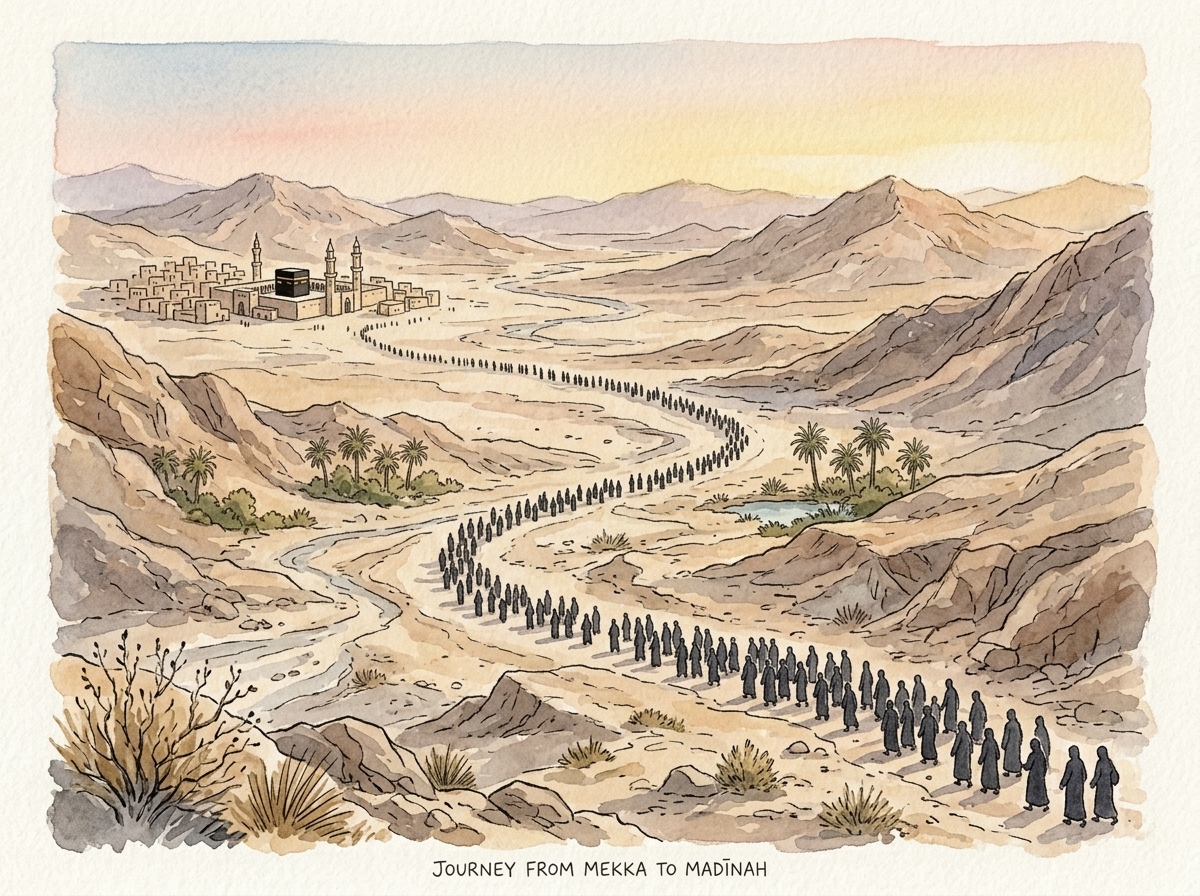
Al-Ansār Set Off to their Appointment with Rasūlullāh ﷺ o we have now covered Bay‘atul ‘Aqabah Al-Ūlā - the First Pledge of Allegiance of Al-‘Aqabah, the terms of which was called The Pledge of Allegiance of the Women. Mus‘ab Ibn ‘Umair has done outstanding work in spreading the Message, and by the time the next Hajj season arrived, the narrator of the Hadīth says, “There was no house in Madīnah that did not have a Muslim in it,” because of the effort of Mus‘ab Bin ‘Umair. So now the appointment to meet Rasūlullāh ﷺ in Pilgrimage was approaching, so over 70 of the Muslims went with the Pilgrims of their people. So the delegation that came out of Madīnah included Muslims and Non-Muslims, and the Muslims had a secret appointment with Muhammad ﷺ, but they went out with the group that was leaving from Madīnah. So there were over 70 men who were Muslim and two women.
Al-Barā' Bin Ma’rūr Prays towards Jerusalem Ka’b Ibn Mālik narrates the following story, he says “We were among the Pilgrims of our people, some were Muslim and some were Non-Muslim, and our leader and elder was Al-Barā' Bin Ma’rūr, he was the leader among the Muslims. Al-Barā' Bin Ma’rūr came to us, a group of Muslims, and he said, ‘I have an Idea and I want to get your opinion; I do not feel comfortable turning my back towards this building in Prayer.’” He was referring to AlKa’bah. What was the Qiblah of the Muslims at that time? Praying to AlAqsā, Jerusalem. So the people who are in Madīnah, they are facing Jerusalem, while their backs are towards Makkah. So Al-Barā' Bin Ma’rūr is saying, “I do not feel comfortable doing that, and I wanted to seek your advice on whether I should pray towards Al-Ka’bah.” Ka’b Ibn Mālik said, “We responded by saying, ‘Rasūlullāh ﷺ is praying towards Jerusalem and we do not want to contradict him.’” Al-Barā' Bin Ma’rūr said, “I am going to pray towards Al-Ka’bah,” and from that day on, he started praying towards Al-Ka’bah. Now the delegation made it to Makkah. Al-Barā' Bin Ma’rūr said to Ka’b Ibn Mālik, “My nephew, let us go after the Messenger of Allāh and ask him about what I have been doing on this journey. The disapproval I have seen in you has somewhat disturbed me.” Let us go and ask Rasūlullāh ﷺ if what I did was right or wrong. Ka’b Ibn Mālik said, “We asked a man from Makkah, ‘Where is Rasūlullāh ﷺ ‘?So the young man said ‘Do you know him? Have you seen him before?’” Ka’b Ibn Mālik said, “No, we do not know him.” The man responded by saying. “Do you know Al-‘Abbās Bin ‘Abdul Muttalib, his uncle?” They said, “Yes, we used to see him in Madīnah on business trips.” Al-‘Abbās Bin ‘Abdul Muttalib used to frequent Madīnah doing business, so they knew him. The man said, “Muhammad ﷺ is the man sitting next to Al-‘Abbās in the mosque, you will find him there.”
So Ka’b Ibn Mālik said, “I went with my uncle Al-Barā' Bin Ma’rūr, we into the mosque and we found Al-‘Abbās Bin ‘Abdul Muttalib and we came and greeted them. Muhammad ﷺ said, ‘O Uncle Abul Fadl, do you know who these two men are?’” The elder son of ‘Abbās, his name is Al-Fadl, and it was the tradition of the Arabs to give a name to the father; the father of so
and so, the eldest son. So Rasūlullāh ﷺ said, “Abul Fadl, do you know these two men?” Al-‘Abbās said, “Yes, this is Al-Barā' Bin Ma’rūr, the leader of his people, and this is Ka’b Ibn Mālik.” Ka’b Ibn Mālik said, “I swear by Allāh, I will never forget the next statement that Rasūlullāh ﷺ made.” Rasūlullāh ﷺ said, “Do you mean the poet?” Ka’b Ibn Mālik was a poet, so when Al-‘Abbās Bin ‘Abdul Muttalib introduced Ka’b Ibn Mālik to Muhammad ﷺ and said this is Ka’b Ibn Mālik, Rasūlullāh ﷺ said, “Is he the poet?” Ka’b Ibn Mālik says, “I can never forget that statement in my whole life.” Why was it such a big deal to Ka’b Ibn Mālik? Because it shows that Rasūlullāh ﷺ has heard of him. And Ka’b Ibn Mālik was so proud and happy that Rasūlullāh ﷺ, his leader, the man who he meets for the first time and has been waiting for this moment to meet him, has heard of him, he might have even heard some of his works. So he was so proud and happy that Rasūlullāh ﷺ has already heard of him. Rasūlullāh ﷺ said, “AshShā‘ir? – Is he the poet?” Al-‘Abbās said, “Yes.” Al-Barā' Bin Ma’rūr said, “O Messenger of Allāh, I have come on this journey having been given guidance to Islām by Allāh. I had the idea of not facing my back to this building, so I prayed towards it. My friends opposed me in this, causing me concern. What do you think?” Muhammad ﷺ said, “You already had a Qiblah, a direction for Prayer, and you should have kept it.” You should have remained praying towards the Qiblah that you know. Since then, AlBarā' Bin Ma’rūr changed the direction. Now, with Rasūlullāh ﷺ, because at the time Rasūlullāh ﷺ was in Makkah, he was not turning his back towards Al-Ka’bah, he was facing Al-Ka’bah but in the direction of Jerusalem. But the people of Madīnah such as Al-Barā' Bin Ma’rūr, did not like that, and Subhān'Allāh, when Rasūlullāh ﷺ made Hijrah, Rasūlullāh ﷺ was feeling the same feeling.
Al-Ansār Secretly Gather in Al-‘Aqabah
Ka’b Ibn Mālik said, “We then left to the Pilgrimage having made an agreement to meet the Messenger of Allāh at Al-‘Aqabah in the middle of the Tashrīq period.” So they made an appointment to meet at a specific time. Ka’b Ibn Mālik says, “We kept this as a secret; none of our people knew about it,” all of the Non-Muslims in our group knew nothing about our
meeting with Rasūlullāh ﷺ, it was secret, “except Abū Jābir – ‘Abdullāh Bin Harām, he was one of our leaders and seniors. We went up to him and we told him, ‘Abū Jābir, you are one of our noble leaders, and we would like you to give up your practices, otherwise one day you would end up as fuel for Hellfire’” Abū Jābir did accept Islām, so they told him about the private meeting, and he was one of the people who attended the meeting with them. In fact, he became one of the leaders who were appointed by Rasūlullāh ﷺ within this group. It was the time for the appointment, it was late at night. Ka’b Ibn Mālik said, “We were going towards Al-‘Aqabah in ones or twos.” They did not want to attract attention of the people; if you have a group of 70 going to meet Rasūlullāh ﷺ, it would turn the attention of others, so they were going in ones and twos until they all gathered in Al-‘Aqabah, and they were all there, and then Rasūlullāh ﷺ showed up.
Al-‘Abbās Bin ‘Abdul Muttalib – The Only Non-Muslim in the
Gathering
Rasūlullāh ﷺ was the only Muslim from Makkah to show up at that meeting, and he had one person with him, and that was the only NonMuslim to attend the meeting, and who was that person? Al-‘Abbās Bin ‘Abdul Muttalib, the uncle of Rasūlullāh ﷺ. And Al-‘Abbās Bin ‘Abdul Muttalib was the first person to speak, he said, “Muhammad holds with us a position of which you are aware. We protect him from our people who think about him as we do. He is respected among his people and safe in his own town, but he is determined to join up with you. If you think you will keep trust with him in the invitation you have given to him, and will protect him from his opponents, then it is up to you to accept your responsibilities, but if you think you might deliver him over and abandon him after he has joined you, then leave him right now, he does have respect and protection among his own people and in his town.”
Al-‘Abbās Bin ‘Abdul Muttalib wanted to make sure that this is a commitment from the side of Al- Ansār. Al-‘Abbās is saying that we are going to take care of Muhammad ﷺ, we are protecting him, however he is
insisting on us; now, are you going to protect him when he leaves to you or not?
How come Al-‘Abbās Bin ‘Abdul Muttalib was there? Why was he present even though he was a Non-Muslim? What is the reason he was there? Al- ‘Abbās Ibn ‘Abdul Muttalib was the uncle of Rasūlullāh ﷺ, and even though he was a Non-Muslim, but he was one of the senior members of the clan of Banū Hāshim, and even though he was a Non-Muslim, but he was taking special interest in following and monitoring the activities of Rasūlullāh ﷺ, and he was one of the people who were offering Rasūlullāh ﷺ protection in Makkah after Abū Tālib passed away, and he wanted to make sure that his nephew will be safe when he leaves Makkah, and that is why Rasūlullāh ﷺ allowed him and included him in this meeting, because even though he was a Non-Muslim, but this is, again, an issue that relates to the tribe of Banū Hāshim; Muhammad ﷺ remains as a member of this clan, and his clan have interest in his safety and security. So Al-‘Abbās Bin ‘Abdul Muttalib attended as a representative of Banū Hāshim to make sure that their son is well protected. Now, you might say, ‘Well, if Al-‘Abbās was offering protection, how come it is different than the time of Abū Tālib?’ Well the difference is that Abū Tālib had respect and power and authority over his people that none of his brothers had. So the ability of Al-‘Abbās Bin ‘Abdul Muttalib to defend Muhammad ﷺ was obviously less than the ability of Abū Tālib because of the seniority of Abū Tālib; Al-‘Abbās was young, nevertheless, they still managed to protect him for that period, and they viewed it as a responsibility on them.
Bay‘atul ‘Aqabah Ath-Thāniyah – Al-Ansār Pledge Second
Allegiance
When Al-‘Abbās finished his statement, Al-Ansār said, “We have heard what you had to say. Now, O Messenger of Allāh, ask us what you want. Go ahead and speak to us about what you want from us, and take for yourself and for your Lord whatever you want.” Rasūlullāh ﷺ stood up and said, “I ask you to pledge that you will defend me as you do your women and children.” So now this is an upgrade, a step higher, than the earlier
agreement in Al-Bay‘atul ‘Aqabah Al-Ūlā. Over there, it is for them to become Muslim, so they pledge allegiance on becoming Muslim, but now there is an additional term that was added to the contract, and that is offering Muhammad ﷺ with protection, and it is a defensive protection. He also told them in a different narration, “You must pledge to hear and obey, at times of both action and inaction. To give, whether times are hard or easy. And to advocate goodness and prohibit evil. You must speak out for Allāh and not fear any blame for supporting Allāh. You must help and defend me if I come to you in the same way you help and defend yourselves, your wives and your children.” Notice here the clarity in the Message of Rasūlullāh ﷺ;I am not coming to you just for you to protect me, but I am to be your leader; you listen to me and you obey me. And then he said, ‘And you fear no one but Allāh.’ I cannot make this move if you have any fear in your hearts; you have to be willing to commit themselves for this mission.
Al-Barā' Bin Ma’rūr stood up and he wanted to give Rasūlullāh ﷺ Bay‘ah, and he said, “O Messenger of Allāh, I swear it; we are warriors from father to son over many generations.” When Rasūlullāh ﷺ said I want you to protect me like you protect your women and children, Al-Barā' Bin Ma’rūr said, ‘O Messenger of Allāh, we are warriors, we have inherited this from generation to generation.’ And this is another thing Allāh ﷻ prepared AlKhazraj with, that they were fighters, they were strong, and they had this reputation in Arabia. And while Al-Barā' Bin Ma’rūr was speaking, Abul Haitham stood up and he interrupted, and he said, “O Messenger of Allāh, we have certain ties to others (referring to the Jews), and if we break these, we are concerned that if God gives you victory, you might return to your people and abandon us.” Abul Haitham is saying that this commitment means that we might get into conflicts with people whom we have agreements with, so in case you win, are you going to stay with us or are you going to leave us? You see, we are willing to enter into this agreement for our whole life, but are you going to stay with us or are you going to leave us? Rasūlullāh ﷺ responded after smiling, he said, “If your blood be
sought, our blood shall be sought. And your destruction is mine as well. I am of you, and you are of me. I will battle those who battle you and make peace with those whom you make peace.” And Rasūlullāh ﷺ kept to his agreement; when Makkah was opened, the hometown of Rasūlullāh ﷺ, he left it and he went back with the people of Al-Ansār to Madīnah and he remained there until he died. Rasūlullāh ﷺ stayed with the people of AlAnsār until the last moment. In another narration, there is another interruption; when the Ansār started extending their hands to pledge allegiance to Rasūlullāh ﷺ, As‘ad Bin Zurārah, the early Muslim among them, stood up and interrupted and said, “Slowly now.” He is telling his people, ‘Take it easy, slow down.’ “We only hurried here because we know that he is the Messenger of Allāh. Bringing him out now however, would be a provocation to all the Arabs, and would cause you to lose your elite, and would box you in with swords raised against you. If you are able to withstand that, then adopt him, and it will be up to Allāh to reward you, but if you are people who have great fear for yourselves, then leave him and make that fact plain; that course would be more forgivable in Allāh’s sight.” He said, ‘Do you realise what agreement we are entering in? If we take Rasūlullāh ﷺ with us, that means that we are going against the whole world, and we will be boxed in with swords surrounding us! We might lose our elites, we might spend our money, we might be killed. Now, we either stand up and commit, otherwise if you have any fear in your hearts, pull out now when it is not too late.’ They pushed As‘ad Bin Zurārah away and said, “We will give pledge of allegiance.” They said, “Keep away from us! We will not renegade on this pledge, we will never deny it!” Allāhu Akbar! Look at the commitment of Al-Ansār and the courage that they had.
‘This is Such a Profitable Deal! We Will Never Give Up!’
Now, when Rasūlullāh ﷺ asked them to protect him, they asked, “What will we get in exchange?” We are going to offer you protection even if we lose our lives and our wealth; what are you going to give us? This is not a one-sided agreement; we are offering you help, what will you give us in
exchange? What did Rasūlullāh ﷺ say? He responded by telling them one word, “Al-Jannah – Paradise.” Nothing else. I am not going to give you kingdom, I am not promising you wealth, I am not going to give you a few cabinet seats or ministries in my government, I am not going to promise you succession after me; all what I can promise you is Jannah. And what was their response? They said, “Rabihal Bay’! Lā Niqīlu Walā Nastaqīl –This is such a profitable deal! We will never give up.” They said what is better than Jannah? Allāhu Akbar, compare this with Baiharah Bin Farās who said, “I am going to take this young man and eat the Arabs with him.” And then he asked Rasūlullāh ﷺ,” If Allāh gives you victory, will you then transfer power to us?” Rasūlullāh ﷺ said, “No, that is up to Allāh.” He said, “We do not want to have anything to do with you.” Al-Ansār said, “That is a good deal.” That is actually the best deal – Jannah.
Quraish Learn of Secret Meeting
Somehow the news reached to Quraish. You know, it is not easy to conceal a meeting of 70 plus people in the crowd of Al-Hajj. In one narration it states that it was Shaitān who announced it to the people of Quraish, but regardless of how it happened, the news reached to the people of Quraish. They investigated the matter further and it led them to the right direction, it led them to Al-Ansār. So next day early in the morning, a group of leaders from Quraish went and visited the campgrounds of Al-Aws Wal-Khazraj. They went to them and said, “We have heard that you have met with Muhammad ﷺ and that you have offered to take him with you and give him protection. Now, listen people of Yathrib, you are the last people on the face of the earth whom we want to have a fight with.” Because Quraish knew that Al-Aws Wal-Khazraj are not an easy opponent, these are fighters, truly as it was said that we have inherited the skills of war generation through generation, so the people of Quraish were saying, “We do not want to have a fight with you. So what have you done? Did you really meet with Muhammad ﷺ “?The Muslims among Al-Aws Wal-Khazraj remained silent, and the Non-Believers started speaking, they said, “That never happened, we never met with Muhammad ﷺ, “and they were speaking the truth, they had no idea of this secret meeting that happened, because only the
Muslims knew about it, and they kept on refuting that and said, “We never met Muhammad ﷺ, we had nothing to do with him, we did not see him.” Ka’b Ibn Mālik said, “We the Muslims were staring at each other silently, and we did not speak.” The people of Quraish were becoming convinced. Now, Ka’b Ibn Mālik said, “I wanted to change the topic, I wanted to change the subject, so there was Al-Hārith Bin Hishām, one of the leaders of Quraish who was present, and he was wearing some brand new sandals.” Ka’b Ibn Mālik said, “I told Abū Jābir, who is one of our seniors, ‘O Abū Jābir, being one of our leaders, you cannot even afford to wear new sandals like this young man of Quraish?’” What is wrong with you? You are one of our leaders and you are wearing these old shoes, while this young man of Quraish is wearing these brand new sandals? Now, this young man of Quraish was quite upset by that statement; what are you talking about, my shoes? Why are you so impressed by my shoes? So he took them off and threw them at K’ab Ibn Mālik. Abū Jābir said, “Take it easy Ka’b Ibn Mālik, you have made the young man angry. Give him back his sandals.” Ka’b Ibn Mālik said, “No, I will not give them back to him. Hādhā Fa'lun Hasan, Sa'aslubuhū – This is a good omen, I am going to take off from him spoils of war.” And that was the end of the meeting. This meeting between Rasūlullāh ﷺ and Al-Ansār, we can fairly say that it is the most important meeting that Rasūlullāh ﷺ had so far, it was a turning point in Islām. Finally now Rasūlullāh ﷺ has a solid base to start spreading the Message from with protection, and free them to go out and propagate the Message of Allāh ﷻ. This is Bay‘atul ‘Aqabah Ath-Thāniyah.
Lessons
Do Not Procrastinate
Number One: Ka’b Ibn Mālik states, “When we left Madīnah, Qad Sallaynā Wa Faqihnā – we had already learned our Prayers and understood our religion.” This happened before Rasūlullāh ﷺ made Hijrah. So for those
brothers and sisters who are delaying their learning until somehow they can travel overseas and go and study with the Shuyūkh, or get admission to an Islāmic college, you are just finding excuses for yourself; you need to study and learn now. Ka’b Ibn Mālik said we already learned our Prayers and we understood our religion even though Rasūlullāh ﷺ was not there yet. It is true that they had a teacher with them, Mus‘ab Bin ‘Umair, but this statement has a message in it, that we were ready, we were learning. Do not put off your learning; study Islām, spend time to learn the Religion of Allāh, try to get the best out of the situation. If you have a Sheikh to teach you, that is the best. You do not have a Sheikh? Find someone who is more learned than you. Cannot find that? Take a book and study, but do not give it up, do not put it off, because you might never get the time when you are free to do it. And procrastination is not an excuse. On the Day of Judgement, Ibn AlQayyim says, if you go through the Āyāt of Qur'ān, you will find that the majority of the screaming of the people of Hellfire in Qur'ān is because of their procrastination, because they delayed. The verses that narrate their sayings in Qur'ān, ‘O Allāh take us back to this world so that we can believe! O Allāh take us back to this world so that we can give! O Allāh take us back!’ But it is too late. So do not put it off.
Islām is a Religion of Sacrifice
Number Two: When Rasūlullāh ﷺ told the Ansār his terms of the agreement, and they asked, “What are we getting in exchange?” Rasūlullāh ﷺ told them, “Jannah.” Dear brothers and sisters, in our Islāmic work, we should be working for the sake of Jannah, to please Allāh ﷻ;that should be our objective. Not to get fame, not to make money, not for the socialising aspect of it; we should purify our intentions every time consistently and make sure that we are doing everything for the sake of Allāh. This Religion needs sacrifice, and if you are waiting for an exchange, if you are waiting for a payback in this world, you might not get it. This is a religion that demands you to give it everything, because you are getting in exchange Jannah, which is more valuable than anything that you could give. Rasūlullāh ﷺ says that what Allāh is offering you is very expensive, what Allāh is offering you is Jannah. We need to pay the price.
We Need to Be Prepared and Ready
Number Three: Rasūlullāh ﷺ was very clear in what he was asking others in conveying the Message. Rasūlullāh ﷺ made it very clear to the Ansār that what you are getting into is risky, what you are getting into is a struggle. Rasūlullāh ﷺ did not promise them wealth, did not promise them power; Rasūlullāh ﷺ told them that you need to protect me, you might be attacked. So we need to prepare ourselves as Muslims and realise that this is not an easy walk, it is not a walk in the park. To establish the Religion of Allāh, it is a struggle and it demands a lot of sacrifice, and we need to prepare ourselves for that. And ‘Umar Ibn Al-Khattāb said, “Ikhshawshanū, Fa'innan Ni’mah Lā Tad'hum – Roughen up, because bounties might not continue forever.” Easy life might not go on for good, so we need to be prepared and ready.
This is an Organised Religion
Number Four: After the second pledge of Al-‘Aqabah – remember, again, that Rasūlullāh ﷺ met with 70 plus, and there were some others maybe who were Muslim who did not come – Rasūlullāh ﷺ, immediately after taking the pledge of allegiance, asked them to appoint 12 Nuqabā' – 12 leaders. So he divided them into smaller groups and appointed on them leaders. This shows you that this is an organised religion, and now since there is a group living away from the organisation structure of Rasūlullāh ﷺ, Rasūlullāh ﷺ wanted them to have their own organisation structure. So he immediately divided the 70 into groups and appointed 12 leaders among them, and these are the Nuqabā' who will report back to Rasūlullāh ﷺ and whom he will give them instructions. So this is also another lesson to learn, that we need to be organised in a manageable fashion.
Beginning of Hijrah to Al-Madīnah
Rasūlullāh ﷺ Dreams about Hijrah to Madīnah
Rasūlullāh ﷺ, may the peace and blessings of Allāh be upon him, said in Muslim Imām Ahmad, “I was shown the land of your Hijrah. It is a land with a lot of palm trees between two volcanic rocky tracks.” Al-Harrah is a rocky volcanic track. So this was the beginning of the Hijrah to Al-Madīnah. Rasūlullāh ﷺ says in another Hadīth narrated in Al-Bukhārī, “I have seen in my dream that I am migrating from Makkah to a land rich with palm trees. I initially thought that it is Yamāmah or Hajar, but then it turned out to be Yathrib.” Yathrib is the old name of Madīnah which was changed by Rasūlullāh ﷺ, and Rasūlullāh ﷺ banned the use of the name Yathrib, in fact Rasūlullāh ﷺ says that if anyone says Yathrib, they should make Istighfār. Rasūlullāh ﷺ wanted to change the identity of this city; Yathrib had a history of rivalry and warfare, and Rasūlullāh ﷺ now is giving it a new identity; it is Madīnah, Madīnat Rasūlullāh ﷺ. What does Madīnah mean? It means it is the town of Rasūlullāh ﷺ.
The Hijrah of Umm Salamah
Umm Salamah narrates this Hadīth, she says, “We came back from AlHabashah, and my husband wanted to go again to Al-Habashah, but then he heard that Madīnah is the new land of Hijrah and that there are some Muslims there, so he decided to take his family and go to Madīnah.” And that was one year before Al-‘Aqabah, so he was one of the earliest to go. So she says, “He mounted me on a camel and he placed my son on my lap and we were ready to leave Makkah, but then my family came to me and said, ‘We are not going to allow you to go with your husband, we are not going to allow him to take you with him to that foreign land.’ So they pulled me away from my husband.” When Banū Al-Asad, the family of Abū Salamah, saw that, they came in and said, “Well, we are not going to allow you to take the child,” so they took the child with them. So now you have Abū Salamah who is separated from Umm Salamah, and they are both separated from their son. The family of Umm Salamah took Umm Salamah, the family of
Abū Salamah took Salamah the child, and now the three were separated. So Abū Salamah ended up making Hijrah alone, while Umm Salamah and Salamah were separated in Makkah. Umm Salamah said, “I would go out of my home every day to the valley and sit on a rock and cry for hours, and I would do that on a daily basis, and that continued for about a year.” Imagine this woman, a mother, missing her husband, missing her child; she said I would go out everyday in the morning and just cry. She continues, “So then one of Banū Al-Mughīrah, my relatives, saw the condition I was in – (this was her uncle) – and said to my family, “Are you not having any mercy and sympathy on this woman? Allow her to go and join her husband.” So they finally agreed and they told Umm Salamah, “You are free to leave.” When the family of the husband knew of this, they gave her her son and they said, “Now you can join your husband.” So Umm Salamah picked up her child Salamah and she headed to Madīnah. Now she was alone, had no one with her; she mounted on a camel with her son and left towards Madīnah, travelling alone.
When she reached to At-Tan‘īm, which is not far away from Makkah; a few kilometres outside of Al-Makkah, she met with ‘Uthmān Bin Talhah. When he saw her he said, “Daughter of Abū Umayyah, where are you heading?” She said, “I am going to Madīnah.” He told her, “Are you having anyone accompany you?” She said, “No, I am alone.” He said, “Well, I will accompany you, it is not appropriate to leave you alone in this travel.” ‘Uthmān Ibn Talhah was a Mushrik, he was a Non-Believer, but he saw this woman, felt sympathy for her, and wanted to help her out, and he was guarding her and protecting her on this journey between Makkah and Madīnah. Umm Salamah says, “And I swear, I was never in the company of any Arab more honourable than him. When we made a stop, he would make my camel kneel, and then he would move away until I would have dismounted. And then he would come back and take the camel and tie it. And then he would leave and go and sleep under a tree, far away from me. Next day in the morning, he would bring my camel, prepare the saddle, and then he would call me to come and mount, and he would leave, and when I was on the camel, he would come back. And then he would guide me
through this trip. He continued doing that until we reached to the outskirts of Madīnah and we saw Qubā' in the distance. He pointed to Qubā' and said, ‘See that village over there? That is where your husband is.’ And he said, ‘Now you are on your own.’” Umm Salamah comments and says, “I know of no other family in Islām who suffered like that of Abū Salamah, and I swear I never had a more honourable companion than ‘Uthmān Bin Talhah.” She was impressed by ‘Uthmān, she says ‘Uthmān Bin Talhah had so much nobility because keep in mind the animosity between the Muslims and NonMuslims, so for ‘Uthmān Ibn Talhah to go out of his way and to accompany a woman who is leaving Makkah, and that is supposed to be a no-no, you are not supposed to leave Makkah for Madīnah, he went out of his way and supported her and helped her in this honourable fashion, she liked that and she appreciated it. ‘Uthmān Ibn Talhah would later on become Muslim, after most of the prominent members of his family were killed in the Battle of Uhud. But later on he did become Muslim, him and Khālid Ibn Al-Walīd and ‘Amr Ibn Al-‘Aas at the same time. Also, ‘Uthmān Ibn Talhah is from the family which were the Keepers of the Keys to Al-Ka’bah, and Rasūlullāh ﷺ kept the keys with them and the keys are still with them today; the family of Banū ‘Abd Ad-Dār, they are the ones who hold the keys to AlKa’bah until this day and time.
The Hijrah of ‘Umar Ibn Al-Khattāb
The next story is the story of ‘Umar Ibn Al-Khattāb. ‘Umar Ibn Al-Khattāb says, “When we decided to make Hijrah to Madīnah, I agreed with ‘Ayyāsh Bin Abī Rabī‘ah and Hishām Bin Al-‘Aas to accompany them and to go together to Madīnah. We set an appointed time to meet at Suruf (this is an area outside of Makkah). We said if morning comes and any of us is missing, that means the person is detained and we should just go ahead and migrate.” Morning came and Hishām Bin Al-‘Aas did not show up, so ‘Umar Ibn Al-Khattāb and ‘Ayyāsh Bin Abī Rabī‘ah were on their own. They reached to Madīnah, and this was before the Hijrah of Rasūlullāh ﷺ; Rasūlullāh ﷺ was the last one to migrate. They reached to Madīnah. Abū Jahl was the half-brother of ‘Ayyāsh Bin Abī Rabī‘ah, so Abū Jahl and his brother Al-Hārith Bin Hishām went all the way to Madīnah to bring back
‘Ayyāsh Bin Abī Rabī‘ah. They went to Al-Madīnah and they told ‘Ayyāsh, “Your mother has made an oath that she will not comb her hair and she will not take shadow until you come back.” So she will remain in the heat under the sun of Makkah and she will not comb her hair until you come back. The exact statement was, “Your mother has warned that she will not allow a comb to touch her hair until she sees you, nor will she shelter from the sun.” ‘Umar Ibn Al-Khattāb was listening. ‘Umar Ibn Al-Khattāb told ‘Ayyāsh Bin Abī Rabī‘ah, “These people want to deceive you, they want to entice you and take you back, it is a trick. And regarding the oath of your mother, when her hair is filled with lice, she will comb, and when she feels the severe heat of Makkah, she will take shelter. So forget about it and do not go with them.” ‘Umar Ibn Al-Khattāb says about himself, “Lastu Bil Khibb Wal Khibb Ikhdā’nī – I am not a man who tricks others, neither do I allow anyone to trick me.” ‘Umar Ibn Al-Khattāb told ‘Ayyāsh Bin Abī Rabī‘ah, ‘Do not go with them.’ ‘Ayyāsh Ibn Abī Rabī‘ah was now feeling sorry for his mother and ‘Umar was not able to convince him. ‘Ayyāsh Ibn Abī Rabī‘ah decided that he was going to go with them. ‘Umar Ibn Al-Khattāb told him, “Well, if you insist, then at least take this camel of mine with you. This is a fast and strong camel, if you ever feel suspicious, run away.” So ‘Ayyāsh Ibn Abī Rabī‘ah, Abū Jahl and Al-Hārith Bin Hishām are now on their way back to Makkah, and everyone had their own camel. Abū Jahl started complaining about his camel, “What a horrible camel, it is too difficult, it is slow.” And then he asked ‘Ayyāsh Ibn Abī Rabī‘ah, “Can you please switch camels just for a while? This camel of mine is causing me trouble.” ‘Ayyāsh Ibn Abī Rabī‘ah, being the nice man he is, agreed. So they now stopped the camels and they had the camels kneel down. As soon as the camel of ‘Ayyāsh reached the ground, both men attacked him and tied him up. And they dragged him into Makkah and they enticed him and he apostatised. And the same thing happened to Hishām Ibn Al-‘Aas, the third partner who was detained in Makkah.
‘Umar Ibn Al-Khattāb said, “We used to say among ourselves, the Muslims, that whoever stayed behind, and foot in, and was enticed by the NonBelievers, Allāh ﷻ will never forgive them; that was the understanding we had, and that was also the understanding going around among the ones who stayed behind.” They felt that they had lost hope; that is it, you have apostatised, there is no way Allāh can forgive your sins. And that was their common understanding for a while, until Rasūlullāh ﷺ made Hijrah to AlMadīnah and received the Revelation where Allāh ﷻ says: O My servants who have transgressed against themselves by sinning, do not despair of the mercy of Allāh. Indeed, Allāh forgives all sins. Indeed, it is He who is the Forgiving, the Merciful. And return in repentance to your Lord and submit to Him before the punishment comes upon you; then you will not be helped. And follow the best of what was revealed to you from your Lord before the punishment comes upon you suddenly while you do not perceive.
‘Umar Ibn Al-Khattāb wrote this verse and he sent it to Hishām Ibn Al-‘Aas; Hishām Ibn Al-‘Aas was the one who was detained in Makkah. Hishām Bin Al-‘Aas said, “I received that verse and I would go up to Tuwā and I would read it and re-read it, and I would read it again and again and again. And for a few days I would go out in this area and just keep on reading that verse, trying to understand why ‘Umar sent it to me, what is the meaning of this verse, until I understood that this verse was revealed talking about us, and saying that no matter what you do, Allāh can still forgive you if you seek forgiveness, no matter what happened, even if you stayed behind, even if you were enticed by the Non-Believers; you still have a chance, you should not give up.” Hishām Ibn Al-‘Aas said, “I asked Allāh for forgiveness, mounted my camel, and went towards AlMadīnah.”
Two lessons to learn from this:
The Forgiveness of Allāh
Number One: The forgiveness of Allāh. Allāh is All-Forgiving. No matter what you do, never give up; ask Allāh to forgive you. The greatest sin which is Shirk, if a person repents from it and goes back to Allāh, Allāh will forgive it. But one needs to ask Allāh for forgiveness before the punishment comes, because Allāh ﷻ says: And return in repentance to your Lord and submit to Him before the punishment comes upon you; then you will not be helped. You need to do it before it is too late.
Beware of the Non-Believers
Second Lesson: Beware of the Non-Believers. Beware, be careful. ‘Ayyāsh Ibn Abī Rabī‘ah trusted Abū Jahl; how can he trust such a person? Do not let the sweet words and the nice-talk of the enemies of Allāh sway you. Some of us are naïve; they hear a good comment here and there, they hear a nice statement that is coming from this politician or that, and they fall in their trap. Beware. Somebody who has a long record of fighting Islām, their record should speak for them. So we should not be tricked. ‘Umar Ibn AlKhattāb; this plot of Abū Jahl did not pass on him; he knew – he knew – and he told ‘Ayyāsh Bin Abī Rabī‘ah, ‘Do not believe them, they are lying. And your mother, when her head gets filled with lice, she will have to comb it. And no one will survive in the heat of Makkah; that is an oath that she will have to break.’ So we should be careful. And Allāh ﷻ says: Wallāhu A’lamu Bi A’dā'ikum – And Allāh is most knowing of your enemies.
And He has told us who our enemies are; we should not fall in their trap, we should be careful, and we should beware.